


25 Eye-Popping Time Management Statistics 2026
Time management has become one of the biggest productivity challenges of modern work.
Despite having more tools, apps, and automation than ever before, many people still feel overwhelmed, distracted, and constantly behind schedule.
Recent time management statistics show the simple reason behind that: our time isn’t being used efficiently. For the average office worker, meetings add up, notifications break focus time, and a big part of the day goes into coordinating work rather than actually doing it.
Below, we look at how time is actually used at work, where it’s most commonly wasted, and which tools and habits can help us manage our time more effectively.
Scroll down, because I will guide you through 25 eye-opening time management statistics that you will not find elsewhere.
Let’s dive in!
Key takeaways
These are the key takeaways we found after researching time management statistics for 2026:
Scroll down, because we will elaborate on each time management statistics with more detail.
Behind the time management statistics for 2026
Here, I want you to give a sneak peek at what is behind the time management statistics I collected for 2026.
How people actually spend their time at work
One of the most common assumptions about time management is that lost time mostly comes down to procrastination.
In practice, that’s rarely the case. Time is far more often lost to structural problems built into the workday itself. Meetings, interruptions, unclear priorities, and constant task switching shape how work gets done long before motivation comes into play.
This is one of the biggest challenges in time management today, especially for knowledge workers dealing with complex existing workloads.
Meetings take up a growing share of the workday
Meetings have become one of the most consistent productivity blockers, especially in remote and hybrid work setups.
Over the past few years, their number has increased. Many employees now attend more meetings than they did before remote work became common. A large share of those meetings feels unnecessary or poorly structured. For many knowledge workers, such as developers, marketers, designers, managers, and other information-based roles, meetings often run back-to-back.
The result is a workday broken into small pieces. Focused work gets squeezed into short gaps between calls or pushed to the edges of the day, when energy and attention are already lower.
This shift also helps explain why calendar management and meeting visibility have become such important features in modern productivity tools, from advanced calendar apps to simple time-blocking systems built into task managers.
Interruptions and notifications break focus time
Another major drain on productivity comes from constant interruptions.
Emails, chat messages, social media, social media apps, task updates, and mobile phones create constant interruptions and app switching throughout the day. On their own, most of these interruptions seem minor. The problem is how often they happen.
Each time attention shifts, it takes effort to get back on track. Over a full workday, that constant refocusing quietly adds up and leaves less energy for meaningful work.
It’s no surprise, then, that many people look for ways to protect their focus. They reduce notifications, group similar tasks together, block time on their calendars, or track deep-work sessions to better understand where their attention actually goes.
Context switching slows work
A big part of this issue comes down to context switching.
Context switching happens whenever people move between different tasks, tools, or types of work. Staying busy can feel productive in the moment, but switching too often usually has the opposite effect.
Over time, this kind of busy work creates productivity leaks that make days feel full without real progress.
That’s why modern task and project management apps place so much emphasis on clear task lists, prioritization, and visual planning. In many cases, reducing context switching does more for productivity than simply working longer hours.
After-hours work is becoming more common
Time management problems rarely end when the workday does.
For many people, the line between work time and personal time becomes harder to draw. When workloads are unclear or schedules are overly optimistic, work tends to leak outside normal hours instead of fitting into them.
This is where planning starts to matter a lot. Clear priorities, realistic schedules, and better visibility into ongoing work make it easier to finish tasks during the day, not after it.
Why time management tools have become essential
As work becomes more fragmented, digital tools have become a practical way to regain some control over time.
However, most people don’t use just one productivity app. They put together a setup that works for them. Tasks and projects are organized in one tool. Calendars handle time and meetings. Time tracking adds a reality check, and note-taking apps catch ideas that would otherwise slip through.
In the next section, we’ll look more closely at some interesting time management statistics.
Time management statistics for 2026
It’s time to delve into the most eye-opening time management statistics in 2026.
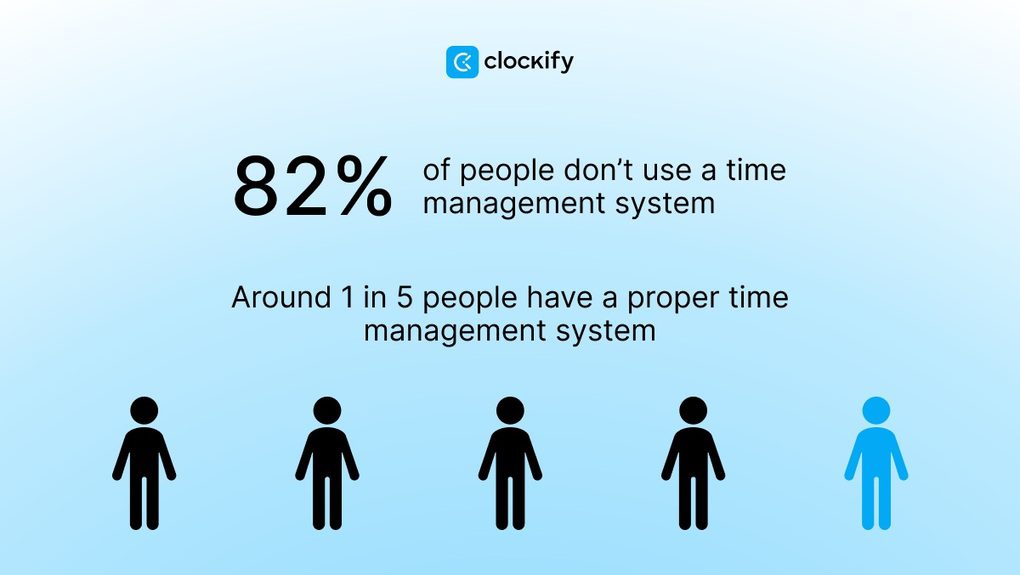
82% of people don’t have a dedicated time management system
According to research from Clockify and Acuity Training, around 82% of people don’t use a dedicated time management system to organize tasks and priorities. Instead, they rely on memory, email inboxes, or loosely kept lists.
This approach quickly breaks down once workloads increase or priorities shift, making planning unreliable.
Task management apps, such as Todoist, turn responsibilities into visible, actionable tasks and support clearer prioritization.
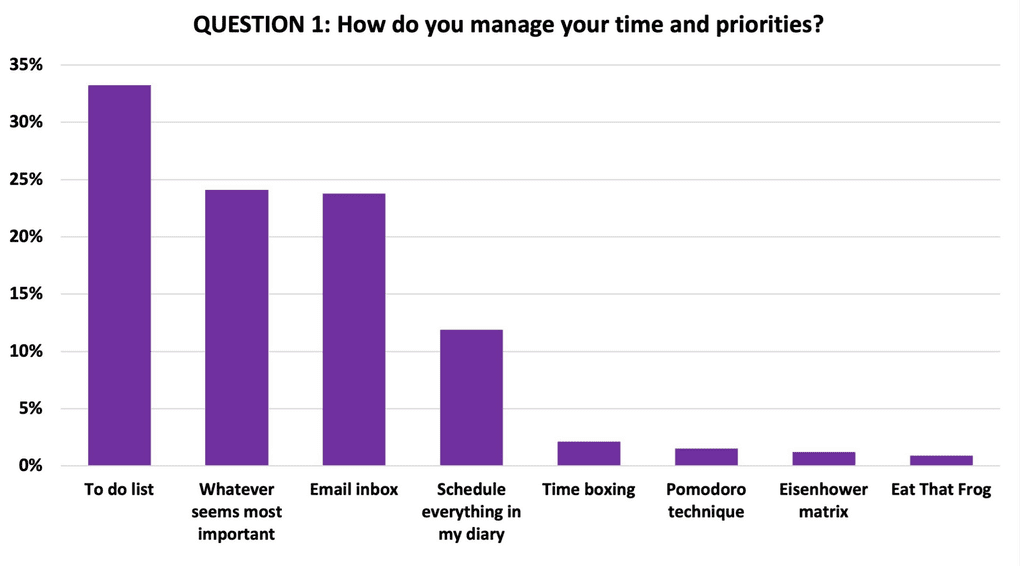
33% of people use a to-do list to manage tasks
Clockify’s data shows that about 33% of people rely on simple to-do lists to organize their work. While lists can be useful, they often lack structure once tasks become more complex or deadlines overlap.
Modern task managers connect tasks to deadlines, priorities, and projects, making planning more realistic.
25% of people use their email inbox as a task manager
Per Clockify’s time management research, around 25% of people use their email inbox to manage tasks. This leads to missed follow-ups, duplicated work, and frequent context switching.
Research also shows that multitasking increases the time needed to complete tasks by about 15%, even when people feel productive in the moment.
Task management tools separate communication from action items and keep work organized.
41% of to-do list items never get completed
Productivity data collected by iDoneThis shows that around 41% of items on to-do lists are never finished.
Lists are great, but without clear priorities or follow-ups, they are not very useful. This is why many people move beyond a basic to-do list and rely on daily planner apps that combine tasks, priorities, and scheduling in one place.
Writing tasks down increases completion rates by about 42%
Research summarized by KaryaKeeper shows that people who write tasks and goals down are around 42% more likely to complete them compared to keeping them in their heads.
Task and project management tools build on this effect by combining written tasks with reminders, deadlines, and progress tracking.
Employees spend an average of 11.3 hours per week in meetings
According to the Fellow’s State of Meetings report, the average employee spends around 11.3 hours per week in meetings, which is close to one-third of a typical workweek.
When calendars fill up this quickly, focused work is often pushed to early mornings, late afternoons, or postponed entirely.
Calendar apps help protect focus through time blocking, meeting limits, and availability rules. Here are our top choices for the best calendar apps for Mac and Windows.
46% of workers attend three or more meetings per day
Data compiled by Flowtrace and Calendly shows that 46% of workers attend three or more meetings per day. Meetings, even short ones, fragment attention and make deep work harder to sustain.
Back-to-back meetings also leave little room to reset between tasks.
Advanced scheduling tools such as Motion, Reclaim AI, and other allow buffer time and focus blocks between meetings.
Over 70% of meetings disrupt planned work
According to meeting productivity data summarized by MyHours, over 70% of meetings interfere with or delay other planned work during the day.
This creates a constant trade-off between attending meetings and completing meaningful tasks. It also helps explain why the average worker spends about 51% of the workday on tasks of little or no value, much of it tied to meetings, coordination, and follow-up work.
Employees are interrupted about every 2 minutes during the workday
Microsoft’s Work Trend Index analysis shows that workers using Microsoft 365 are interrupted roughly every two minutes by meetings, emails, or notifications, adding up to hundreds of interruptions per day.
Calendar apps and scheduling assistants help reduce this by consolidating meetings and protecting uninterrupted focus time.
Only 17–18% of people actively track their time
According to MyHours and Acuity Training data, only around 17–18% of people actively track how they spend their time during the workday. Most people plan without clear data on how long tasks actually take.
Over time, this leads to unrealistic schedules and work spilling into evenings or weekends. Without doing some form of time audit, it’s hard to use time effectively or spot where wasted time comes from. That’s why employees lose an average of 4 hours and 32 minutes each week just reprioritizing unfinished work.
Time tracking apps provide a reality check by showing where time really goes.
Related articles:
- 8 Best Time Tracking Apps In 2026| 20+ Personally Tested Tools
- 5 Best Clockify Alternatives: My Personal Picks (2025)
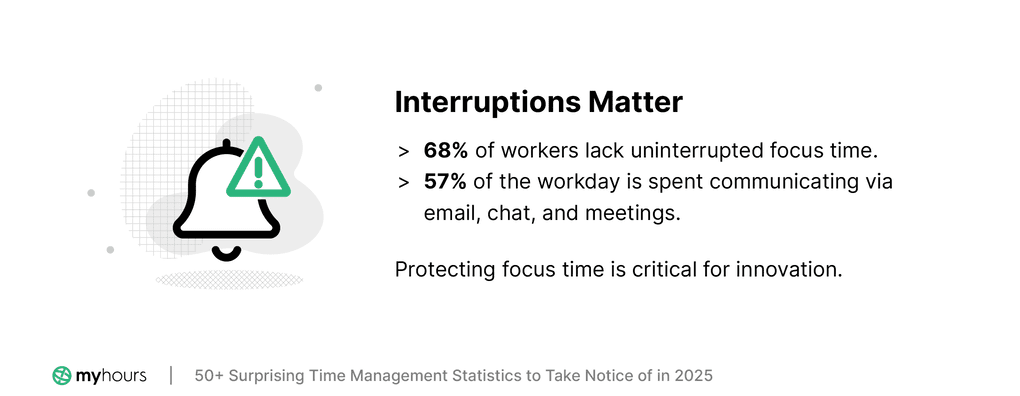
68% of people say they don’t have enough uninterrupted focus time
Based on Microsoft 365 usage analysis referenced by MyHours, 68% of people report not having enough uninterrupted focus time during the workday.
Clockify and other time tracking apps can identify these interruptions and protect focus time.
Up to 88% of the workweek is spent on communication and coordination
According to data summarized by The Digital Project Manager, based on Grammarly and workplace communication research, as much as 88% of the workweek can be spent on communication, including email, meetings, and chat, rather than focused task work.
In other words, we lose time digging through emails and chat threads just to figure out what’s going on, not because the work is complex, but because the context is spread out.
Explore our Apps directory
A curated directory of software tools we’ve independently reviewed, with links to full reviews, comparisons, and category guides.
The average office worker receives around 121 emails per day
According to workplace email statistics summarized by CloudHQ, the average office worker receives around 121 emails per day. Even when messages are short, the constant need to check, read, and respond breaks focus time into small fragments.
Over the course of a full workday, email alone becomes a major source of interruptions and app switching. Email productivity apps can help you spend less time in your inbox and more on the actual work.
Employees spend between 5 and 15.5 hours a week on email
CloudHQ’s analysis shows that employees spend anywhere between 5 and 15.5 hours a week reading and responding to email, depending on role and industry. For many knowledge workers, that’s a significant share of total work hours spent on communication rather than execution.
This helps explain why workdays feel busy even when progress feels slow. There are numerous email apps that can help you get to inbox zero, such as Sanebox.
Email can take up to 28% of the workweek for knowledge workers
Similarly, for some knowledge workers, email accounts for up to 28% of the entire workweek, according to CloudHQ. That’s more than a full workday spent managing inboxes, threads, and follow-ups.
The average employee is productive for just 2 hours and 53 minutes per day
Several workplace studies summarized by Acuity Training suggest that the average employee is productive for only 2 hours and 53 minutes per day. The remaining time is largely spent on meetings, communication, and administrative tasks rather than focused execution.
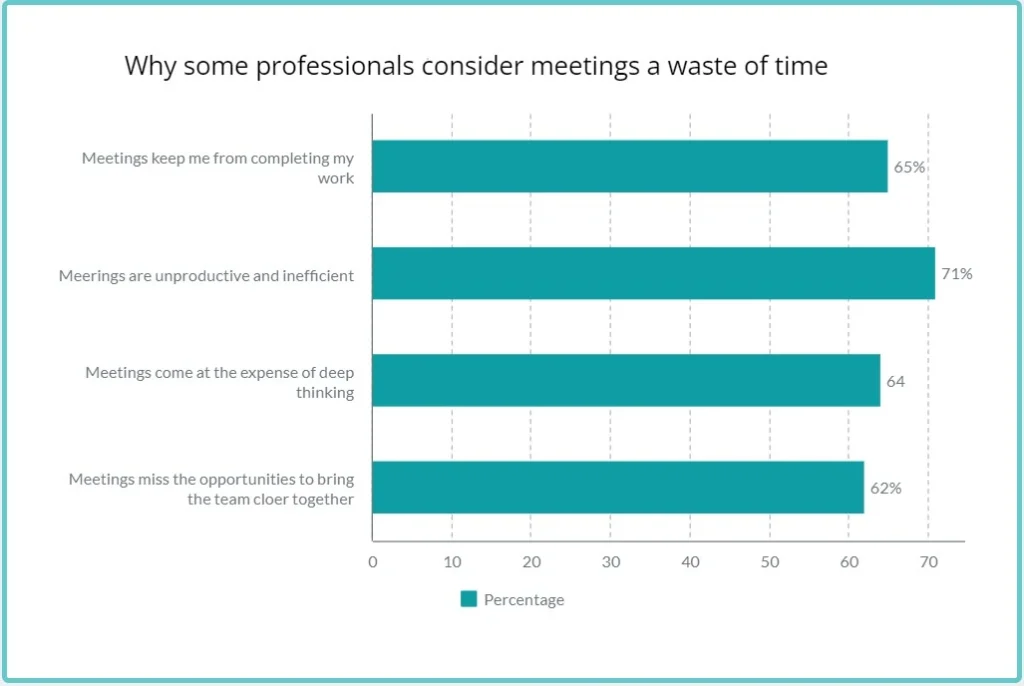
72% of meetings are considered unproductive
According to research compiled by Atlassian and other workplace productivity studies, 72% of meetings are perceived as unproductive. Much of this time goes into status updates, unclear discussions, or follow-up work that could be handled asynchronously.
The average employee spends 57% of their time on communication
Workplace communication data referenced by McKinsey and RescueTime shows that the average employee spends around 57% of their work time on communication, including meetings, email, and chat. This leaves less than half of the workday for focused, independent work.
Employees check their email every 1 hour and 40 minutes on average
According to workplace email statistics aggregated by CloudHQ, employees check their email roughly every 1 hour and 40 minutes. Even brief inbox checks add up and contribute to frequent interruptions throughout the day.
39% of employees multitask during virtual meetings
Survey data summarized by Harvard Business Review indicates that 39% of employees multitask during virtual meetings, often working on other tasks at the same time. This behavior increases context switching and reduces overall attention.
Related articles:
- Best 9 AI Note-Takers | My Top Picks After +2 Years Testing (2026)
- 7 Best Zoom Note-Taker Apps: My Findings After 2 Years (2026)
- 5 Best Google Meet AI Note-Takers | +20 Apps Tested (2025)
- Best 5 Otter AI Alternatives | 20+ Personally Tested Apps (2026)
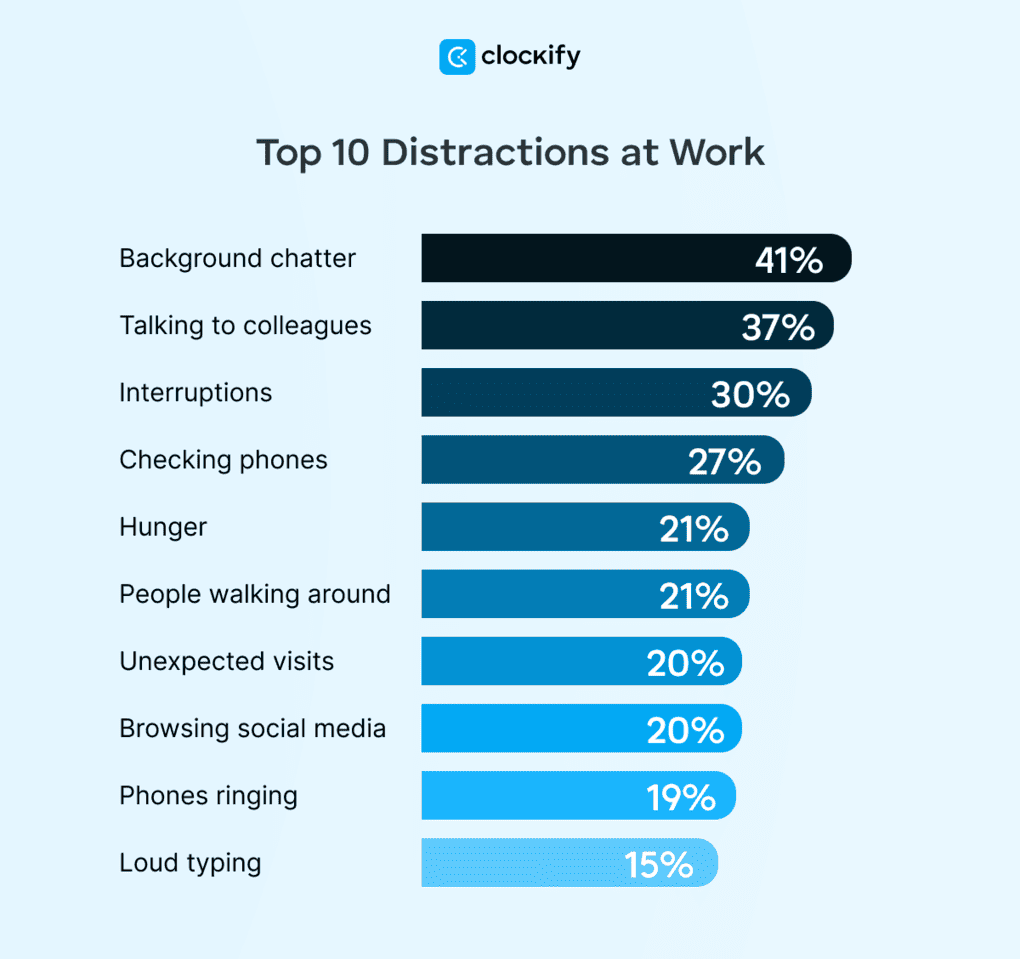
41% of employees say coworkers talking nearby disrupts their focus
According to survey results cited by Udemy Business and workplace distraction studies, 41% of employees identify nearby conversations as a major distraction at work. Background noise and informal discussions often interrupt concentration during the workday.
80% of workers struggle to focus for more than one hour
Research referenced by Atlassian and productivity studies shows that 80% of workers have difficulty maintaining focus for more than one hour without interruption. Notifications, conversations, and task switching are common causes.
73% of people say better time management improves work-life balance
Survey data from Acuity Training shows that 73% of people believe better time management leads to improved work-life balance. Clearer planning helps reduce overtime and makes it easier to disconnect after work.
91% of employees believe better time management would reduce work stress
According to Acuity Training research, 91% of employees say improved time management would lower stress at work. Feeling more in control of time is closely tied to overall well-being.
Time management is positively linked to job performance
A meta-analysis of time management research published in peer-reviewed journals found a moderate positive relationship between time management and job performance. Employees with stronger time management habits tend to perform better and feel more in control of their workload.
Summary: Time management statistics for 2026
General time management research shows that many people don’t lack time management skills, but a clear time management system. The average office worker and the average employee spend a large part of their work hours on meetings, administrative tasks, app switching, and other busy work instead of important tasks.
Key time management statistics suggest that over half of the workday is lost to poor time management and productivity leaks. Without a dedicated time management system and basic time management methods to manage time effectively, even a simple to-do list falls apart, making it harder to protect focus time and maintain work-life balance across personal and professional lives.
As someone who spends a lot of time testing and writing about productivity tools, I find these time management statistics hard to ignore.
Looking at these numbers, it’s clear that better time management isn’t about working more hours. It’s about having simple, reliable ways to organize tasks, plan time, and keep information in one place so work can actually move forward.
From personal experience, using the right productivity and time management apps makes a real difference. They help bring structure to the day, reduce unnecessary friction, and make it easier to finish work on time, leaving more space for life outside of work.
Frequently Asked Questions
What do time management statistics reveal about modern work?
Most key time management statistics show that the average worker spends a large part of their work hours on meetings, administrative tasks, and app switching. Research shows that employees spend more time coordinating work than doing important tasks, which leads to wasted time and productivity leaks.
How does poor time management affect work-life balance?
Poor time management often pushes work into evenings and weekends, affecting work-life balance and overall well-being. When people struggle to manage time during work hours, their personal and professional lives start to overlap, leaving less valuable time for rest and recovery.
Why do to-do lists often fail as a time management system?
General time management statistics show that over half of to-do list items are never completed. Without a dedicated time management system, to-do lists quickly turn into long, unmanaged collections of daily tasks instead of a clear time management strategy.
Do time management apps actually improve job performance?
From both time management research and personal experience, productivity and time management apps help people schedule tasks more realistically and track time spent on work. This often leads to better job performance, higher job satisfaction, and fewer long hours caused by poor planning.
What do time management stats say about focus time and social media?
Time management stats show that focus time is heavily fragmented by notifications, mobile phones, and social media apps. The average employee switches between tasks and apps frequently, which makes it harder to use time wisely and maintain focus throughout the workday.

Hey! I’m Jovana, a content writer who loves writing, researching, and testing new productivity apps. With a background in philosophy, I bring a thoughtful but no-bullshit approach to everything I do. Let’s connect on Linkedin!