


7 Best OCR Software For 2026 | 30+ Personally Tested Tools
TL;DR: I tested 30+ OCR solutions across different documents to find the best OCR software. PDNob is my best OCR tool for PDFs, delivering the highest accuracy I tested (95%+), while Nanonets is my top choice for businesses processing invoices, receipts, and other structured documents.
If you want a budget-friendly OCR tool, EaseUS PDF is a strong option with around 90% accuracy in my testing. If you don’t want to spend anything, PDFgear is my pick for the best free OCR software.
Below, you’ll find more OCR tools tailored to specific needs, including dedicated OCR software, easy-to-use options, and document automation tools.
Short on Time? Here’s the Quick Take
Tool | 🎯Look for | 🔍My OCR accuracy | ⚠️Biggest issue in my test | 🌐Language support | 💰Pricing starts |
|---|---|---|---|---|---|
The best OCR software for PDFs | ~95% | Didn’t handle tables well | 16 | Free plan + paid from $49.99/year | |
Best budget-friendly OCR + PDF editor | ~90% | Sometimes failed to preserve the original formatting | 29 | Free plan + paid from $49.95/year | |
Best free OCR tool | ~80% | Accuracy wasn’t as good as the paid alternatives | 30 | Free | |
OCR for invoices & business documents | Nearly 100% | Works only with specific document types | +200 | $50 free credits, then $100/month | |
Dedicated OCR workflows | ~80% | Accuracy and formatting were worse than I expected | +190 | Paid from $69.99/year | |
Best open-source OCR solution | ~80% on regular text | Struggled with tables & handwriting | +100 | Free | |
Easy-to-use OCR | ~85% | Less accurate than PDNob and EaseUS while costing more | +25 | Paid from $89.99/year |
How Each OCR Tool Performed in My Testing
Tenorshare PDNob
PDNob delivered the highest accuracy among the general-purpose OCR tools I tested at 95%+. It was fast, preserved formatting well, and combined OCR with PDF editing and AI tools. Tables required more cleanup, and there’s currently no Android version.
MY TAKE AFTER TESTING
Accurate OCR + PDF editing
Android users or complex tables
95%+ OCR accuracy in my test
Table recognition was only okay
How PDNob performed in my OCR test
OCR test | Result |
|---|---|
Accuracy in my test | 🟢 95%+ |
Formatting retention | 🟢 Very good |
OCR speed | 🟢 Fast |
Table recognition | 🟠Okay |
PDNob delivered the highest OCR accuracy among the general-purpose tools I tested, correctly recognizing more than 95% of the text.
The whole process was also fast, and I had almost no learning curve when converting scanned documents into editable or searchable PDFs.
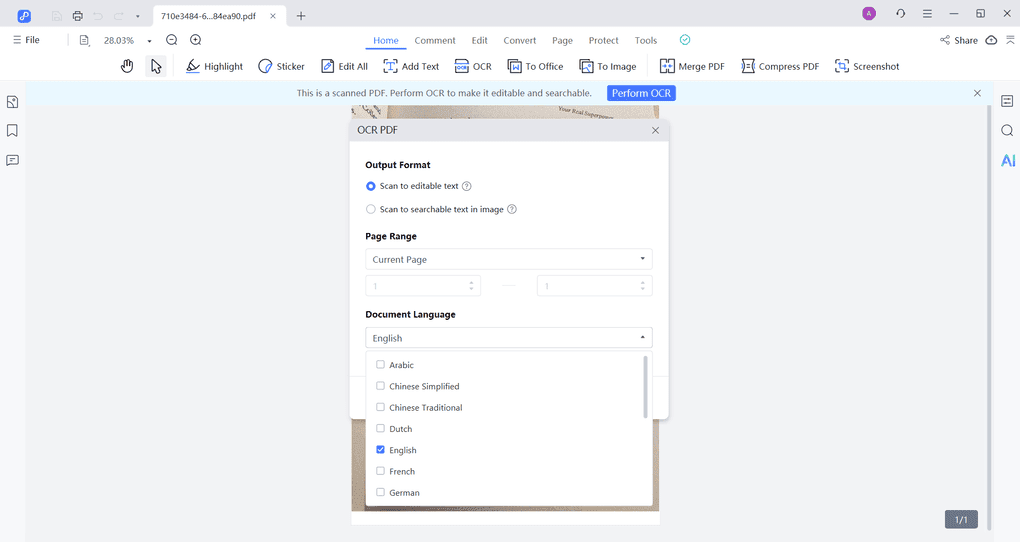
Formatting retention was generally very good. Once PDNob recognized the text, I could edit it directly and change the font, size, and other formatting without rebuilding the document. It struggled more with tables, which required more cleanup than regular text.
Another advantage is that OCR works offline, so you don’t need an internet connection to process documents.
It supports 16 languages, including English, French, German, and Chinese. It’s not as many as other OCR software, but it covers the main languages.
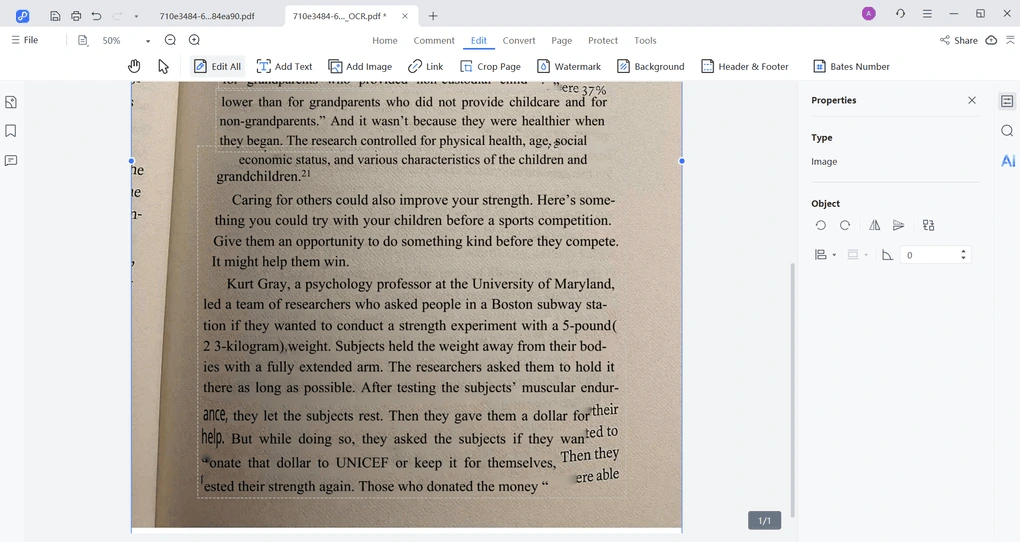
As you can see, once PDNob recognizes the scanned text, you can edit the parts of your documents. You can change the size, fonts, etc., in the recognized text with a few clicks.
While PDNob wasn’t 100% accurate in my test, its 95%+ result was the highest among the general-purpose tools I tested.
PDNob’s best parts and biggest pain points
| What stood out | The trade-offs |
|---|---|
| 🟢 Highest general-purpose accuracy in my test: Recognized 95%+ of the text correctly. | 🔴No Android mobile support: The con for me is that PDNob currently lacks an Android version. |
| 🟢 Good formatting retention: It preserved most of the original document structure. | 🔴Table recognition was only okay: Tables required more cleanup than regular text. |
| 🟢 Fast OCR processing: Converting scanned documents was quick in my testing. | 🔴Limited language support: Compared to other alternatives, PDNob offers the least language support |
| 🟢 Offline OCR: You don’t need an internet connection to recognize documents. |
Which PDNob plan makes sense?
- Free: Best for trying PDNob before upgrading.
- 1-Year License – $49.99/year: Includes OCR and PDNob’s core PDF editing features.
- Lifetime License – $69.99 one-time: Lifetime access to all features and future updates.
If you’re primarily interested in PDNob for OCR, the 1-year License is the one that makes the most sense because it includes PDF editing, conversion, compression, and AI features.
PDNob is also my number one pick if you’re looking for an Adobe Acrobat alternative, thanks not only to its accurate OCR but also to its smooth PDF editing experience and advanced AI features.
Who should use PDNob?
🟢Pick PDNob if: You want highly accurate OCR for PDFs combined with PDF editing tools, particularly on Windows or Mac.
🔴Skip PDNob if: You primarily need OCR on Android or regularly extract complex tables.
🔎Read my full review: Tenorshare PDNob Review 2026 | My Unfiltered Opinion
Use the link above and the discount code TS-TBD-20 to get 20% OFF paid plans.
EaseUS PDF Editor
EaseUS PDF Editor offers one of the best balances of features, usability, and pricing among the PDF editors I tested. It works on Windows, and Mac and combines solid editing with accurate OCR. While I missed the built-in AI features, it is an excellent alternative to Adobe Acrobat for everyday use.
MY TAKE AFTER TESTING
Accurate OCR on a budget
You need OCR on mobile
~90% OCR accuracy in my test
Formatting wasn’t always preserved
How EaseUS PDF performed in my OCR test
OCR test | Result |
|---|---|
Accuracy in my test | 🟢 ~90% |
Formatting retention | 🟠 Good, but inconsistent |
OCR speed | 🟢 Fast |
Output options | 🟢 Editable PDF + Word |
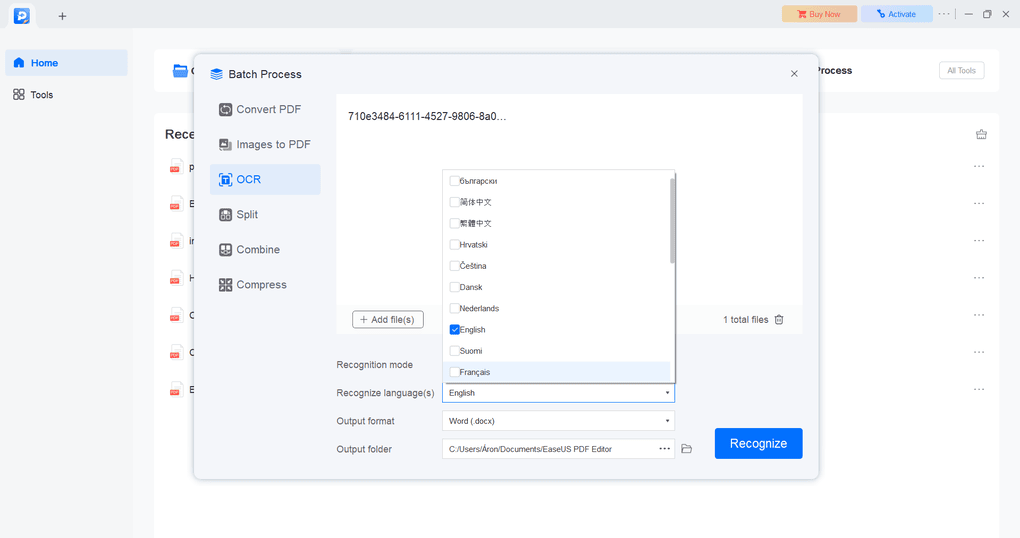
EaseUS PDF achieved around 90% accuracy in my OCR test, which was slightly behind PDNob but better than ABBYY FineReader. It successfully turned my scanned documents into editable text, and the whole process was fast and straightforward.
You can access the OCR feature by opening a PDF document, or you can use it directly from the Tools menu.
Once you open the OCR tool, you need to choose the recognition mode, language, output format, and saving path. I loved that EaseUS PDF took a step ahead and offered the option to convert the PDF into a Word document at the same time.
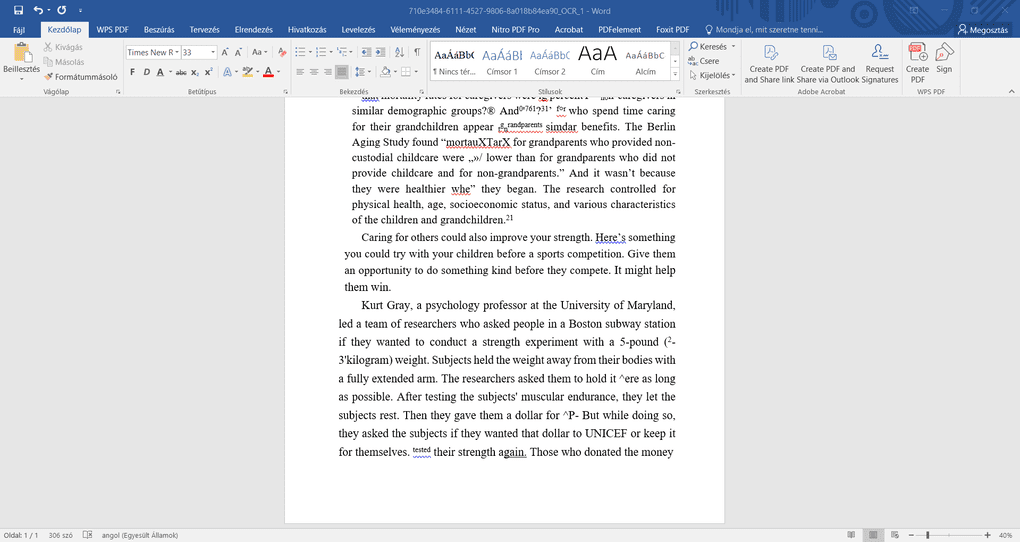
The biggest issue I noticed was formatting retention. While EaseUS recognized most of the text correctly from scanned images, some words didn’t retain the correct formatting.
You can see an example in my test below, where the last sentence contains a word with different formatting. For instance, in the last sentence of the picture, you can see a word with a different text format.
However, EaseUS PDF still has one of the best OCR engines, especially if you’re also looking for an affordable PDF editor.
EaseUS PDF’s best parts and biggest pain points
| What stood out | The trade-offs |
|---|---|
| 🟢 High OCR accuracy: Around 90% of the text was recognized correctly in my testing. | 🔴 Formatting wasn’t always preserved: Some recognized words had incorrect formatting. |
| 🟢 Fast OCR processing: Scanned documents were converted quickly in my testing. | 🔴 No mobile app: You can only use EaseUS PDF on desktop. |
| 🟢 Direct Word conversion: You can turn scanned PDFs into editable Word documents during OCR. | |
| 🟢 Good performance with large PDFs: I didn’t experience performance issues when working with larger documents. |
Which EaseUS PDF plan makes sense?
- Free: Best for trying EaseUS PDF before upgrading. You can use basic PDF reading, creation, and page arrangement tools, while advanced processing features are limited.
- 1-Year License – $49.95/year: Best for professionals who regularly work with PDFs. Includes the full feature set for one computer and one year of free upgrades.
- Lifetime Upgrades – $79.95 one-time: Best for individuals and small businesses with ongoing PDF needs. Includes the full feature set with lifetime upgrades.
If you plan to use OCR and PDF editing regularly, the 1-Year License offers the best value for most users. The Lifetime Upgrades plan makes more sense if you expect to use EaseUS PDF for more than a couple of years.
Just a heads up: EaseUS PDF also earned the first spot on my list of best PDF editors, so you will get more than just OCR features.
Who should use EaseUS PDF?
🟢Pick EaseUS PDF if: You want accurate OCR combined with PDF editing at a lower price than many premium OCR tools, especially if you regularly convert scanned PDFs into editable documents.
🔴Skip EaseUS PDF if: Preserving the original formatting perfectly is particularly important to you, or you need to scan and process documents on mobile.
🔎Read my full review: EaseUS PDF Editor Review 2026 | My Unfiltered Opinion
If you think you may need the advanced features, use the above link for signup and enter the code THEBUSINESSDIVE20 to receive 20% OFF if you fall in love with EaseUS PDF later.
PDFgear
PDFgear is my top free OCR pick, recognizing around 80% of the text correctly in my testing. It supports 30+ languages and turns scanned documents into editable text without watermarks or an OCR paywall. Accuracy trails the paid alternatives, though, and complex layouts require more cleanup.
MY TAKE AFTER TESTING
Completely free OCR
OCR accuracy is your top priority
No OCR paywall or watermark
~80% accuracy in my test
How PDFgear performed in my OCR test
OCR test | Result |
|---|---|
Accuracy in my test | 🟠 ~80% |
OCR speed | 🟢 Fast |
Editable output | 🟢 Yes |
Watermark | 🟢 None |
PDFGear has an easy-to-use OCR feature to extract text from images and scanned documents. I especially valued its built-in AI feature, which can also help with OCR tasks, so you can simply type what you need instead of searching for the feature.
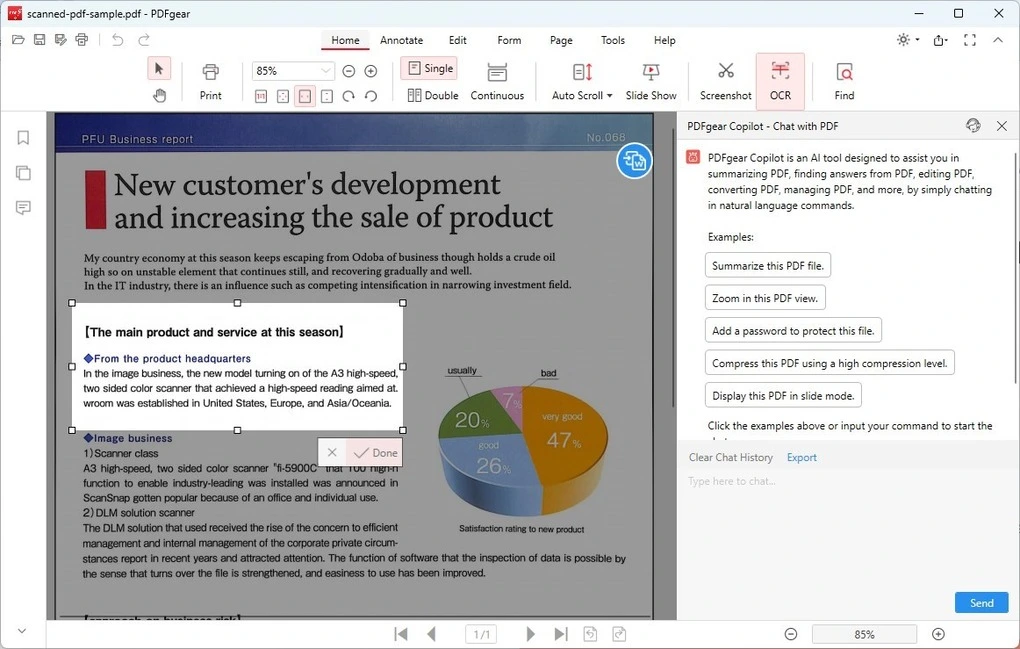
PDFgear recognized around 80% of the text correctly in my testing. That’s noticeably behind PDNob and EaseUS, so you’ll likely need to spend more time checking and correcting the output when accuracy matters.
The OCR itself is straightforward to use. You can extract text from images and scanned documents, then edit the recognized content directly in your PDF. It also supports 30+ languages, giving it broader language support than PDNob.
However, what really impressed me is that you can use the OCR feature without a watermark or a sneaky “upgrade to pro” pop-up.
To be fair, I wouldn’t use PDFgear for business purposes, as there are debates about its privacy (more on that in my PDFgear review); I would use it for personal purposes without hesitation.
PDFgear’s best parts and biggest pain points
| What stood out | The trade-offs |
|---|---|
| 🟢 Completely free OCR: No subscription, watermark, or OCR paywall. | 🔴 Lower OCR accuracy: Around 80% in my testing, behind PDNob and EaseUS. |
| 🟢 30+ supported languages: One of the broader language selections among the tools I tested. | 🔴 More manual corrections: Lower accuracy means you’ll need to check important documents more carefully. |
| 🟢 Editable OCR output: You can edit recognized text directly in your PDFs. | 🔴 Ongoing privacy debate: I found no evidence of malware or spyware and haven’t experienced privacy issues myself, but concerns about PDFgear’s security are still debated online. |
| 🟢 Built-in AI tools: Its AI assistant adds extra functionality beyond basic OCR. |
Is PDFgear really free?
Its OCR is completely free. You don’t need a paid subscription to extract text from scanned documents, and it doesn’t add a watermark to the output.
Who should use PDFgear?
🟢Pick PDFgear if: You only need OCR occasionally and want a completely free OCR and PDF editing tool without watermarks or paid upgrades.
🔴Skip PDFgear if: OCR accuracy is your priority or you regularly process important documents where manual corrections would slow down your workflow.
🔎Read my full review: My Honest PDFgear Review 2026 | What They Don’t Tell You

Nanonets
Nanonets is my top OCR pick for businesses processing invoices, receipts, purchase orders, and other structured documents. It achieved nearly 100% accuracy in my test and was excellent at extracting specific data, although it’s less suitable for everyday PDF OCR and took around 20–30 seconds to process my document.
MY TAKE AFTER TESTING
Invoices & structured business documents
You just need everyday PDF OCR
Nearly 100% accuracy in my test
Limited to specific document workflows
How Nanonets performed in my OCR test
OCR test | Result |
|---|---|
Accuracy in my test | 🟢 Nearly 100% |
Data extraction | 🟢 Excellent |
Processing time | 🟠 ~20–30 seconds |
Editable output | 🟢 Yes |
Document versatility | 🔴 Limited |
In terms of OCR technology, Nanonets specializes in invoices, purchase orders, ID cards, passports, receipts, and similar documents. So, it offers a much narrower circle of use cases than the other OCR software in this list.
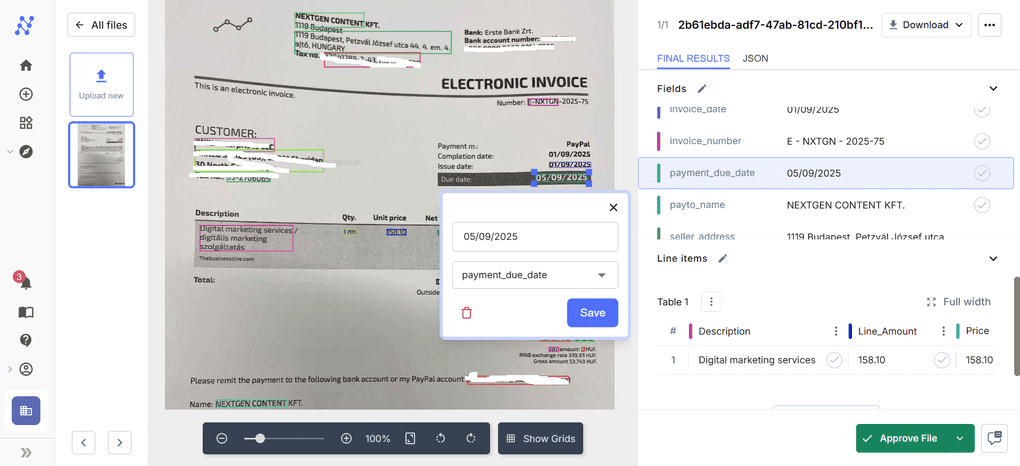
Nanonets delivered nearly 100% accuracy in my testing, correctly extracting the data from the business document I uploaded. I removed some sensitive information from the screenshot above, but the data Nanonets extracted was accurate.
Processing took around 20–30 seconds in my test. Once Nanonets finished, I could extract and modify the recognized data. That’s slower than some of the general-purpose OCR tools I tested, but the accuracy was excellent for this type of document.
Nanonets’ best parts and biggest pain points
| What stood out | The trade-offs |
|---|---|
| 🟢 Nearly 100% accuracy in my test: It correctly extracted almost all the data from my structured business document. | 🔴 Narrower use cases: It’s primarily designed for invoices, receipts, IDs, purchase orders, and similar documents. |
| 🟢 Excellent structured data extraction: Particularly useful when you need specific information rather than simply converting a scan into editable text. | 🔴 Slower processing: My document took around 20–30 seconds to process. |
| 🟢 Built for business workflows: OCR is combined with document processing and workflow automation. | 🔴 Overkill for casual OCR: Individuals who occasionally need to OCR a PDF should check out alternatives like PDNob, EaseUs PDF, or PDFgear |
How does Nanonets’ pricing work?
Nanonets uses a usage-based pricing model rather than the traditional license structure you’ll find with most OCR software.
- Starter – $50 in free credits, then $100/month for 100 credits: Best for smaller businesses and teams getting started with automated document processing.
- Growth – Custom volume pricing: Best for businesses processing larger document volumes. It adds more advanced automation, integrations, analytics, and volume discounts of up to 40%.
- Enterprise – Custom pricing: Best for larger organizations requiring features such as SSO, role-based access, advanced compliance options, data residency, and dedicated support.
Usage also depends on the processing blocks your workflow runs, ranging from $0.02 for simple operations to $0.30 for complex AI operations. A typical invoice workflow uses multiple blocks, so the final cost depends heavily on the complexity and volume of your document processing.
Who should use Nanonets?
🟢 Pick Nanonets if: You want to automate data extraction from invoices, receipts, and other business documents.
🔴 Skip Nanonets if: You need general-purpose OCR for PDFs and images.

ABBYY FineReader
ABBYY FineReader is a dedicated OCR tool with support for 190+ languages and strong document-processing features. However, it achieved only around 80% accuracy in my test, with more formatting issues than I experienced with PDNob and EaseUS.
MY TAKE AFTER TESTING
Dedicated OCR workflows
Accuracy is your top priority
190+ supported languages
Formatting issues
How ABBYY FineReader performed in my OCR test
OCR test | Result |
|---|---|
Accuracy in my test | 🟠 ~80% |
Formatting retention | 🟠 Okay |
OCR speed | 🟢 Fast |
Handling multiple OCR tasks | 🟢 Very good |
ABBYY FineReader recognized around 80% of the text correctly in my testing. That’s a decent result, but I expected more from software that specializes so heavily in OCR. Both PDNob and EaseUS produced more accurate results in my tests.
Accuracy wasn’t my only issue. I also encountered some formatting errors, including incorrect text highlighting, as you can see in my test above.
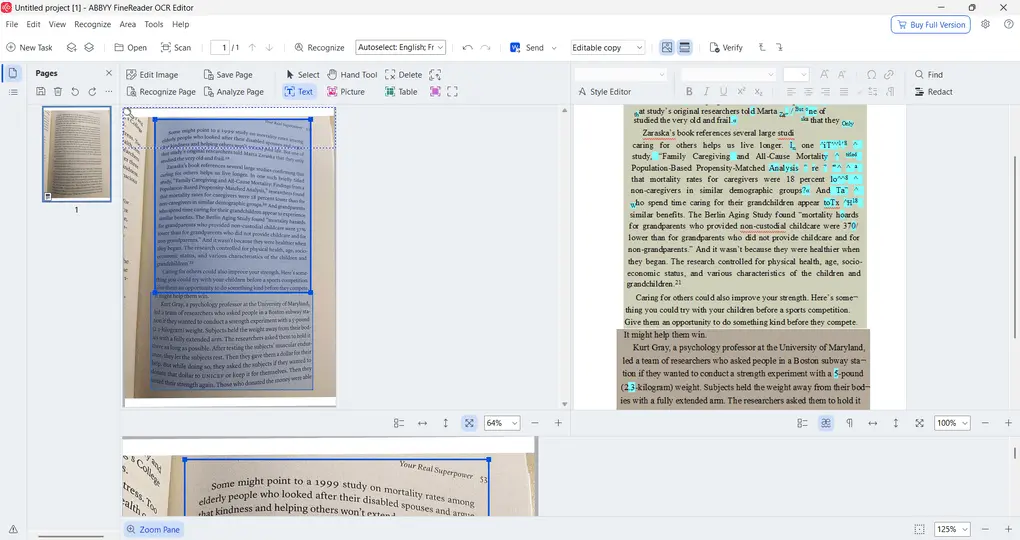
Where ABBYY performed better was the overall OCR workflow. Processing documents was fast and straightforward, and I particularly liked how easily I could manage a larger number of OCR tasks.
It also supports 190 languages, which gives it significantly broader language support than other OCR solutions for PDFs on this list.
The learning curve was minimal as well. But, to be honest, considering ABBYY’s strong focus on OCR, I wasn’t as impressed as I expected and saw better results from PDNob and EaseUS PDF.
ABBYY FineReader’s best parts and biggest pain points
| What stood out | The trade-offs |
|---|---|
| 🟢 Built specifically for OCR: ABBYY offers a more dedicated OCR experience than most PDF editors on this list. | 🔴 Only ~80% accuracy in my test: PDNob and EaseUS produced more accurate results. |
| 🟢 190+supported languages: One of the broader language selections among the OCR tools I tested. | 🔴 Formatting issues: I encountered misformatting and incorrect text highlighting. |
| 🟢 Good for larger OCR workloads: It was easy to manage multiple OCR tasks. | |
| 🟢 Fast and easy to use: Processing documents was quick with a minimal learning curve. |
Which ABBYY FineReader plan makes sense?
- FineReader PDF Standard – $99/year: Best for individuals and professionals who need OCR alongside everyday PDF editing. This is the plan I’d recommend for most users.
- FineReader PDF Corporate – $165/year: Best for larger businesses processing many documents daily.
- FineReader PDF for Mac – $69/year: Best for Mac users primarily interested in OCR and document conversion. It’s more limited than the Windows versions and doesn’t provide the same full PDF workflow.
Who should use ABBYY FineReader?
🟢 Pick ABBYY FineReader if: You want a dedicated OCR tool, need support for many languages, or regularly process a larger number of documents.
🔴 Skip ABBYY FineReader if: Your number-one priority is getting the highest possible OCR accuracy, and don’t require a solution for large volume of data entry.
🔎Read my full review: My Honest ABBYY FineReader PDF Review 2026

Tessaract OCR
Tesseract is a free, open-source OCR engine that achieved around 80% accuracy with regular text in my testing. It was fast and worked well with clean documents, but accuracy dropped significantly with tables, handwriting, and distorted pages.
MY TAKE AFTER TESTING
Free, open-source OCR
You scan complex documents
Fast OCR with simple text
Tables & handwriting performed poorly
How Tesseract OCR performed in my OCR test
OCR test | Result |
|---|---|
Accuracy in my test | 🟠 ~80% |
Processing time | 🟢 ~3–4 seconds |
Simple text recognition | 🟢 Good |
Distorted/angled text | 🔴 Poor |
Formatting retention | 🔴 Poor |
Main issue | Struggled with curved pages, tables, invoices, and handwritten text |
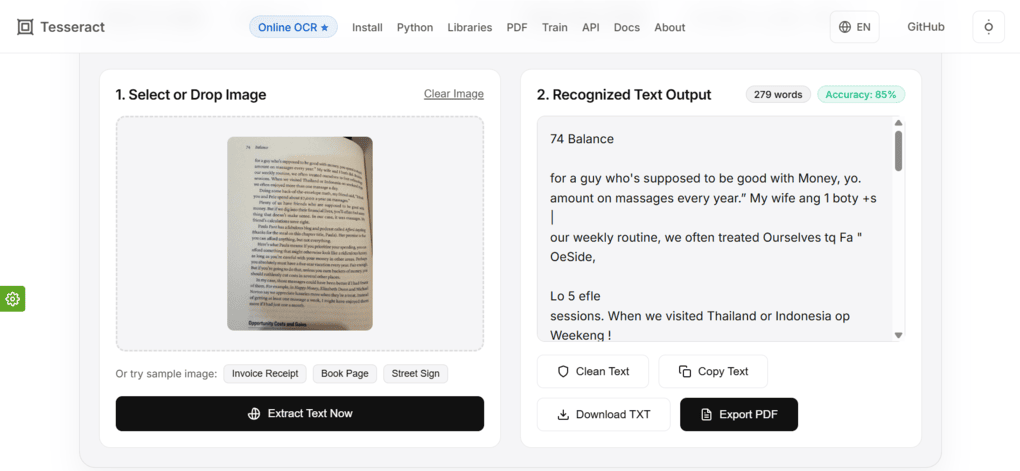
You can use Tesseract OCR’s desktop and web version for optical character recognition. For me the processing normally took 3-4 seconds, and I could download the result in TXT or PDF format when using the web version.
On average, Tesseract provided approx. 80% accuracy in my tests. While most of the simpler paragraphs were accurate, it struggled significantly with parts of the page where the scan was slightly distorted, producing several incorrect or missing words.
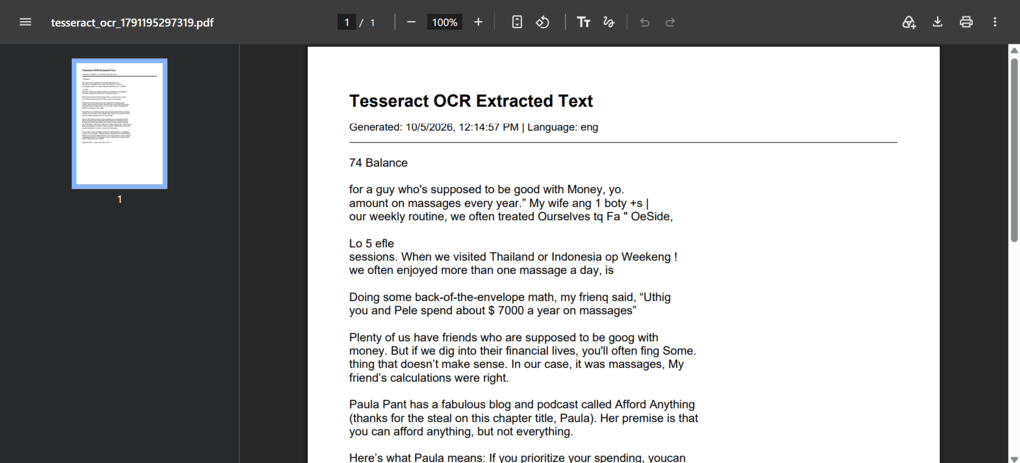
The results got much worse when I tested tables, invoices, and handwritten text, where accuracy dropped below 50% in some of my tests. Tables were particularly frustrating because Tesseract sometimes missed text entirely, while the recognized content required significant manual cleanup.
Still, Tesseract made my list because it’s free and open-source. It’s also popular with developers because it integrates into applications and OCR workflows rather than being limited to a traditional PDF editor.
Explore our Apps directory
A curated directory of software tools we’ve independently reviewed, with links to full reviews, comparisons, and category guides.
Tesseract’s best parts and biggest pain points
| What stood out | The trade-offs |
|---|---|
| 🟢 Completely free and open-source: There’s no subscription or OCR paywall. | 🔴 Poor formatting retention: The extracted text often required significant cleanup. |
| 🟢 Good with simple text: Clean paragraphs produced reasonably accurate results in my testing. | 🔴 Struggled with complex documents: Tables, invoices, and handwriting sometimes dropped below 50% accuracy in my tests. |
| 🟢 Fast processing: My OCR tests normally took around 3–4 seconds. | 🔴 Sensitive to image quality: Curved or distorted pages resulted in significantly more recognition errors. |
| 🟢 Developer-friendly: It can be integrated into custom OCR workflows and applications. | 🔴 No PDF support: It doesn’t support PDFs for scanning |
| 🟢 Supports common image formats: Including PNG, JPG, WEBP, and BMP. |
Is Tesseract really free?
Yes. Tesseract is completely free and open-source, which is arguably its biggest advantage. There are no subscription fees or page limits for the OCR engine itself.
Who should use Tesseract?
🟢 Pick Tesseract OCR if: You want a free, open-source OCR engine, particularly for extracting simple text or integrating OCR into your own application or workflow.
🔴Skip Tesseract OCR if: You regularly scan tables, invoices, handwritten notes, or poorly photographed documents. Based on my testing, these required far more manual cleanup than with the better-performing OCR tools on this list.

PDFelement
PDFelement delivered around 85% OCR accuracy in my testing and was one of the easiest tools to use. Processing was fast, it handled longer PDFs without performance issues, and it works across desktop and mobile, although PDNob and EaseUS were more accurate.
MY TAKE AFTER TESTING
Easy OCR + PDF editing
You’re looking for a budget-friendly OCR tool
Simple and fast OCR workflow
~85% accuracy in my test
How PDFelement performed in my OCR test
OCR test | Result |
|---|---|
Accuracy in my test | 🟢 ~85% |
OCR speed | 🟢 Fast |
Searchable & editable output | 🟢 Yes |
Performance with large PDFs | 🟢 No issues in my testing |
If you click on the “Tool>OCR” button in the top toolbar, you can easily access the OCR feature of PDFelement. This OCR software supports over 25 languages, and you can select the page range for the OCR.
PDFelement recognized around 85% of the text correctly in my testing. That’s below the results I got with PDNob and EaseUS, but still solid enough to eliminate most of the manual work involved in extracting text from scanned documents.
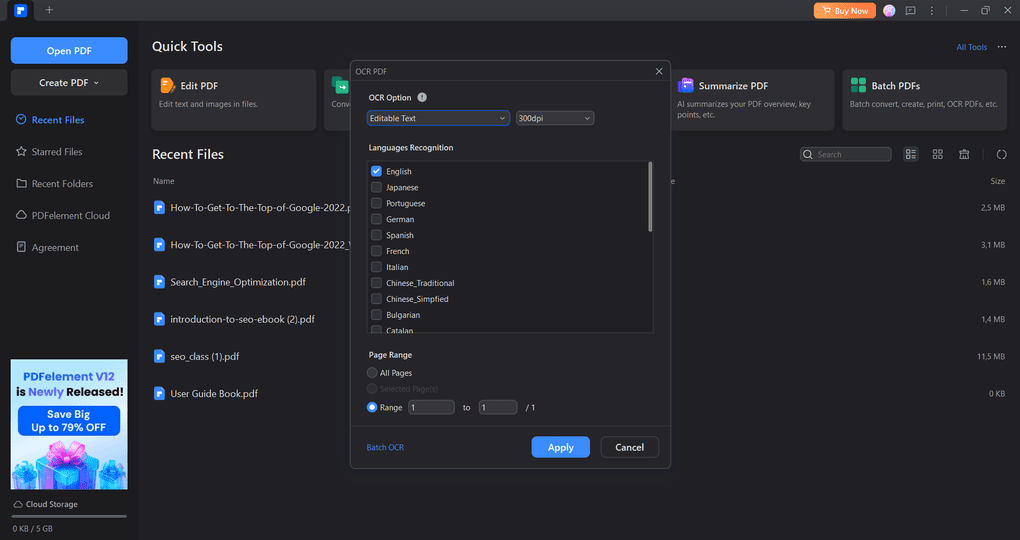
What stood out more was how straightforward the whole process was. You can select the pages you want to process and convert scanned documents into either searchable or editable files. It supports more than 25 languages, and converting my scanned documents only took a few clicks.
I also had a good experience with its overall performance. I worked with multiple longer PDF files without noticing the performance issues I’ve experienced with some other PDF editors.
PDFelement’s best parts and biggest pain points
| What stood out | The trade-offs |
|---|---|
| 🟢 Easy OCR workflow: Turning scanned documents into editable or searchable PDFs only took a few clicks. | 🔴 Not the highest accuracy: ~85% in my test, compared with ~90% for EaseUS and 95%+ for PDNob. |
| 🟢 Fast processing: OCR was quick in my testing. | 🔴 Some manual checking is still needed: With ~85% accuracy, I wouldn’t rely on the output without reviewing important documents. |
| 🟢 25+ supported languages: Solid language coverage for everyday OCR. | 🔴 High price: It significantly more expensive than PDNob or EaseUS PDF and I don’t see that the price is justified. |
| 🟢 Good performance with larger PDFs: I didn’t experience performance issues even when working with longer documents. | |
| 🟢 Cross-platform: Available on Windows, Mac, Android, and iOS. |
Which PDFelement plan makes sense?
- Yearly – $89.99/year: Best for regular PDF and OCR work. It provides one year of access to all features across desktop, mobile, and web, plus 100 GB of cloud storage.
- Free: Best for occasional OCR. You can use OCR once per day, but PDF features and batch processing are limited.
- Monthly – $9.99/month: Best if you only need PDFelement temporarily. It unlocks full OCR and PDF tools across desktop, mobile, and web.
Who should use PDFelement?
🟢 Pick PDFelement if: You want an easy-to-use PDF editor with solid OCR that works across desktop and mobile, especially if you regularly work with larger PDF files.
🔴Skip PDFelement if: OCR accuracy is your number-one priority. In my testing, PDNob and EaseUS both produced more accurate results, so I’d choose one of those instead for accuracy-sensitive workflows.
Final Thoughts: The best OCR software in 2026
After testing 30+ OCR tools, I found that there isn’t one option that’s best for every type of document. Some delivered excellent accuracy with regular text but struggled with tables, formatting, or more complex scans.
That’s why I picked the tools in this list based on how they actually performed in my tests and the workflows they’re best suited for, rather than simply comparing their feature lists.
Related articles:
- The 6 Best PDF Readers For 2026 (Only FREE Options)
- 6 Best PDF Converter For 2026 | 30+ Personally Tested Tools
Looking for similar tools?
Visit our library of PDF editors to explore other apps we’ve reviewed in this space and how they compare.
Why you can trust our reviews
At thebusinessdive.com, our team tests, reviews, and compares hundreds of productivity apps every year — from project management tools to note-taking apps. We dive deep into real-world use cases to help you find the right tools that actually improve your workflow, not just add noise.
Our mission? No fluff, no shortcuts—just honest, hands-on insights from productivity pros.
Discover how we stay transparent, read our review methodology, and let us know about any tools we missed.
Frequently asked questions
What is the best OCR software right now?
Based on my testing of 30+ OCR tools, PDNob is the best OCR software for PDFs. It achieved 95%+ accuracy in my test, the highest among the OCR tools for PDFs, while also offering PDF editing and conversion features.
However, the best option depends on what you’re scanning. EaseUS PDF offers a solid combination of OCR and PDF editing features, PDFgear is the best free option, and Nanonets performed particularly well with structured business documents such as invoices and receipts.
What is better than Tesseract?
If OCR accuracy and ease of use matter more than having a free, open-source solution, several tools performed better than Tesseract in my testing.
Tesseract achieved around 80% accuracy with regular text, but struggled with curved pages, tables, invoices, and handwritten text. PDNob and EaseUS PDF produced more accurate results in my tests, while Nanonets is a better fit for extracting structured data from business documents.
What is OCR most commonly used for?
OCR is commonly used to turn scanned documents, images, and photographed text into searchable or editable digital text. Typical use cases include digitizing paper documents, making scanned PDFs searchable, extracting text from images, and processing invoices and receipts.
What is the best free OCR software?
PDFgear is my pick for the best free OCR software. It achieved around 80% accuracy in my testing, supports 30+ languages, and lets you turn scanned documents into searchable, editable text without a subscription.
Tesseract is another strong free option if you specifically want an open-source OCR engine or plan to integrate OCR into your own application.
Disclosure: I only recommend products I would use myself, and all opinions expressed here are my own. This post may contain affiliate links through which, at no additional cost to you, I may earn a small commission. Read the full privacy policy here.

Hey there! I am Aron, the founder of Thebusinessdive. I have been testing productivity apps for almost three years now. I reach 25.000 -50.000 people monthly with the mission to help you find the perfect productivity apps. Subscribe to my YouTube channel, newsletter, and social media to hear more about the best productivity tools. Let’s dive in!