


Akiflow vs Motion (2026): My Honest Opinion
Choosing between Akiflow and Motion can be tricky, especially since both position themselves as advanced daily planner tools designed to improve time management and day-to-day planning.
While they overlap in some areas, the key differences become obvious once you start using them for real work.
In this Akiflow vs Motion comparison, I tested both productivity tools side by side so you don’t have to.
Below, I break down the key features, integrations with third-party apps, pricing, and project management capabilities, and share my hands-on experience.
Let’s dive in!
Verdict
Here’s the quick verdict if you don’t want to read the full Motion vs Akiflow review:
🎯 Best for:
Motion: Busy professionals and teams who want AI to plan and optimize their day
Akiflow: Professionals who rely on time blocking and want to manage tasks and calendar in one focused daily planner
🚫 Not ideal for:
Motion: Teams needing deep project management and reporting features
Akiflow: Users looking for a free, lightweight to-do list or full project management tool
⭐ Biggest strength:
Motion: Industry-leading AI scheduling and automation
Akiflow: Seamless task capture and calendar-based planning in one unified workflow
⚠️ Biggest weakness:
Motion: High price and limited PM depth
Akiflow: Relatively high price and lacks a free plan
⚖️ Verdict:
Motion is better for AI auto-scheduling, automation, and team workflows, while Akiflow is ideal for manual time blocking, task consolidation, and users who want more control over planning.
🏆 Winner:
Motion for AI-powered productivity and teams, Akiflow for individual planning and flexibility
✅ Tested with our review & scoring methodology ✅ Real-world testing ✅ Unbiased evaluation
My ratings: Akiflow Vs Motion
Akiflow
|
|
Intuitive design and user-friendly interface
|
|
|
Smooth capture and scheduling
|
|
|
Simple, clear task views
|
|
|
Handy integrations
|
|
|
Built-in share availability for quick scheduling
|
|
|
Lightweight AI workflows and statistics
|
|
|
No free plan
|
|
|
Higher price than most to-do apps
|
Motion
|
|
All-in-one tool for calendar, tasks, and projects
|
|
|
Strong AI auto-scheduling
|
|
|
Syncs all calendars in one place
|
|
|
Efficient for small team project management
|
|
|
Easy to add and manage tasks
|
|
|
No free plan
|
|
|
Higher pricing
|
|
|
Some AI features still evolving
|
How We Test Daily Planners
To keep our reviews & final score for each daily planner app fair and consistent, we evaluate every tool using the same testing framework based on real-world usage, feature depth, and overall value.
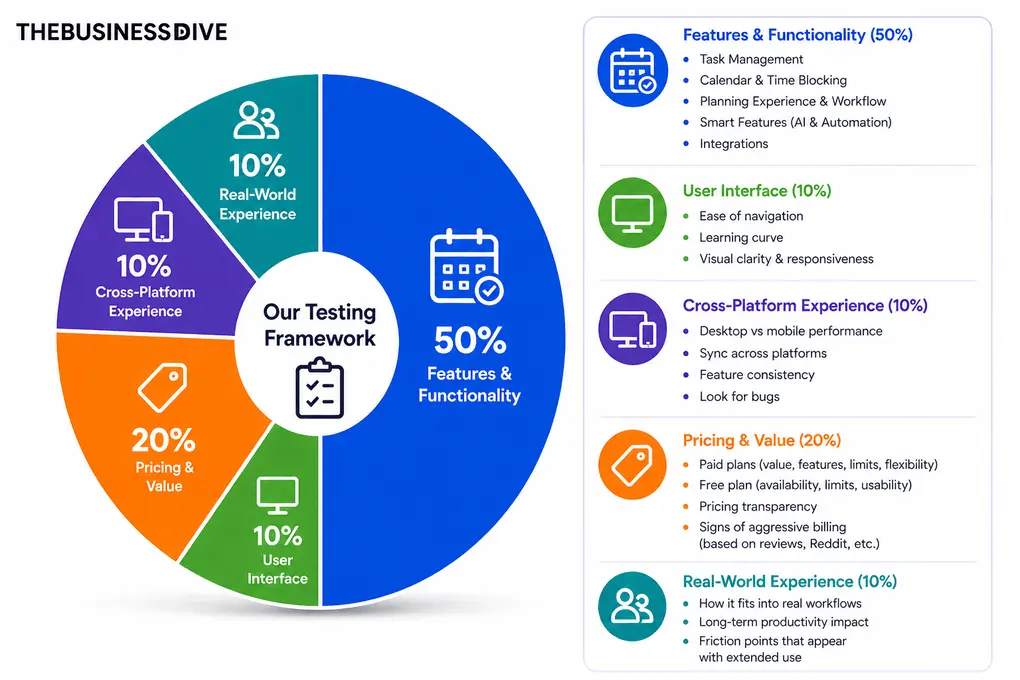
Our scoring breakdown after testing 10+ daily planner apps:
⚙️Features & functionality — 50%
🖥️ User interface — 10%
⚡Cross-platform performance—10%
💰 Pricing — 20%
👥 Real-world experience — 10%
Want a detailed breakdown of how we test each category?
Learn exactly how we test tools → Review methodology
Key differences between Akiflow and Motion
Here’s a quick overview of the main differences that stood out during testing:
|
|
|||
|---|---|---|---|
|
Best for |
Professionals using time blocking and calendar-based planning |
Busy professionals and teams wanting AI-powered scheduling and planning |
|
|
Core focus |
Calendar-centered task and workflow management |
AI productivity app combining scheduling, tasks, projects, and calendar management |
|
|
Key strengths |
|
|
|
|
Main limitations |
No free plan and expensive pricing |
Expensive pricing and limited advanced PM/reporting features |
|
|
Ease of use |
Easy |
Moderate |
|
|
Pricing |
|
|
|
|
Integrations |
Extensive integrations |
Extensive integrations |
|
|
Cross-platform |
Web / Desktop / Mobile |
Web / Desktop / Mobile |
What is Akiflow?
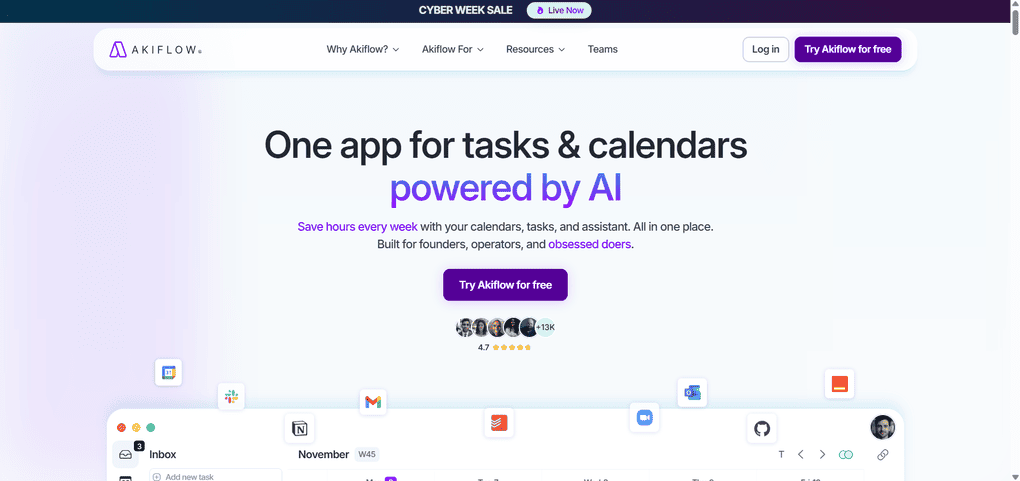
Akiflow is a productivity app built around one idea: keeping all your tasks, events, and plans in a single place. It combines a universal inbox, a fast calendar, natural language task creation, and simple time blocking so you can plan your day without switching between task management apps or calendar tools.
Instead of acting as a traditional to-do list, Akiflow works more like a daily command center. You capture tasks from anywhere, drag them into your schedule, and use lightweight features like AI workflows, statistics, and share availability to keep your day structured.
🔎 Read my full An Honest Akiflow Review 2026: Is It Worth $34 For YOU?
Short on time? Here’s a quick overview of Akiflow
What is Motion?

Motion is an artificial intelligence-based scheduling tool with task and project management features. More than 1 million people use Motion in their day-to-day life for better meeting scheduling and task management.
Besides many other use cases, Motion can auto-schedule meetings, synchronize your work and personal calendar, and block time slots for recurring tasks and certain projects. Motion has a web app, desktop, and mobile app.
Short on time? Here’s a quick overview of Motion
Comparison: Akiflow vs Motion
Below, I’ll walk you through each tool step by step. First, we will break down the features for each tool, then we’ll take a look at the integrations, user interfaces, pricing plans, pros and cons, and finally, I’ll share my personal experience using both Motion and Akiflow.
Features
Let’s start with Akiflow’s key features!
Akiflow’s features
Here, I will share the key features and how they performed during my Akiflow review.
Capture and task creation
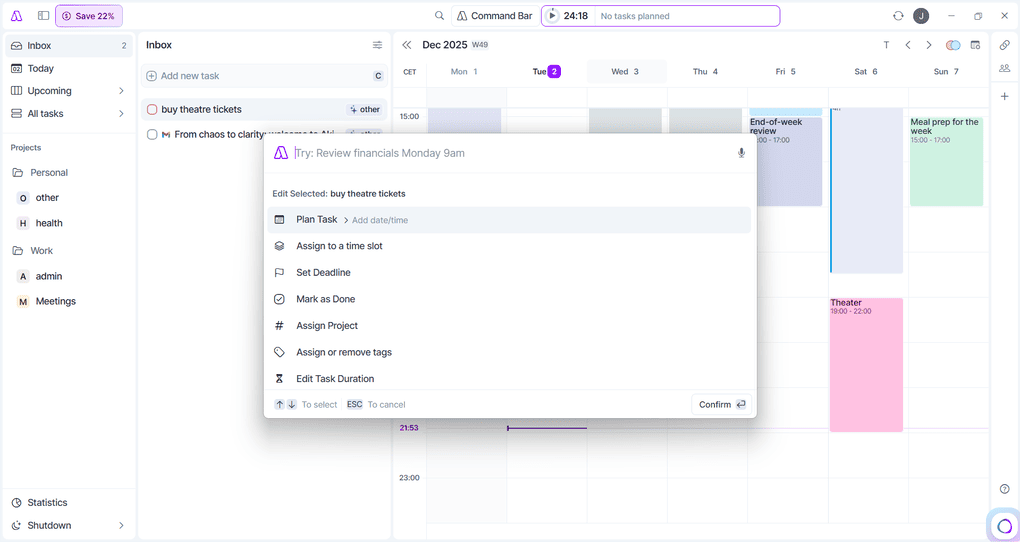
The first thing that I noticed during my Akiflow review was how practical its inbox is. Akiflow’s universal inbox is built to catch everything you need to act on, no matter where it comes from. Emails, calendar invites, saved links, Slack messages, and browser tabs all land in one place.
Every item can be processed in seconds. You can turn it into a task, schedule it, snooze it, or send it to a project. Task creation is quick whether you use the Command Bar at the top, click directly on the calendar, or convert something from the inbox.
It all feels smooth and consistent and works well as a quick capture tool for task consolidation from other tools.
Planning and time blocking
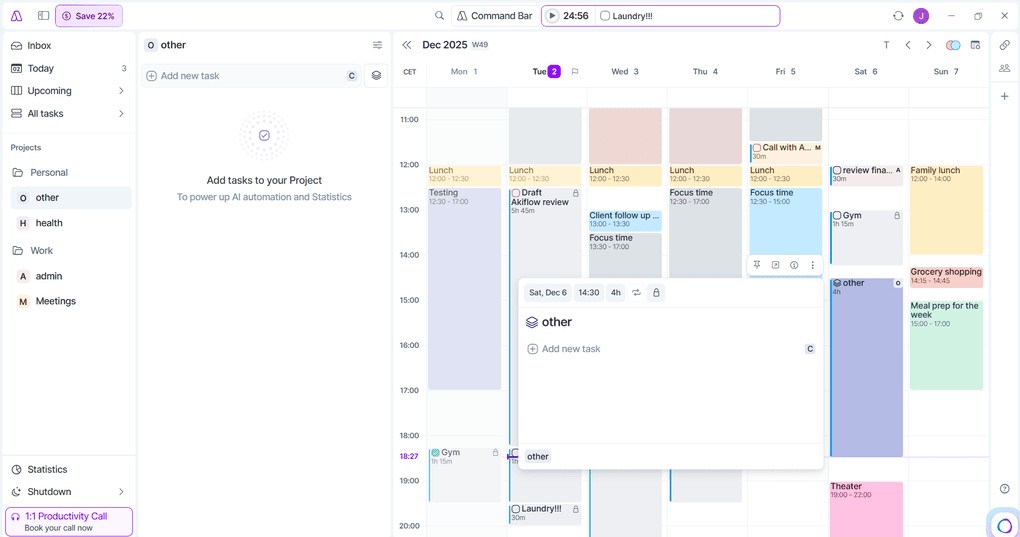
If you prefer visual planning, dragging a task into the calendar instantly turns it into a time block. The block takes your project color, shows the duration, and becomes part of your schedule, which is great if you want more control over how you plan calendar tasks.
You can also plan tasks from list views like Today, Upcoming, or Inbox. Assign a time slot, set a deadline, or leave the task flexible. Tasks behave like events when placed in the calendar, but they stay easy to move and adjust, which keeps the day from feeling rigid.
The Today view brings everything into one screen. It brings tasks, calendar events, and time blocks in a way that makes it easier to see what realistically fits in your day and how your daily tasks line up with your daily routine.
Calendar management
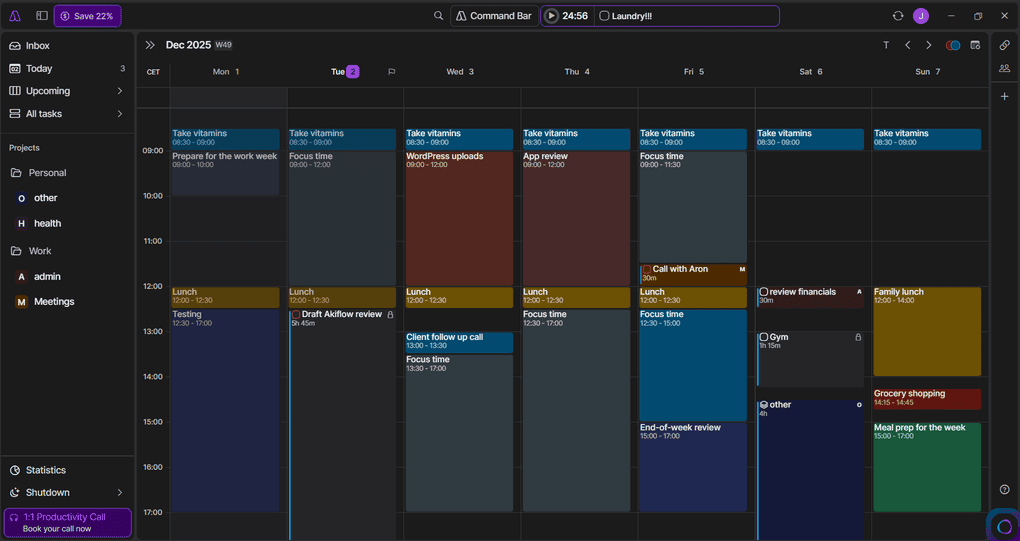
Akiflow’s calendar supports multiple accounts, including Google Calendar & Outlook, and keeps your meetings, personal tasks, and deadlines in one place.
Events and tasks appear side by side, but only tasks stay flexible until you schedule them. Tasks with deadlines show up as small flags at the top of the calendar, which makes due dates visible without filling your day with fake events.
The calendar sits next to every major view rather than living in its own tab, which makes it feel more integrated into the workflow.
It is also customizable. You can show the whole month, a few days, or the full week, and resize the panel however you like. Color coding helps the layout stay readable at a glance and gives you a clear calendar experience.
Navigation is simple. You can jump through days and weeks quickly or return to Today with a single click. Dragging tasks into the calendar turns them into time blocks instantly, and everything syncs across your accounts without delay.
For basic meeting scheduling and everyday calendar management, Akiflow covers the essential features most people actually use.
Natural language input
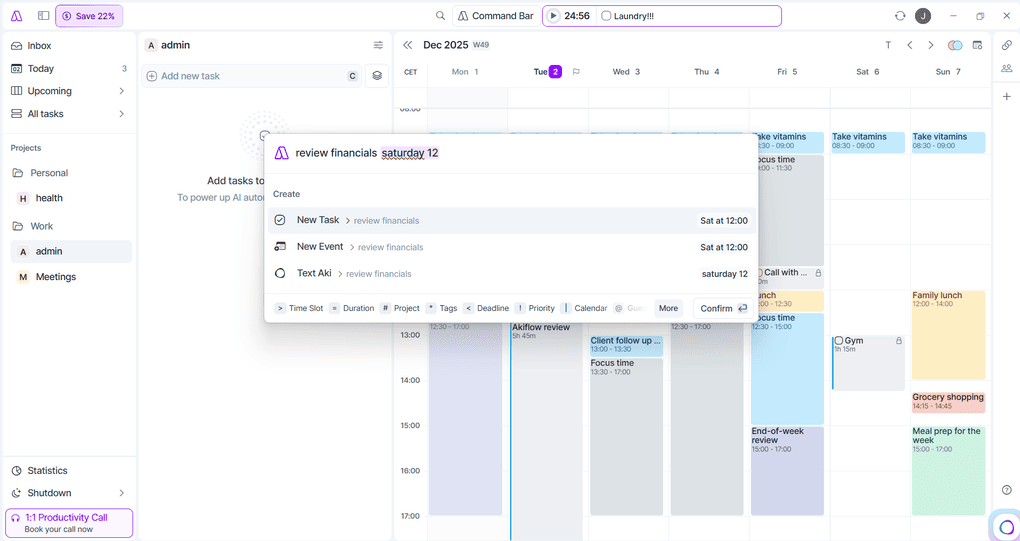
Akiflow lets you create tasks the way you would say them out loud. You can type “Call the vet tomorrow at 9” or “Pay rent on the first of every month,” and the app turns that into a scheduled task. It feels more like capturing a thought than filling out a form.
The same logic works inside the Command Bar, which is always visible. You can type or use voice input, speak a sentence, and Akiflow will parse it on the spot.
It understands simple phrases like “tomorrow,” “next week,” or “every weekday,” which is enough for everyday task entry and makes new tasks quick to add.
Task Management
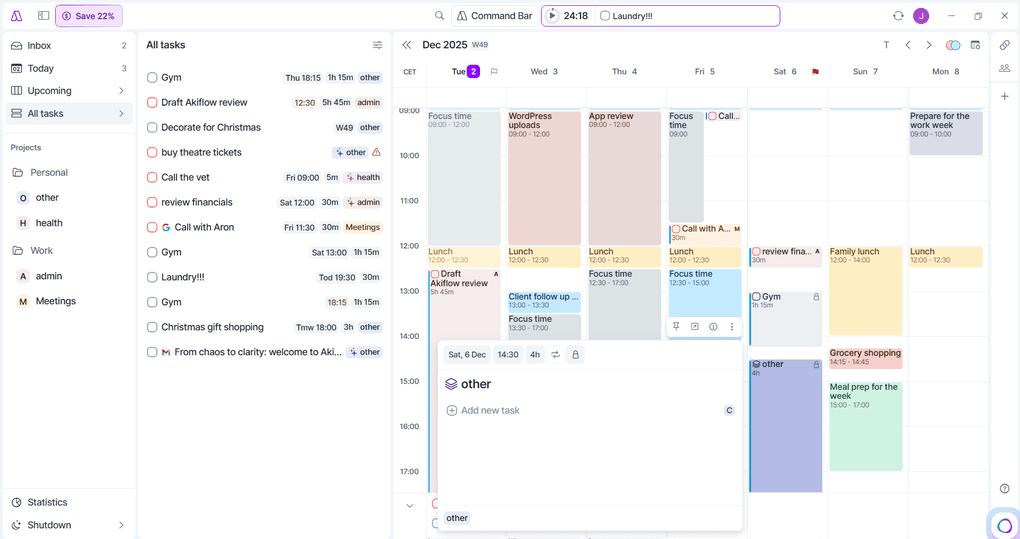
Akiflow keeps task management straightforward. Tasks sit in four main views: Inbox, Today, Upcoming, and All Tasks. This makes it easy to see what needs attention now, what is coming up next, and what still needs to be processed in your task list.
Each task can be scheduled, snoozed, assigned a project or label, or turned into a time block. You can also convert a task into an event or keep it flexible until you decide where it fits. No matter where the task comes from, the actions are predictable and fast, which helps when you are managing tasks across many tools.
Projects and labels help you group related work without becoming full project management boards. Akiflow is not designed to manage projects at the same depth as a dedicated project management tool, and it does not try to replace larger projects that live in ClickUp or Notion.
Priorities stay simple. Instead of multiple task priority levels, Akiflow uses pinning to highlight the few things you truly want to focus on.
AI Workflows
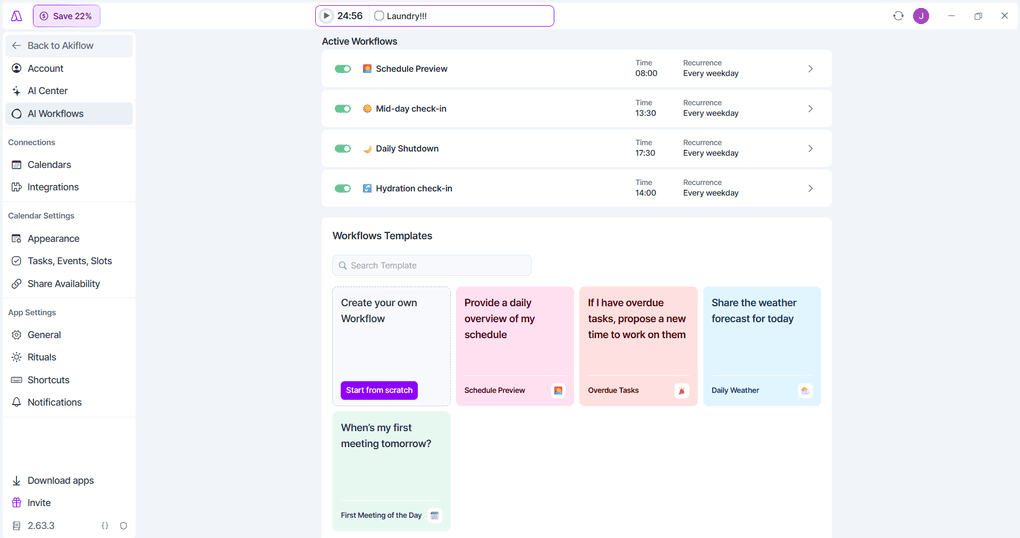
Akiflow includes several AI workflow templates that automate small parts of your day, like schedule previews, weather updates, or reminders about overdue tasks. You choose the time and recurrence, and Aki sends the message when it is most useful.
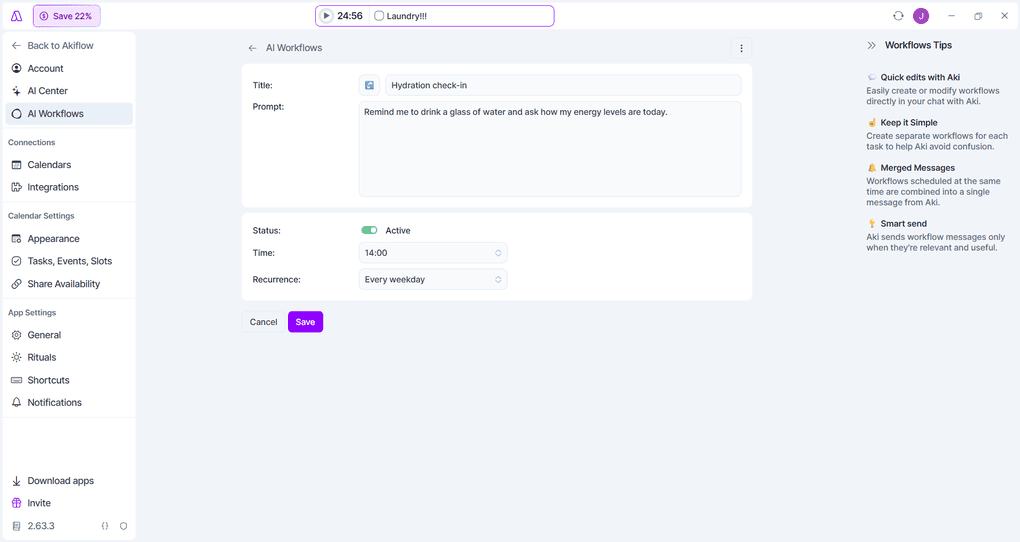
If you want something more personal, you can create a workflow from scratch. Write your own prompt, set when it should run, and Aki turns it into a recurring message. It works well for simple routines and habit check-ins.
The workflows stay lightweight and do not try to plan your day for you, but they add basic AI capabilities on top of your existing time management system.
Focus and Timer
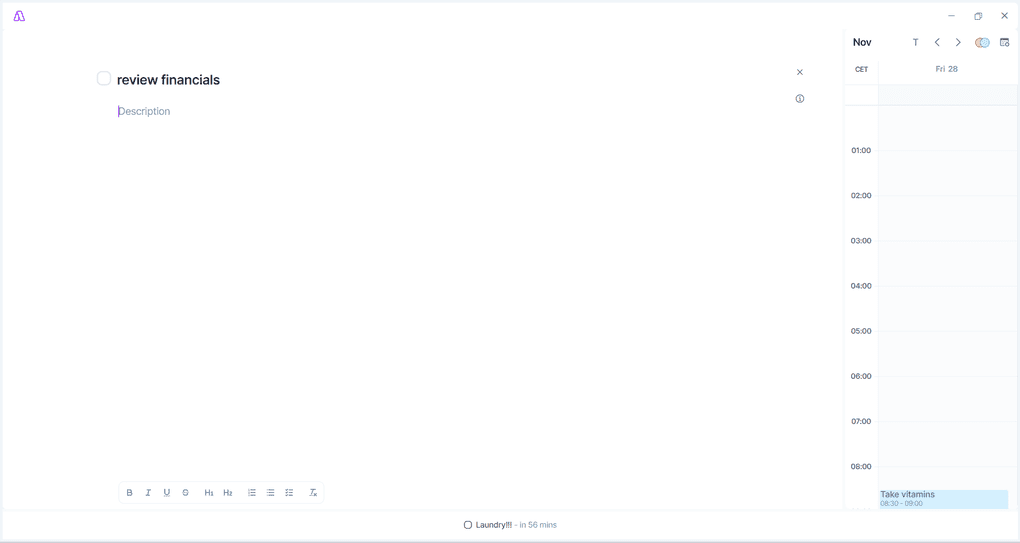
Akiflow includes a simple focus timer that helps you stay committed to one task at a time. You can start a session directly from a task or from a time block in the calendar. The timer shows your progress, stays out of the way, and mutes distractions while you work.
It is not a full Pomodoro system, but it pairs naturally with time blocking. Drag a task onto the calendar, lock it, start the timer, and you have a small routine that keeps you grounded in the work you want to finish and helps you stay focused during focused work sessions.
Share availability
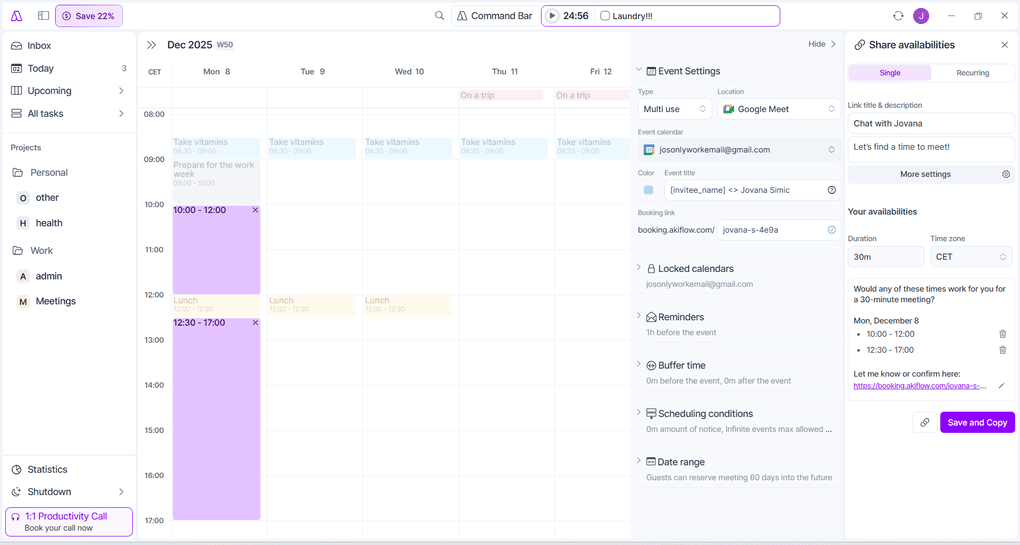
Akiflow also covers basic scheduling through its Share availability feature. You choose a few time slots, set the meeting duration, and Akiflow generates a simple booking link. The other person picks one of the times you offered, and the event is added to your calendar automatically.
The setup panel is easy to use. You can customize the event title, choose the meeting location, such as Google Meet, set reminders, add buffer time, and decide how far into the future people can book. Locked calendars help keep private events protected while still showing your real availability.
Other Features
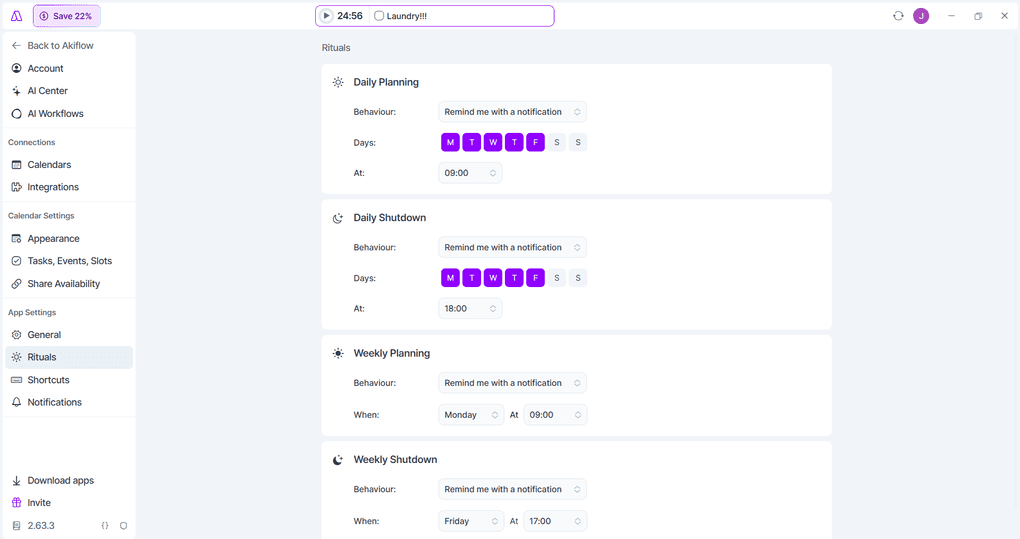
Akiflow includes a long list of keyboard shortcuts that make the app quick to navigate. You can move between views, create tasks, open the Command Bar, or start a focus session without lifting your hands from the keyboard, which is especially nice for power users.
The universal search is fast and flexible. You can jump to tasks, projects, labels, or calendar views with a few letters. Search also doubles as a command launcher, which helps when you do not remember the exact shortcut.
Notifications and reminders stay simple. You can snooze tasks, overdue items surface naturally, and deadlines appear as small calendar flags. You can enable desktop notifications or keep everything inside the app if you prefer a quieter workflow, without adding cognitive overload on top of your existing productivity system.
Motion’s features
Now, it’s time to delve into Motion’s features!
Motion calendar
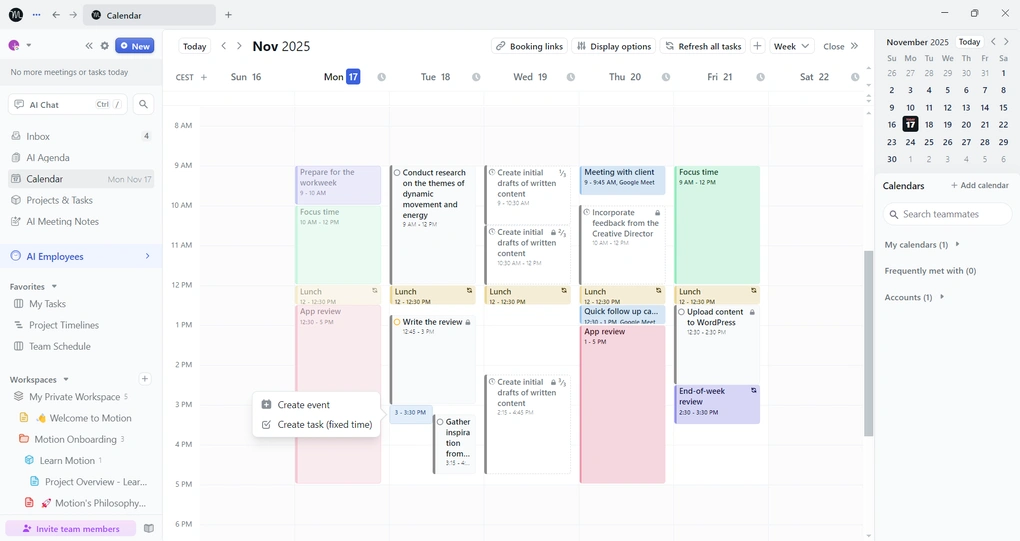
Managing your personal and work tasks across different apps, like Gmail and Outlook, can get pretty challenging. Motion offers seamless calendar integration with Google Calendar, Apple Calendar, and Outlook Calendar, allowing you to bring them into a centralized view.
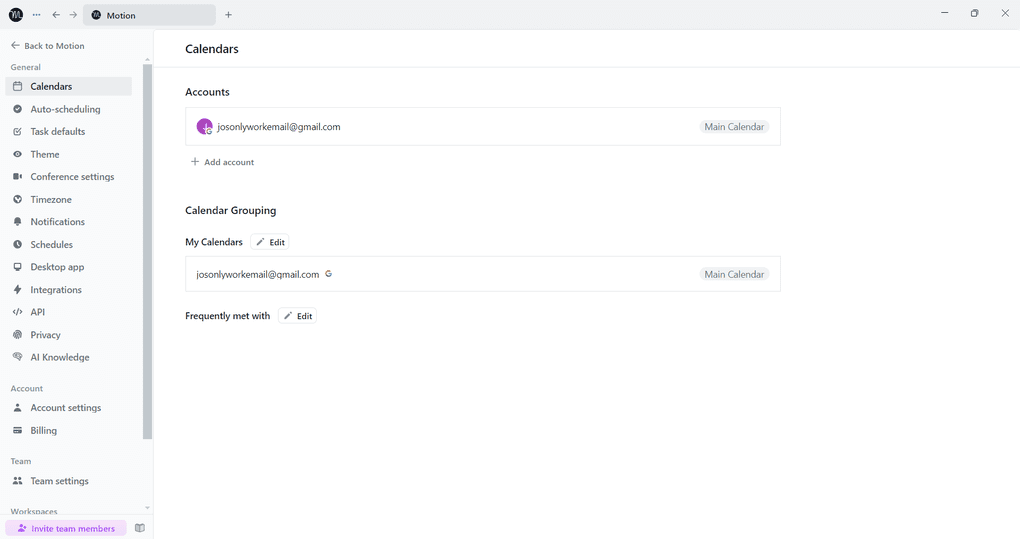
If you go to settings and click on the “calendars” tab, you can add your calendars with just one click. It is super easy.
Bringing your calendar management into one tool is really efficient. You not only see your personal and work calendar items simultaneously, but you also plan your weekly to-do list much more easily and add calendar events smoothly.
The best thing is that you can just drag and drop your calendar events to move them, and you can create tasks from this view as well.
Also, Motion recently improved its calendar sync speed across Google, Apple, and Outlook. This reduces context switching, making it easier to move between calendars.
AI scheduling tool
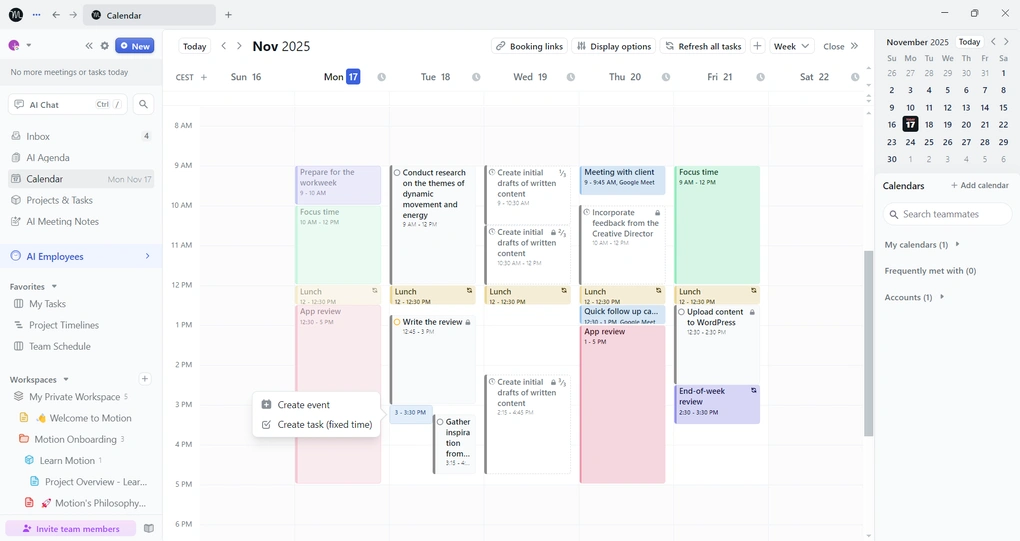
Motion not only integrates your calendar events into one single place, but it also uses AI scheduling to ensure you can meet all the deadlines and focus on high-priority tasks.
You can create tasks using your calendar view, and you can also make changes here. Personally, I used the “all task tab” to manage tasks. Once you create the task, Motion schedules it based on your availability, priorities, and settings.
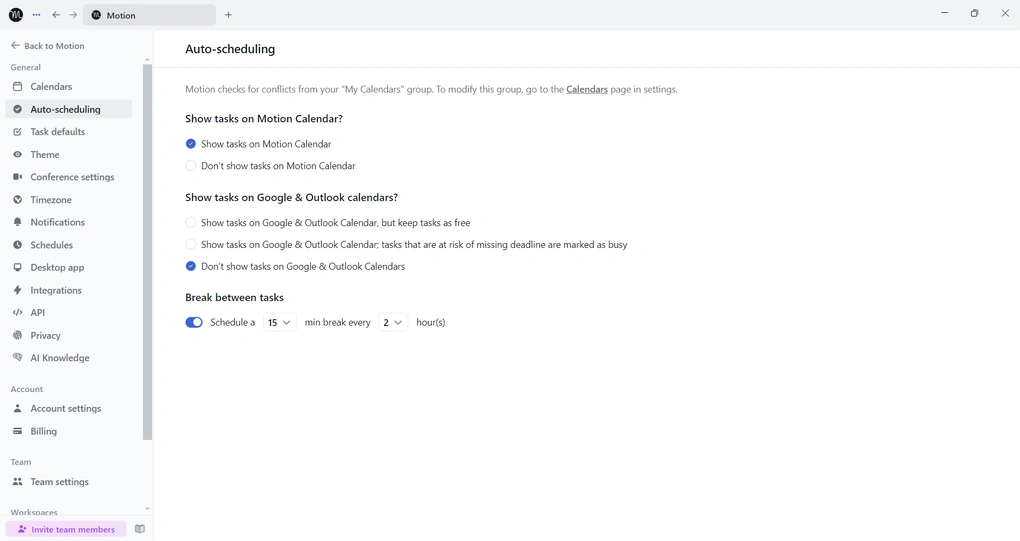
During my Motion review, I found the scheduling tool to be the most exciting one. The auto-scheduling feature is useful when loading your tasks here, and it lets Motion find the best timeslot to complete them.
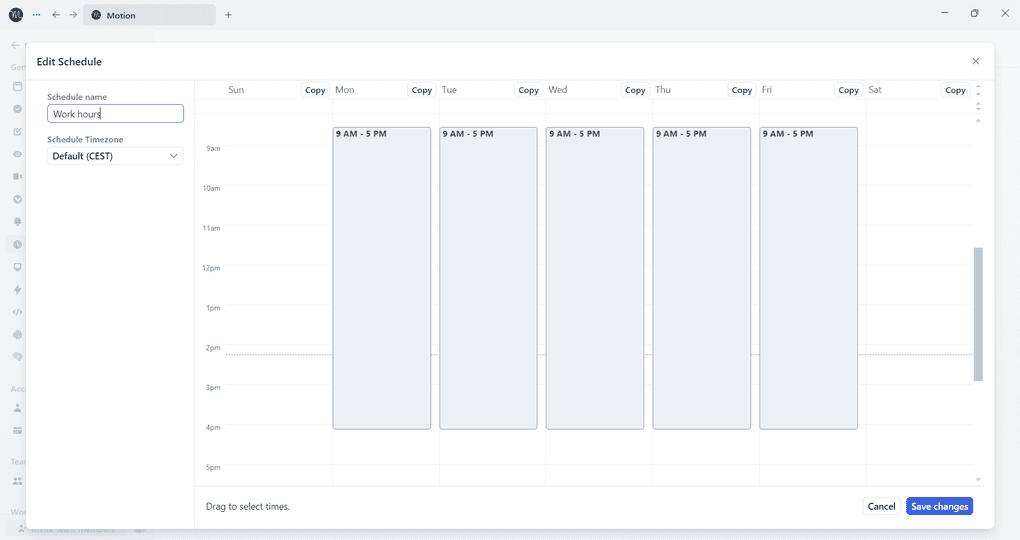
Nevertheless, before scheduling tasks, it makes sense to add your working hours, timeslots for personal activities, and more. You can do this in the settings menu using the schedules option.
If your task takes more time than you think, and you have no time to finish it or other tasks, Motion will reschedule based on your priorities, deep work hours, preferences, and personal events.
Motion designed its auto-scheduling feature based on how the most productive people work daily. However, if Motion schedules your tasks to an ideal time, you can simply drag and drop, and Motion will learn from it.
The auto-scheduling engine recently received an update, so the task rescheduling logic and duration predictions are now more accurate. This is especially useful when you want Motion AI to break longer tasks into smaller ones.
Meeting assistant
Motion’s meeting scheduler helps you and others to book time with you. Motion uses booking links to simplify appointment scheduling.
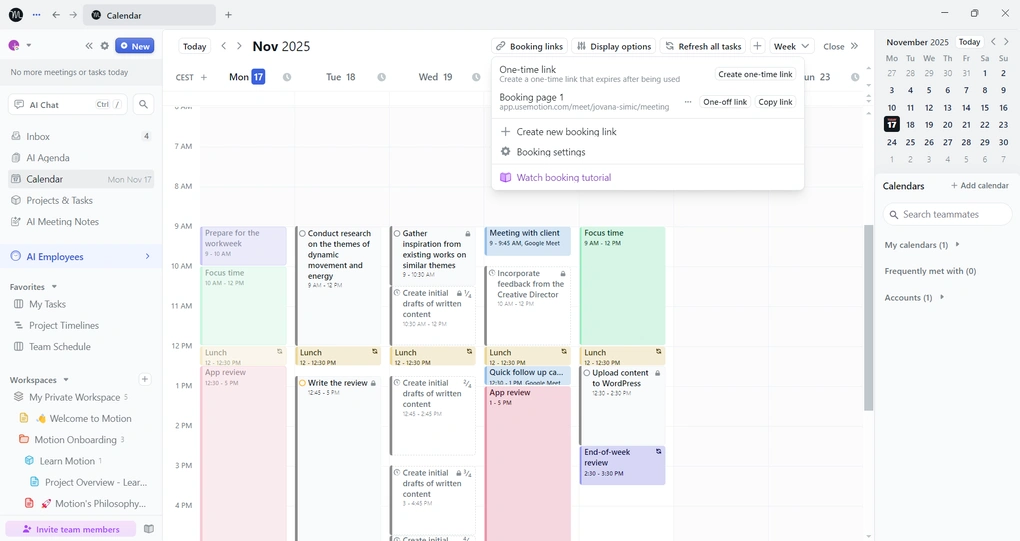
To access the booking link feature, hit the “booking links” option at the top. Here, you can select which booking link you want to send, but you can also make changes when it should show you as available.
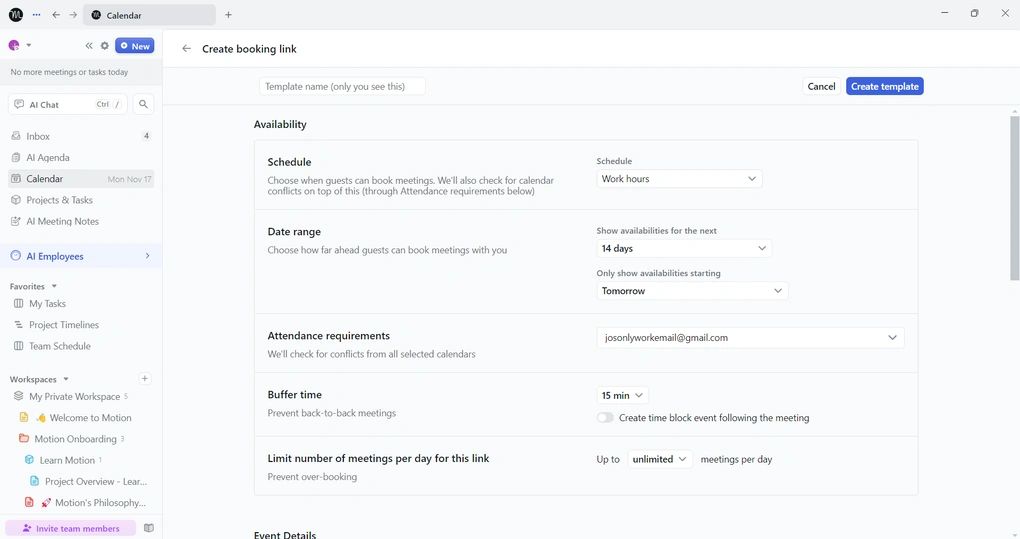
For example, I prepared a new schedule for myself called “Meetings,” and Motion will only show the timeslots I gave in this schedule. However, you can customize it in more detail.
You can add buffer time and date range, or limit the number of days for the meetings. Once you finish the customization, you can just share the link, and they can access your booking page. Motion also refreshed its booking link UI, so customizing availability or buffer times feels more intuitive now.
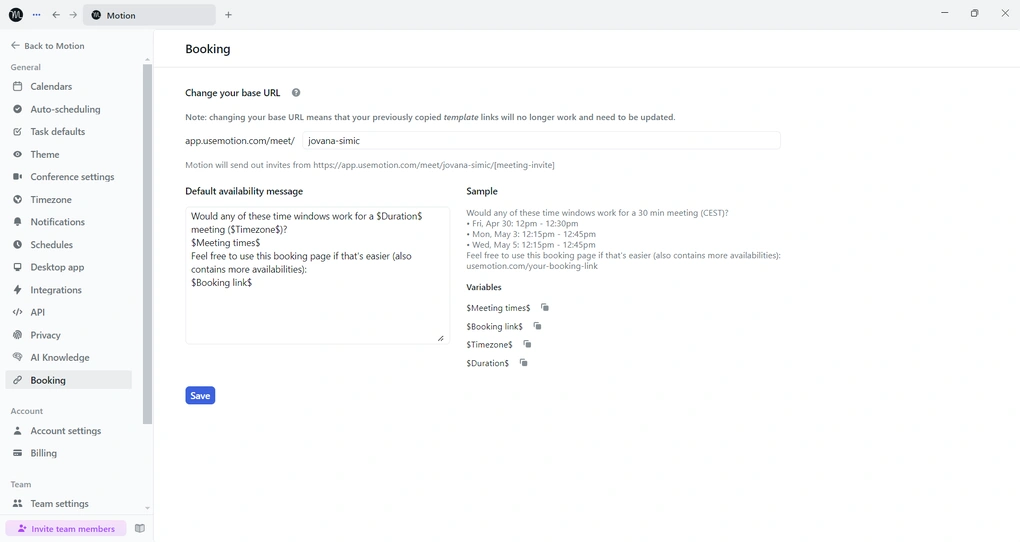
Overall, the meeting scheduler feature assists you with automatic scheduling, limiting the daily meetings, and displaying preferred meeting times to others. I particularly loved that during my Motion app review, it offers many options to personalize your booking page.
Ultimately, this is a valuable feature for virtual meetings, as it eliminates the constant back-and-forth communication and helps find a suitable time slot for virtual meetings.
Task management
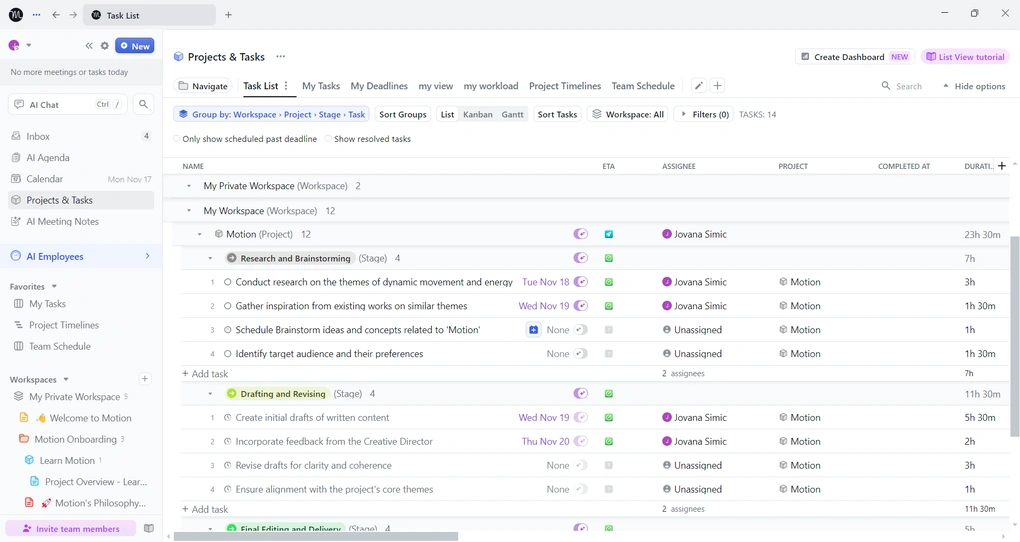
Motion’s task management feature is a powerful tool for developing more efficient tasks and time management. It allows you to smoothly add and assign new tasks to you or your teammates, while the tasks dashboard provides a clear overview of tasks in progress and those that have not been completed yet.
Having a customizable central hub for your tasks can make your life easier. You can overview your outstanding tasks and projects on a list or in a board view.
When adding a task, you can select the assignee, duration, start date, due date, and when to auto-schedule it. Also, users can set custom priority levels for tasks, enabling flexible management of workload.
What I recognized during my Motion app review is that you can add tasks from almost all the pages. It is a small feature, but quite useful to ensure you add and manage tasks with the highest efficiency.
We all know there are times when it is all about firefighting. You need to jump into an important Google Meet or Microsoft Teams call, or some important tasks have come up. With a single click, Motion’s automatic scheduling reorganizes your tasks based on your preferences and priorities.
Motion also improved recurring tasks and default task fields, which makes adding new tasks slightly faster than in the older version. To stay up to date, users can track changes and updates in task management via an activity feed, enhancing organization.
This feature makes Motion an excellent tool for effective task management. Beyond helping you manage and track your focus time and tasks effectively, it simplifies task prioritization, creation, and time tracking, and fosters team collaboration.
Project management solution
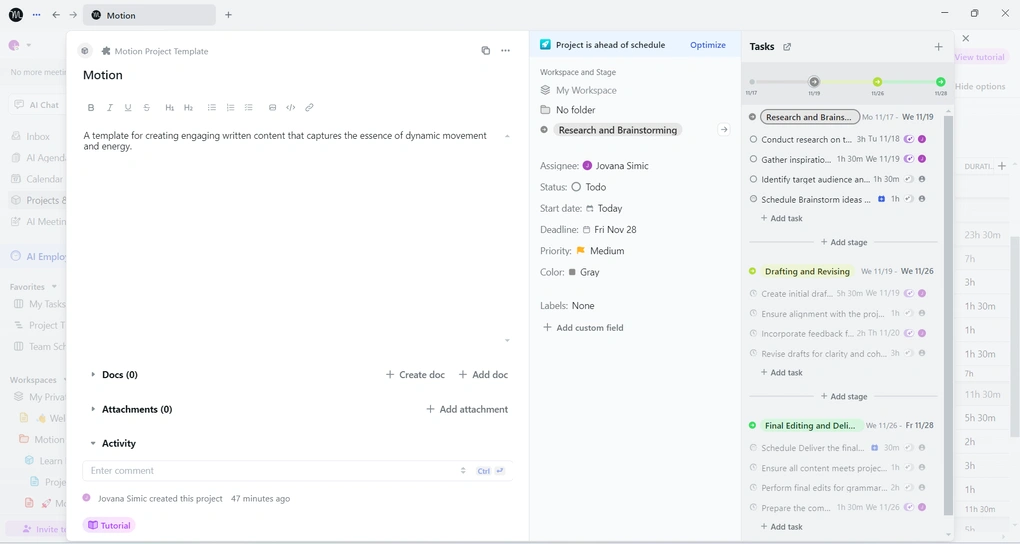
One of the key differences between Motion and most productivity tools is that Motion is an all-in-one tool. This is where it is quite similar to Notion.
Motion is a lightweight project management software that has all the tools to organize projects. It works similarly to the task manager feature.
When setting up a project, you can specify the due date, add priority notes, and assign tasks to your team members. Additionally, you and your teammates can leave comments under each project and add new tasks if necessary.
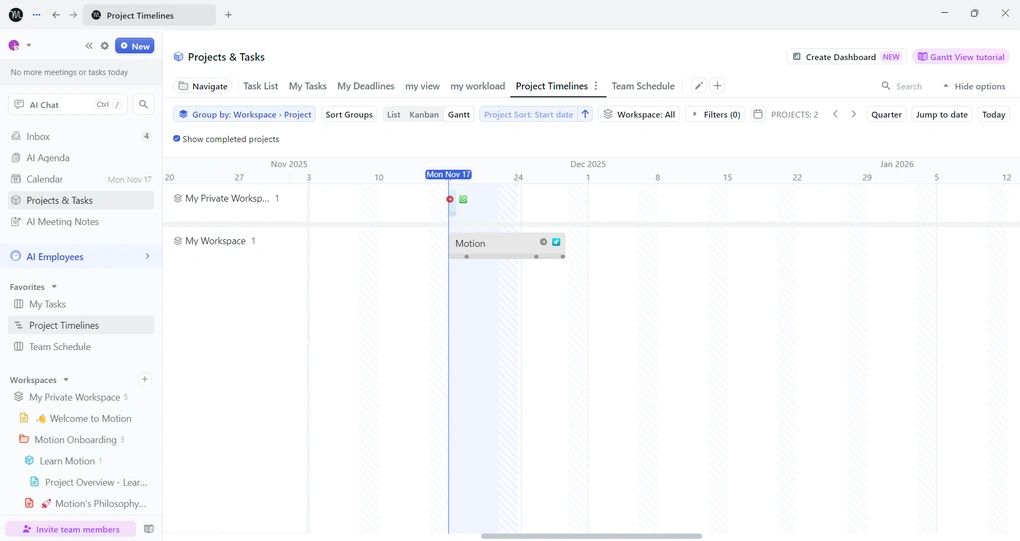
It was also great that Motion offers several view options like Gantt charts, Kanban boards, and list views. Also, you can apply filters and easily select, move, edit, or manage projects. The Gantt chart view received small usability improvements, especially around scrolling and updating dependencies.
After you add the tasks, Motion will take it from here and make a balanced schedule using its AI task management features. So, after you add a project, it makes sense to check your Motion calendar to see the upcoming tasks.
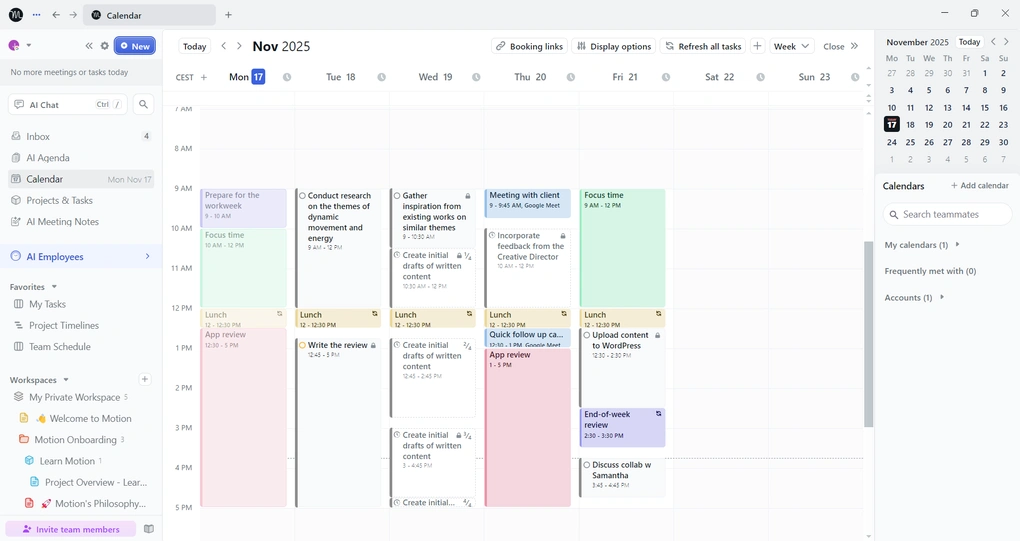
As you can see, Motion updated my calendar with the new tasks. It found the empty timeslots based on my preferences and automatically scheduled all the tasks. Compared to many project management tools, Motion not only helps you with project management itself but also ensures that you will complete the tasks on time.
You can utilize Motion’s AI-powered dashboards to centralize critical insights and data into one view. With this feature, you will get a solid understanding of capacity, project progress, and potential roadblocks.
Motion’s project management feature has all the functions to manage small business projects and workflows. Essentially, the more projects and tasks you give, the more accurate your schedule will become.
Overall, using Motion for your project management can almost entirely automate your project planning, and you can focus on the tasks.
Team collaboration
Motion has strong team collaboration features as well. You can track each team member’s plan and priorities using the team schedule feature.
It is also great that they designed Motion for teams. So when you add a project, you can handle task assignments and team communication directly on the same page.
AI note-taker
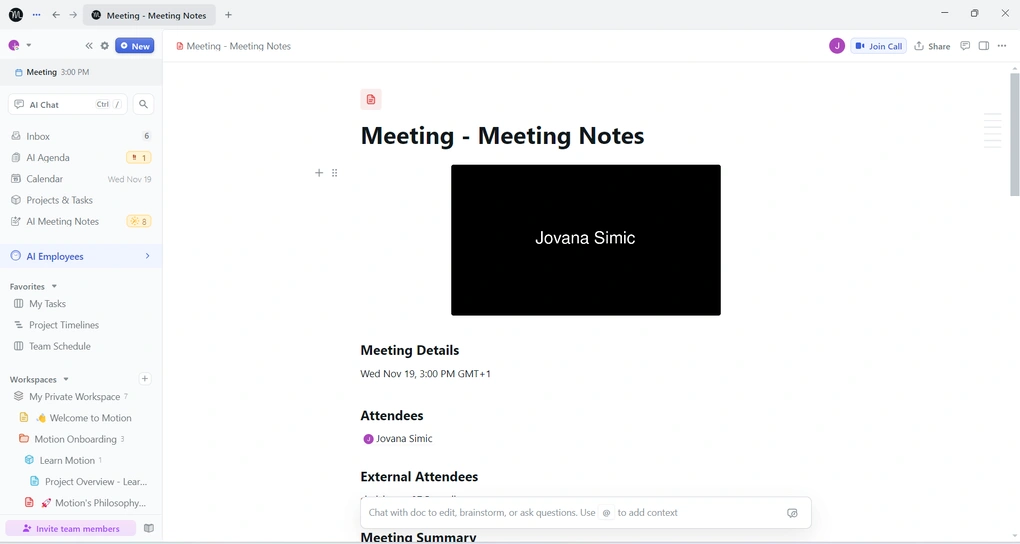
Motion recently launched its AI note-taker for taking online meeting notes. It automatically records, transcribes, and summarizes your calls on Zoom, Microsoft Teams, and Google Meet. At the moment, transcription works in English, and Motion sends a summary within a minute after the meeting ends.
Essentially, it works similarly to other platforms on the AI meeting assistant market. While it still has fewer functionalities than the current AI note-takers, this feature makes Motion a great all-in-one productivity tool.
AI docs assistant
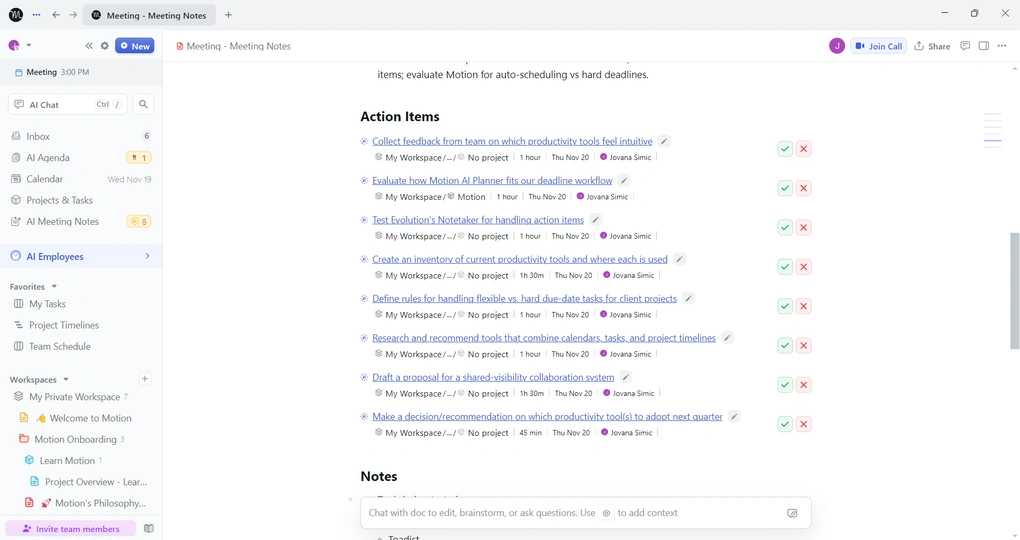
Besides AI note-taking, Motion also launched its AI-powered docs assistant. This feature helps you turn your notes, ideas, and drafts into tasks.
What makes Motion special is that it automatically converts text into actionable tasks that sync directly into your team’s workflows. Using AI, it auto-fills durations, deadlines, and descriptions for your to-do list based on your team’s docs, notes, and wikis.
Motion also expanded this feature with better task extraction, so action items appear more consistently.
AI Employees
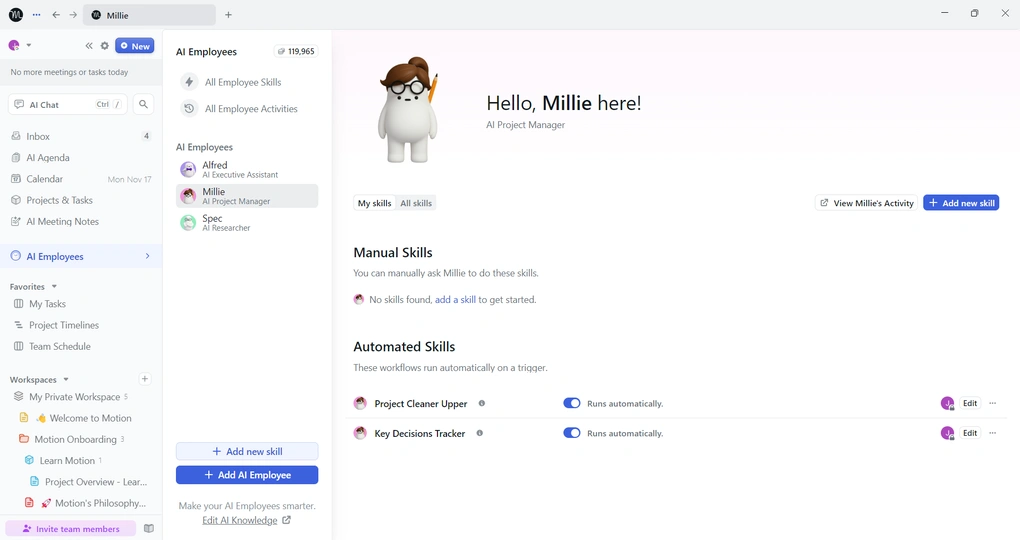
Motion’s AI Employees are essentially customizable AI bots trained on your data, writing style, and workflows.
You can make different employees for different areas of your work. Each AI Employee can read your notes, review existing tasks, analyze documents, and generate new action items or suggestions based on what you’re working on.
What makes it interesting is that it doesn’t just produce text like a generic AI tool. Instead, it converts ideas and drafts directly into structured tasks that are automatically added to your Motion calendar. You can also use AI Employees to draft follow-up emails, prepare briefs, summarize meetings, or build step-by-step project plans.
Another benefit is that the Employees keep improving over time. As you interact with them, Motion learns more about your preferences, tone of voice, and task patterns. This allows the AI to become more accurate, faster, and more aligned with how you like to work.
For individual users, AI Employees can automate a big part of administrative or repetitive work. For teams, they can act as unified assistants that help everyone stay aligned and reduce manual planning.
Explore our Apps directory
A curated directory of software tools we’ve independently reviewed, with links to full reviews, comparisons, and category guides.
Integrations
Now, it’s time to check their integrations!
Akiflow’s integrations
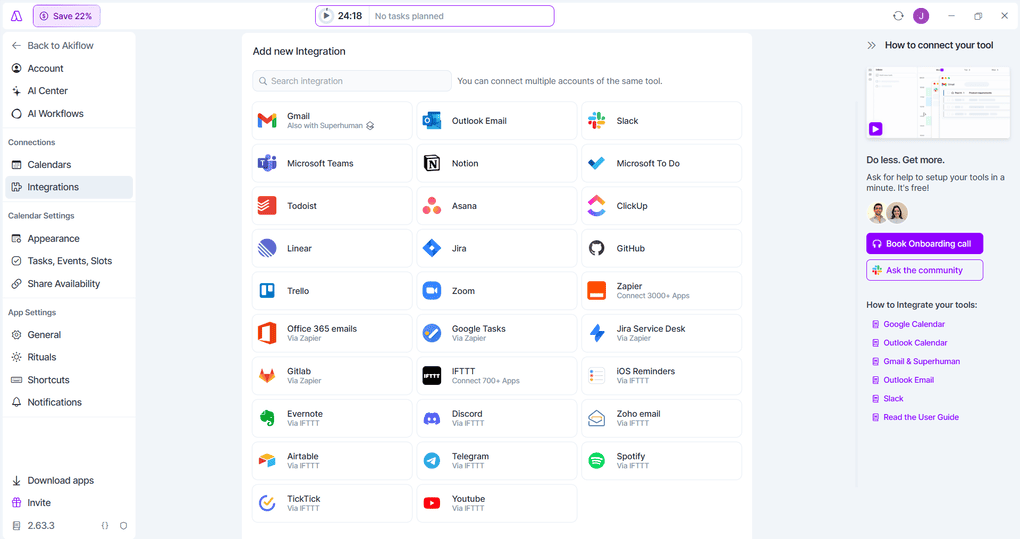
Akiflow offers seamless integration with most tools you probably already use, such as Google Calendar, Outlook Calendar, Gmail and Outlook email, Slack, Zoom, and more. Multiple accounts are supported, so it is easy to keep both personal and work setups in the same place and integrate tasks from different platforms.
With Gmail, you can simply star an email and have it show up in Akiflow as a task. You can even send a quick WhatsApp message to Aki, the built-in assistant, and turn that into a task.
For everything else, Akiflow integrates with Zapier and IFTTT. That is where the more unusual options show up, such as Spotify and YouTube. These are not native integrations, but simple automations you set up once.
They exist for one purpose: capturing tasks from anything you are doing online. If you hear something useful in a podcast or want to save a video for later, you can turn it into a task with one click. Everything flows into your universal inbox, so you never lose track of content you want to revisit.
Motion’s integrations
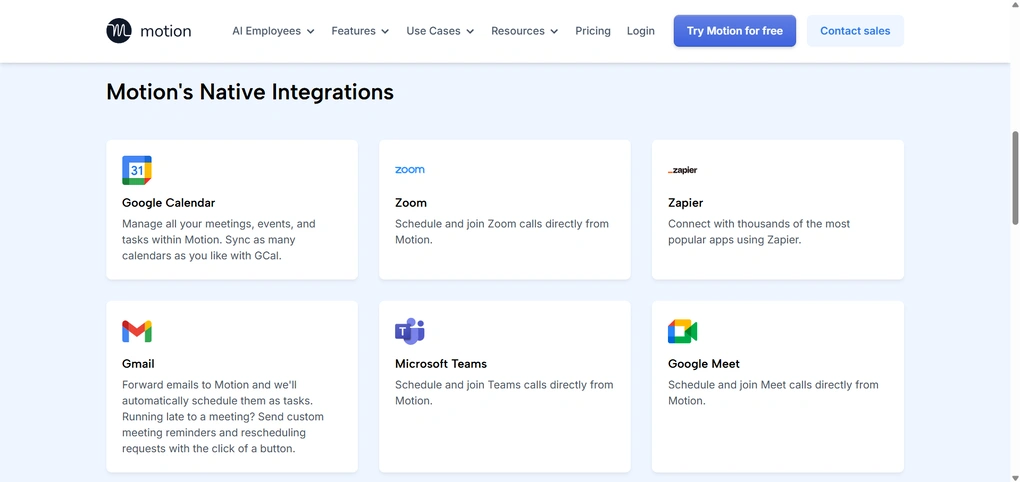
Motion offers numerous integrations. You can connect it with Google Calendar, Outlook Calendar, iCloud Calendar, Siri, Zapier, and more.
Motion also improved its Zapier workflows, so automations trigger more reliably. Utilizing the Zapier integration, you can access an additional 7,000 third-party apps. So, Motion is quite good in terms of integrations.
Pricing
In this round of the Akiflow vs Motion comparison, let’s take a look at the pricing structure of each daily planner tool.
Akiflow pricing
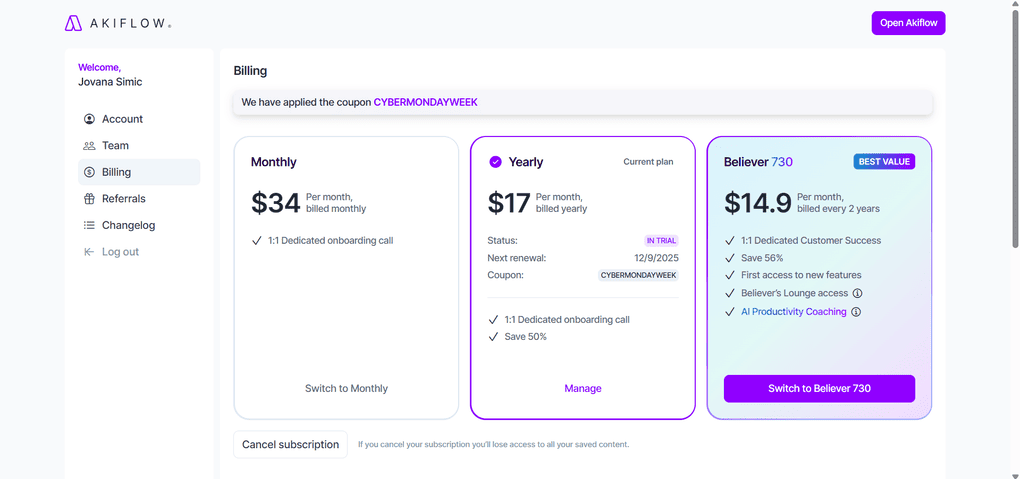
In the course of my Akiflow review, I found that it has one feature set with three billing options.
The monthly subscription costs $34 per month, the yearly subscription drops the price to $17 per month billed yearly, and the Believer 730 plan goes down to $14.90 per month billed every two years.
All three include unlimited tasks, integrations, meetings, full access to Aki, and a 1:1 onboarding call, while the Believer plan adds perks like priority customer success, early access to new features, and AI productivity coaching.
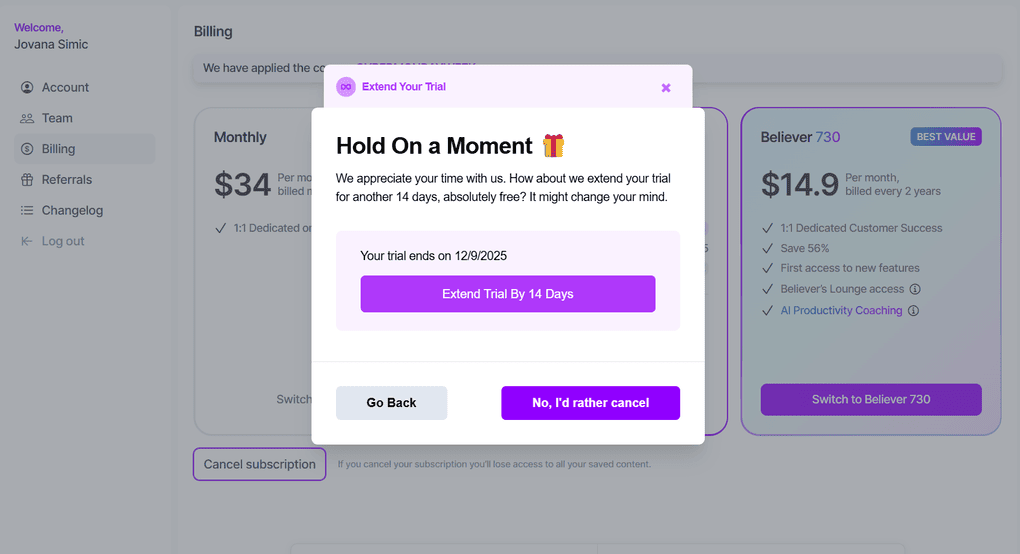
Akiflow offers a 7-day free trial for new users, and the subscription can be canceled at any time. When I clicked to cancel during my trial, Akiflow offered to extend it by another 14 days for free, and I have seen other users report the same experience, so this seems to be a common safety net rather than a one-off gesture.
Students, researchers, and teams can also request special pricing, which is helpful if you are testing Akiflow in a professional or academic setting. Still, the price is higher than most to-do lists and simple task management apps, and there is no free plan.
Akiflow positions itself closer to time-blocking and workflow tools like Sunsama. It is aimed at people who want to run their whole day from one place, not just manage a basic task list.
Motion pricing
Although Motion doesn’t offer a free plan, it does provide a 7-day free trial, giving you enough time to explore the app and see how it fits your workflow.
If you decide to continue using Motion, you can choose from several pricing plans, separated into individual users and teams.
Motion pricing for individuals
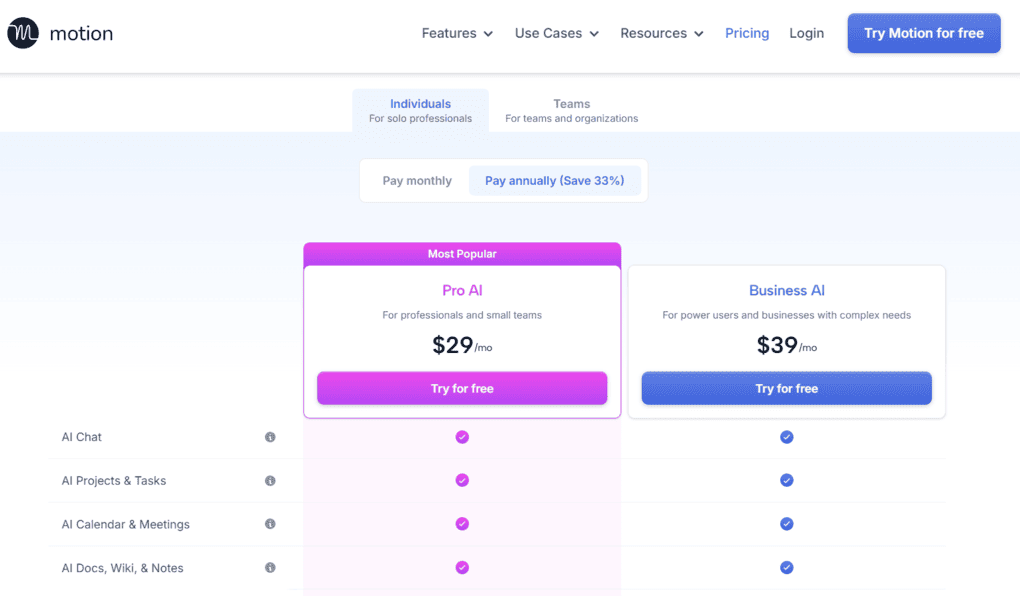
For individual users, Motion currently offers two plans:
The Pro AI plan costs $29 per month when billed annually. It includes AI chat, AI projects and tasks, AI calendar and meetings, and AI docs, wiki, and notes. This plan is positioned as the most popular option for individual users and small teams.
The Business AI plan is $39 per month with annual billing. It includes everything from Pro AI, with higher usage limits, and is designed for power users and businesses with more complex needs.
Motion pricing for teams
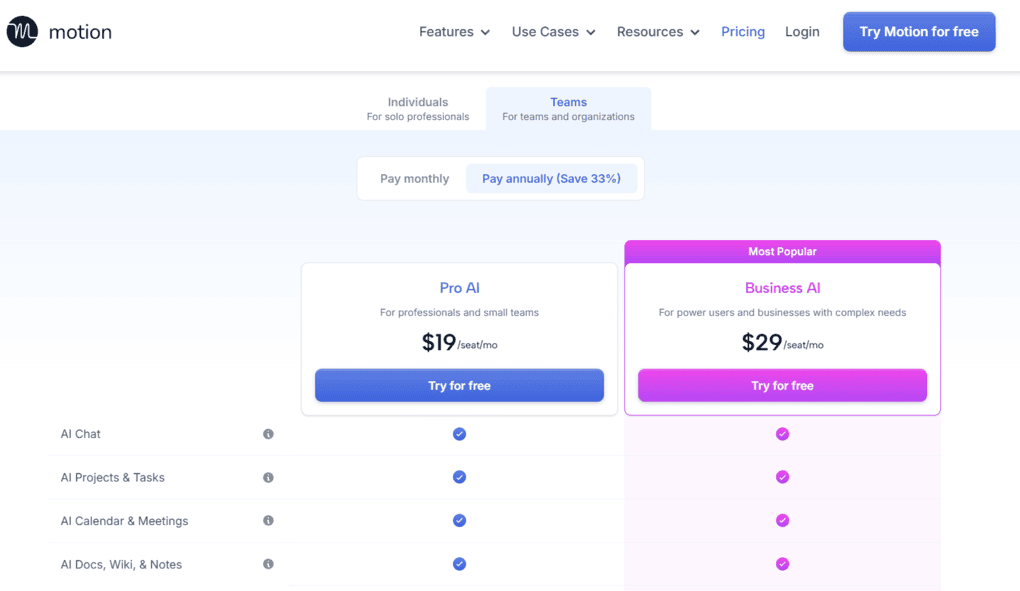
For teams and organizations, Motion offers seat-based pricing:
The Pro AI team plan costs $19 per seat per month when billed annually. It includes AI chat, AI projects and tasks, AI calendar and meetings, and AI docs, wiki, and notes, and is aimed at small teams getting started with Motion.
The Business AI team plan is $29 per seat per month when billed annually. It includes higher limits and is marked as the most popular option for teams that rely more heavily on Motion’s AI features.
Larger organizations can choose an Enterprise plan with custom pricing.
User interface
Akiflow’s user interface
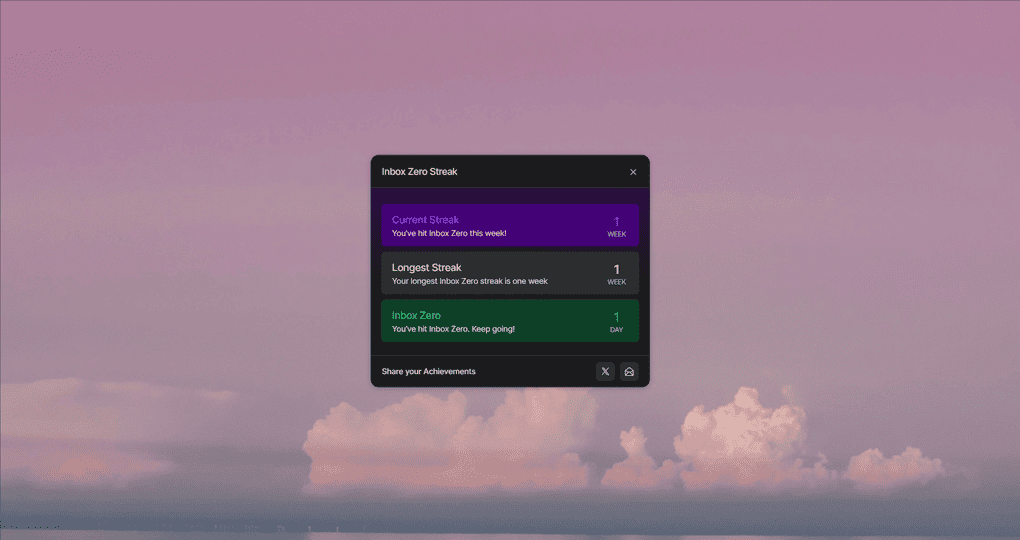
The first thing that stood out to me with Akiflow was how polished it feels. This is easily one of the better-designed apps in this category, in my opinion. It looks like a serious tool, but not a heavy one.
The onboarding and everyday guidance are very well done. I always felt like the app was quietly showing me what to do next. Everything is highly customizable in a practical way, and most things worked exactly how I expected the first time I clicked on them.
Motion’s user interface
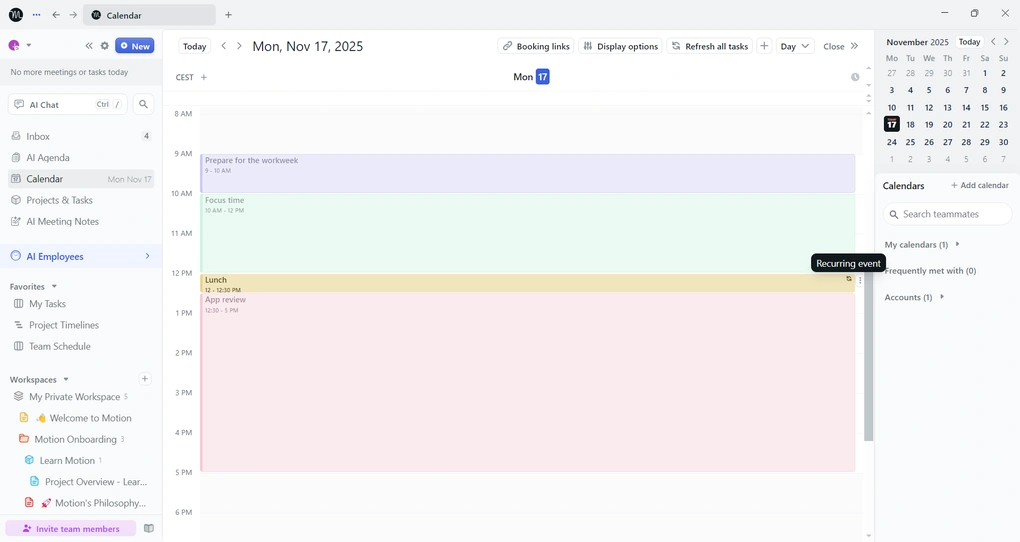
Motion’s user interface has been noted as having a steep learning curve, which might hinder new users. However, I found that it has a simple user interface. I would not call it beautiful, but rather practical. You can easily navigate its pages, and it is easy to find its tools.
Compared to Reclaim AI, Motion has a less intuitive interface, and maybe it would be great if there were more colors. Nevertheless, I appreciated the option to change between numerous themes.
My experience with Akiflow
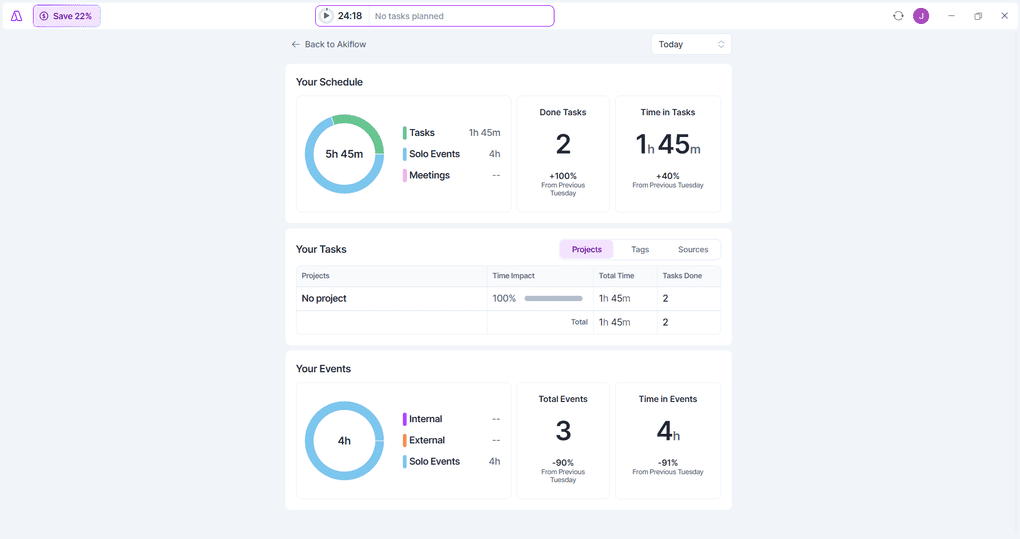
I tested Akiflow on the Windows desktop app during the free trial, and it felt smooth from the start. The inbox, calendar, and Command Bar work together in a smarter way that makes capturing and scheduling tasks feel natural. I did not have to learn anything twice, and most actions became automatic after a day or two.
What stood out the most was how easy it was to keep my day realistic. Dragging tasks into the calendar, adjusting time blocks, and checking the Today view helped me see very quickly when I was trying to fit too much into one day and when all my tasks simply did not fit in the available time slots.
I also liked the Statistics view more than I expected. It shows how much time actually went into tasks and events, and how many tasks I finished, without overcomplicating things. It gave me just enough feedback to notice patterns in my time management, but not so much that I felt analyzed instead of helped.
Overall, Akiflow felt reliable and thoughtfully designed, especially for planning my day in a realistic way. It did not radically change how I work, but it made the parts I already do like scheduling, reviewing, and committing to tasks noticeably smoother.
You can read my full experience here: An Honest Akiflow Review 2026: Is It Worth $34 For YOU?
My experience with Motion
During the Motion app review, the first thing that came up was that the navigation was pretty straightforward. It was also easy to locate all the key features and start using them.
However, I would say it has a steep learning curve compared to most productivity tools. For example, it took me 10-15 minutes to set up my booking page and find all the relevant options for this.
The good news is that there are many tutorial videos and articles, so you do not have to find the solution for all your issues.
Moreover, Motion provides users with many customizable options to make sure they will not miss any important information. Entering tasks, changing existing tasks, or adding new tasks to a project work smoothly for me.
I particularly liked Motion as a project management software and scheduling tool. It is a great combination to create projects fast.
All in all, I had a very pleasant experience using Motion in my daily schedule.
You can read my full experience here: Motion App Review: My $348 Experience and Why I Don’t Regret It
Akiflow’s pros and cons
Now, I will show you Akiflow’s pros and cons I discovered.
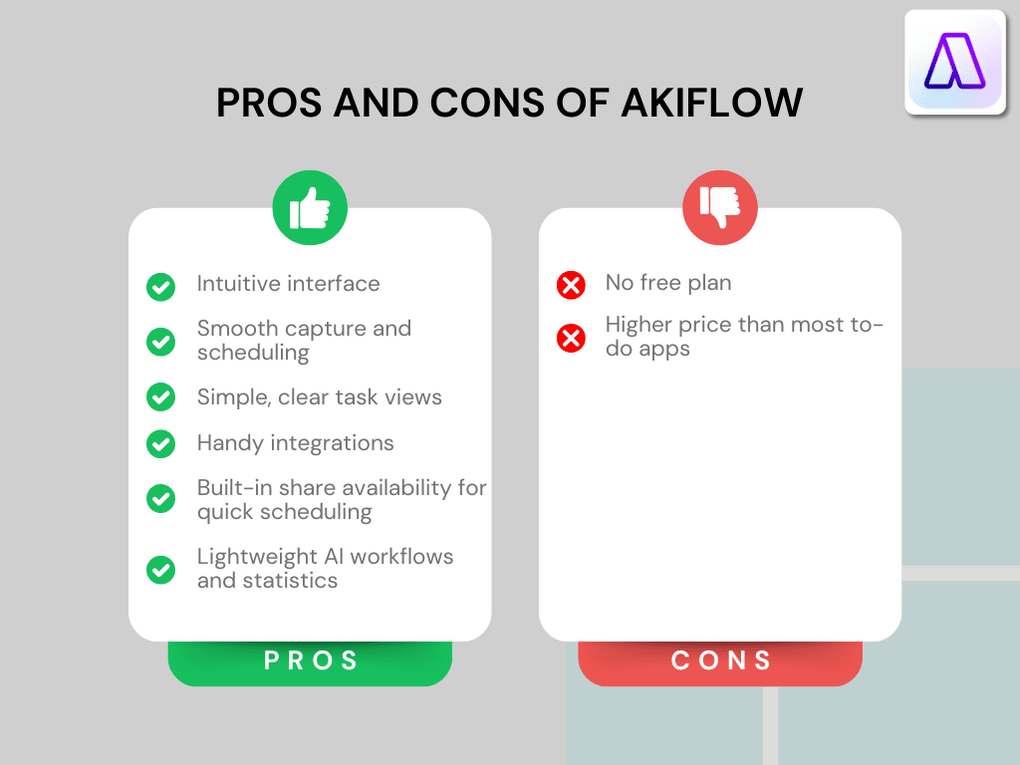
Pros of Akiflow
Cons of Akiflow
Motion’s pros and cons
Let’s continue with Motion’s pros and cons!
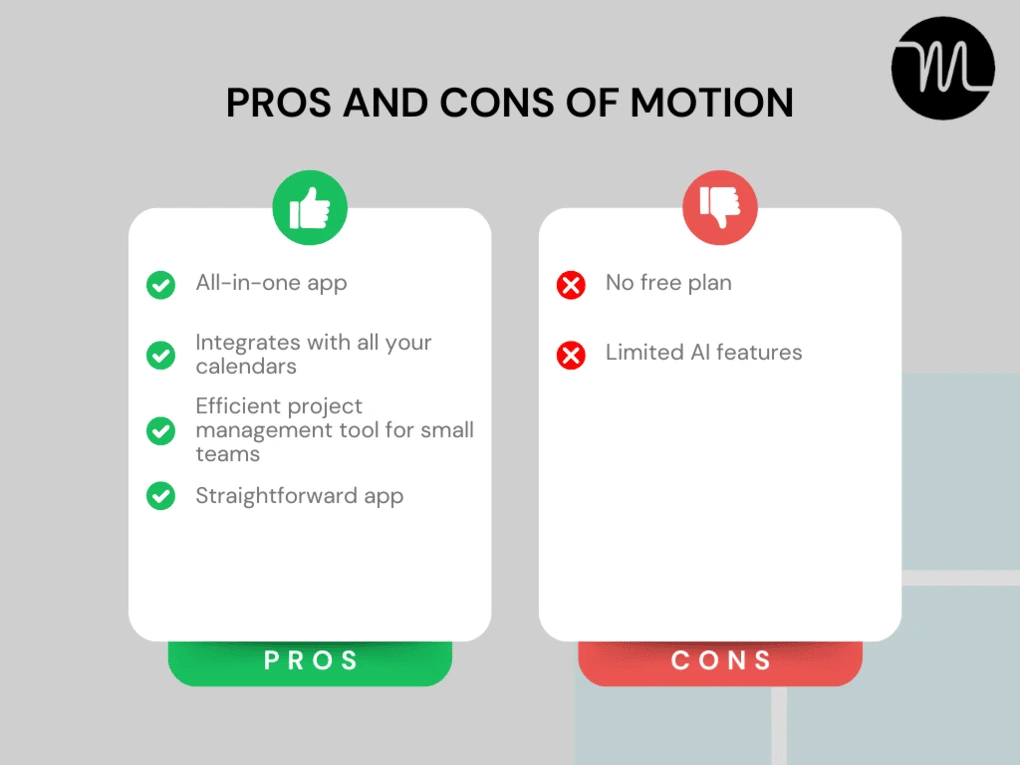
Pros of Motion
Cons of Motion
Alternatives to Akiflow and Motion
If you are not sure if Akiflow and Motion are the best choices for you, here are some worth considering:
- Morgen: It is a cross-platform calendar app that combines multiple calendars, tasks, and scheduling in one place
- Todoist: A powerful task management tool focused on simplicity and organization, ideal for people who need structured to-do lists and basic task management without switching between several calendars.
- Routine: A minimalist productivity app that combines calendars, tasks, notes, and simple journaling in one place.
- Notion: A flexible calendar built into Notion’s workspace, great for users already managing tasks, projects, and notes there, who want task integration within one platform.
- Timehero: A predictive task management and time blocking solution that automatically arranges work based on your availability and deadlines.
- Reclaim: An intelligent planner that uses AI to automate time management, protect focus hours, and balance meetings with flexible task scheduling.
- Outlook: Microsoft’s long-standing app combining email, calendar events, and collaboration tools for teams in enterprise environments.
- Upbase: Upbase has a free plan available and offers comprehensive features for task and project management, making it a strong alternative to Sunsama.
- BusyCal: A highly customizable Mac and iOS app for users who want full control over views, reminders, and scheduling links.
My pick: Akiflow vs Motion
After using both tools side by side, the choice becomes obvious pretty quickly.
When you compare Akiflow and Motion as a daily planner, Akiflow is a better pick for most individual users. It focuses on essential tools for planning, managing tasks, and building a realistic daily schedule.
On the other hand, Motion is better suited for larger teams that need more advanced features. It shines when collaboration and complex planning matter more than simplicity, which also means it can feel heavy for solo daily planning.
Related article:
- 11 Best Daily Planner Apps | 20+ Personally Tested Tools (2026)
- My Honest Morgen Review After 5 Weeks (2026)
- Motion App Review: My $348 Experience and Why I Don’t Regret It
- 9 Best Motion Alternatives | I Tried 20+ Apps (2026)
- Sunsama vs Motion 2026: I found the best one for you
I hope I was able to help you find out whether Akiflow or Motion suits you the best. As always, I will keep updating this Akiflow vs Motion article.
Looking for similar tools?
Visit the link to explore other apps we’ve reviewed in this space and how they compare.
Why you can trust our reviews
At thebusinessdive.com, our team tests, reviews, and compares hundreds of productivity apps every year — from project management tools to note-taking apps. We dive deep into real-world use cases to help you find the right tools that actually improve your workflow, not just add noise.
Our mission? No fluff, no shortcuts—just honest, hands-on insights from productivity pros.
Discover how we stay transparent, read our review methodology, and let us know about any tools we missed.
Frequently asked questions
What is the main difference between Motion vs Akiflow?
The core difference in Motion vs Akiflow is how they help you plan your work. Akiflow focuses on manual planning and task consolidation, giving you full control over how you allocate time to tasks. Motion, on the other hand, uses automation to schedule your day for you.
Can Akiflow and Motion replace external tools?
Akiflow and Motion are designed to reduce reliance on external tools, but they approach this differently. Akiflow pulls tasks from external apps like email and calendars into one place, while Motion aims to replace several planning and project tools with a single system.
Which tool is better for project planning and timelines?
When it comes to planning work over time, Motion has the edge thanks to built-in project timelines and automated scheduling. Akiflow works better for flexible planning and daily execution, especially if you want to protect your precious time from overplanning.
Disclosure: I only recommend products I would use myself, and all opinions expressed here are our own. This post may contain affiliate links that, at no additional cost to you, may earn a small commission. Read the full privacy policy here.

Hey! I’m Jovana, a content writer who loves writing, researching, and testing new productivity apps. With a background in philosophy, I bring a thoughtful but no-bullshit approach to everything I do. Let’s connect on Linkedin!