


Fellow vs Fathom 2026: I Found The Best One For You
I am in a tough spot with this Fathom vs Fellow post, since both AI note-takers are among my favorites. Still, they are ideal for different use cases and offer a completely different experience for your online meetings.
I’ll be straightforward with you: Fathom and Fellow are both excellent AI meeting note-takers, but they are built for fundamentally different users.
One (Fathom) is a lean tool that does a few things exceptionally well.
The other (Fellow) is a full AI meeting assistant designed to run your entire meeting workflow — from preparation to follow-up — backed by robust integrations with your existing tools and the security controls that people who care about security and compliance usually need.
To help you figure out which is which for you, I’ll break down both by features, pricing, and real-world use.
Let’s dive in!
Verdict
Here’s the quick verdict if you don’t want to read the full Fathom vs Fellow review:
🎯 Best for:
Fellow: Teams & professionals that need an advanced and safe AI note-taker
Fathom: Simple AI note-taking with free core features
🚫 Not ideal for:
Fellow: Free AI note-taking
Fathom: If you require more advanced features
⭐ Biggest strength:
Fellow: One of the most accurate transcriptions & meeting notes
Fathom: Accurate transcriptions and well-structured meeting notes for free
⚠️ Biggest weakness:
Fellow: The free version is more like a trial
Fathom: No mobile app
⚖️ Verdict:
Fellow is better for advanced meeting workflows, security, collaboration, and bot-less recording, while Fathom is ideal for simple AI note-taking and generous free transcription features.
🏆 Winner:
Fellow for teams and advanced workflows, Fathom for free plans and simplicity
✅ Tested with our review & scoring methodology ✅ Real-world testing ✅ Unbiased evaluation
My ratings: Fellow Vs Fathom
Fellow
|
|
Accurate transcriptions and summaries
|
|
|
Bot and Bot-less transcription & recording
|
|
|
It offers numerous productivity tools besides the essential features
|
|
|
AI summaries
|
|
|
A budget-friendly option for teams
|
|
|
High-security standards
|
|
|
Have more features in the free plan
|
|
|
You need to install the Fellow desktop app in order to use botless recording
|
Fathom
|
|
Oustanding free plan
|
|
|
Accurate transcriptions
|
|
|
Top-notch customer service
|
|
|
Simple user interface
|
|
|
You can access the meeting templates only with teams plan
|
|
|
It does not transcribe files
|
|
|
No mobile app
|
How We Test AI Note-Takers
To keep our reviews and final scores fair and consistent, we evaluate every AI note-taking tool using a standardized testing framework built on real-world usage and hands-on experience.
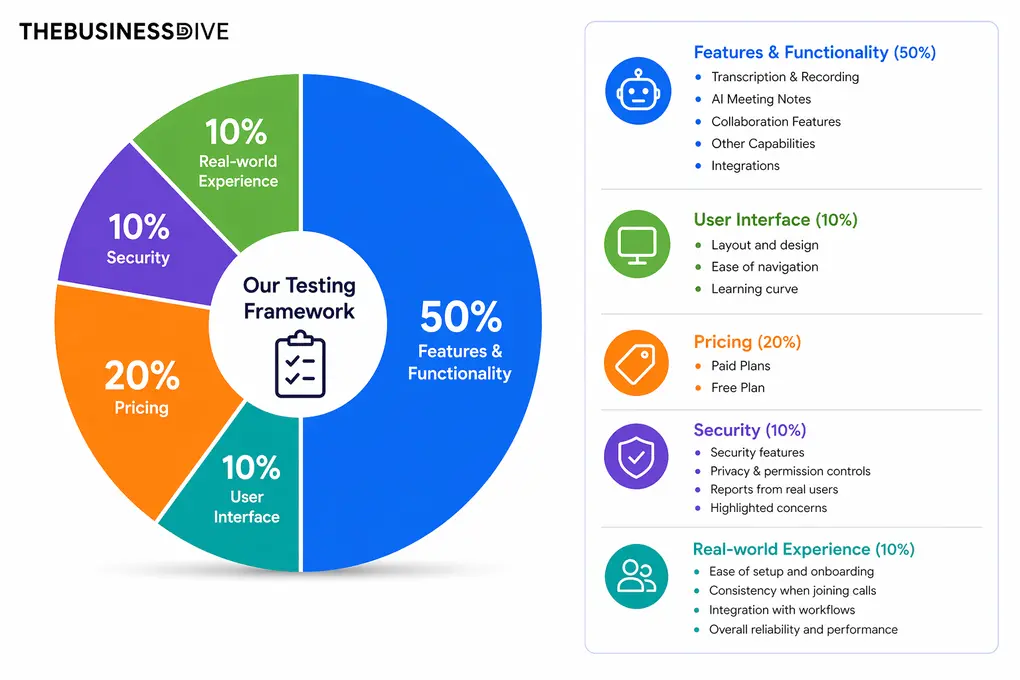
Our scoring breakdown after testing 20+ AI note-takers:
🤖 Features & functionality — 50%
🖥️ User interface — 10%
💰 Pricing — 20%
🔐 Security — 10%
👥 Real-world experience — 10%
Want a detailed breakdown of how we test each category?
Learn exactly how we test tools → Review methodology
Key differences between Fathom and Fellow
Here is a short overview of the key differences I found in the Fathom vs Fellow showdown:
|
|
|||
|---|---|---|---|
|
Best for |
Teams and professionals needing an advanced and secure AI note-taker |
Simple AI note-taking with free core features |
|
|
Core focus |
AI meeting assistant with transcription, collaboration, meeting workflows, and enterprise security |
AI meeting assistant for transcription, recording, and meeting summaries |
|
|
Key strengths |
|
|
|
|
Main limitations |
Weak free plan and bot-less recording requires desktop app |
No mobile app and limited advanced features |
|
|
Ease of use |
Easy |
Easy |
|
|
Pricing |
|
|
|
|
Integrations |
Extensive integrations |
Extensive integrations |
|
|
Cross-platform |
Web / Desktop / Mobile |
Web / Desktop |
Comparison: Fellow vs Fathom
First, I will show you the features of both AI note-taking apps one by one. After, I will guide you through their language and meeting platform support, integrations, pricing, and user interfaces. Finally, I collected the pros and cons that I discovered during the Fellow vs Fathom comparison.
Features
Let’s begin with Fellow’s features!
Fellow’s features
Below, I guide you through the key features I tried during my Fathom vs Fellow testing.
Bot-free or Bot Transcription
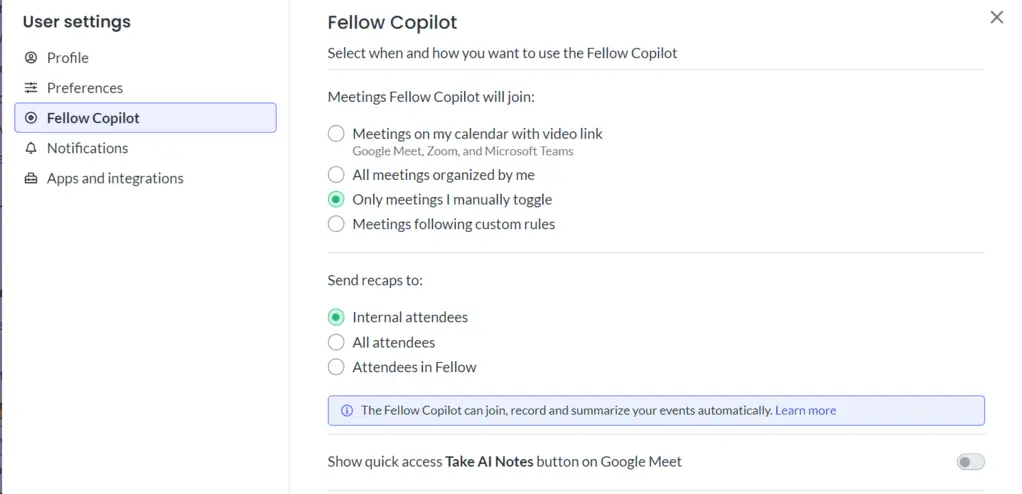
Whenever you join online meetings on Microsoft Teams, Zoom, Slack, and Google Meet, Fellow will automatically transcribe and record them in over 92 languages. If there are meetings where you do not want Fellow to join automatically, you can easily change it in the user settings menu or simply remove or pause the recording in the meeting.
With Fellow, you can choose whether you want to transcribe your meetings with a bot or without a bot when attending a call. This is a key differentiator from Fireflies AI, as some users prefer to use botless recording. Fellow gives users the flexibility to choose between bot and bot-free recording, depending on the type of meeting they are joining.
In contrast to Fathom, Fellow offers botless recording. If you want to transcribe calls without a bot, Fellow offers the same enterprise governance as its bot-based recordings. Just select the “Record without bot” option from your meeting, and Fellow will record your meeting in the background without compromising privacy and security.
Alternatively, if you want a bot to join, Fellow always asks to be let into a meeting and appears as a participant, so everyone knows the meeting is being recorded.
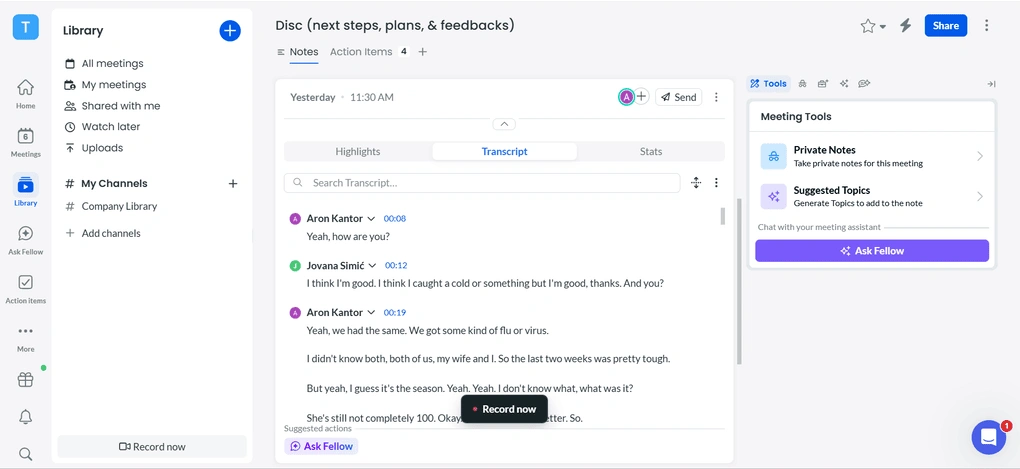
The transcription of your meetings takes only a couple of minutes, and you can access them. Based on my experience, the transcriptions are highly accurate – I’d say 95% and higher. Also, Fellow uses timestamps and speaker IDs, so you can easily track who said what.
Recordings library and channels
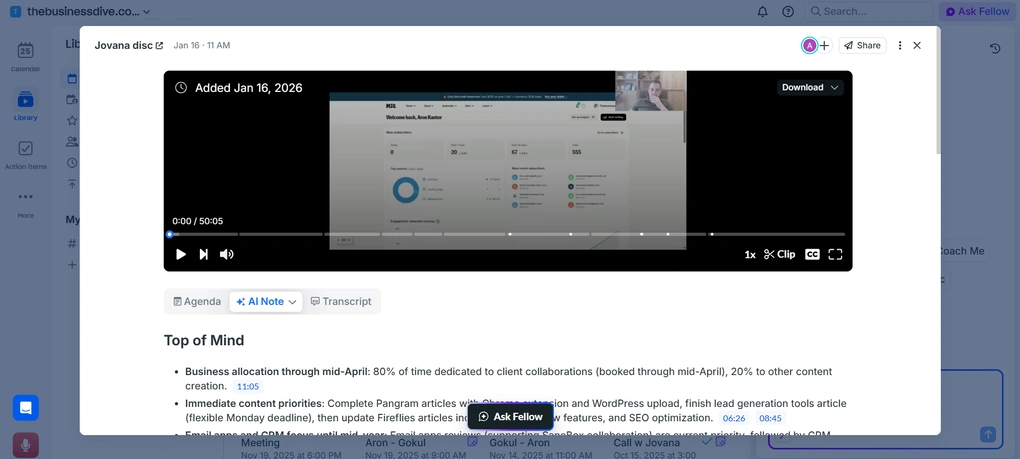
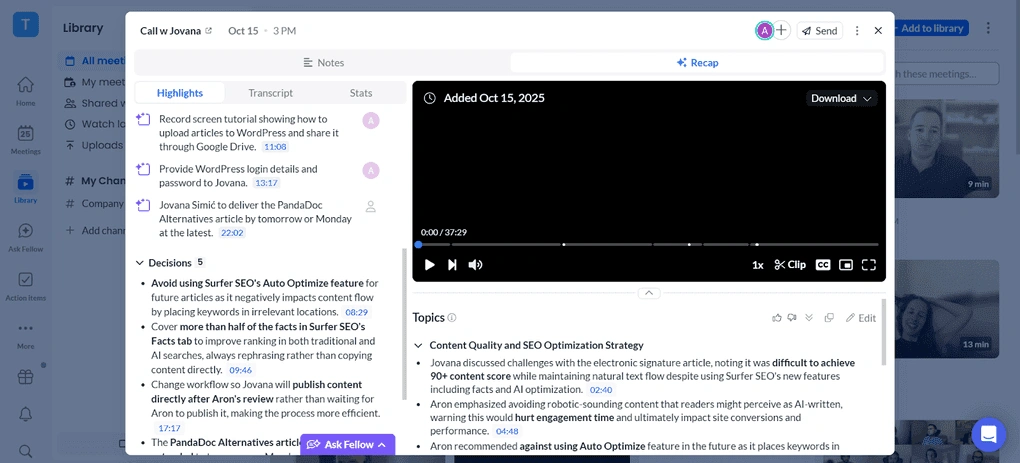
Fellow automatically records calls, which you can access through your transcription and meeting notes. I found the recordings library valuable, especially for teams or larger organizations. You can organize your previous meetings into custom channels and auto-publish your recordings to the right ones.
Furthermore, you can create new channels for yourself or even your whole company. Essentially, this library helps you structure your meeting recaps and offers an excellent way to organize your meeting history, and a way to share recaps with people who did not attend those meetings but want access to that information.
For example, the CEO can be a part of the Sales calls channel or the Project Check-In channel even if they didn’t attend those meetings, and then use “Ask Fellow” to ask for insights and updates from those conversations.
Use this link to sign up and get 10% off the paid plans if you upgrade.
AI meeting notes
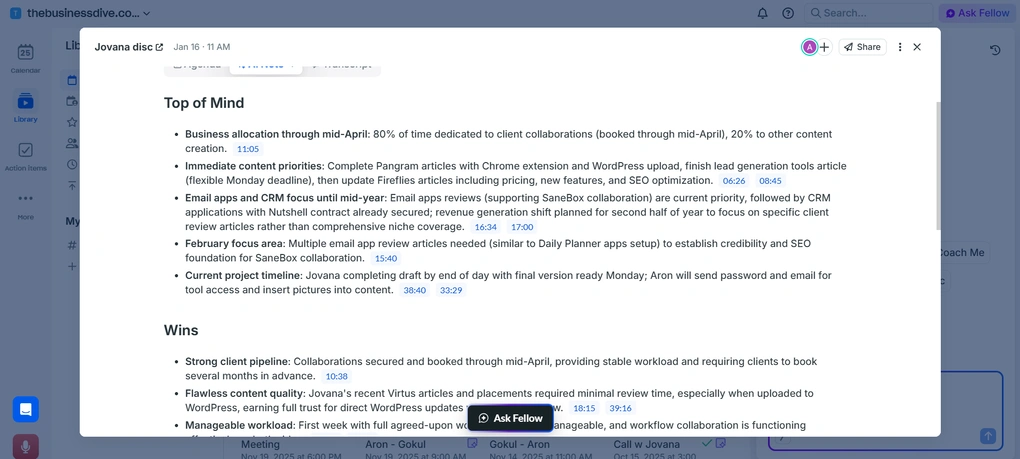
Fellow’s AI summaries provide you with the key insights, action items, and decisions from the meeting. Essentially, the AI summaries just save a ton of time, as you no longer need to go through the entire transcription.
I also love that you can assign the action items to your team members with Fellow, so it is clear after each meeting who is responsible for what. You can choose from numerous pre-built templates, and Fellow will organize the AI summaries accordingly. Moreover, you can create custom meeting templates.
Ultimately, my overall experience with Fellow’s AI meeting notes was great. After my virtual meetings, it automatically generated meeting notes linked to your meeting transcriptions and recordings.
Meeting agendas
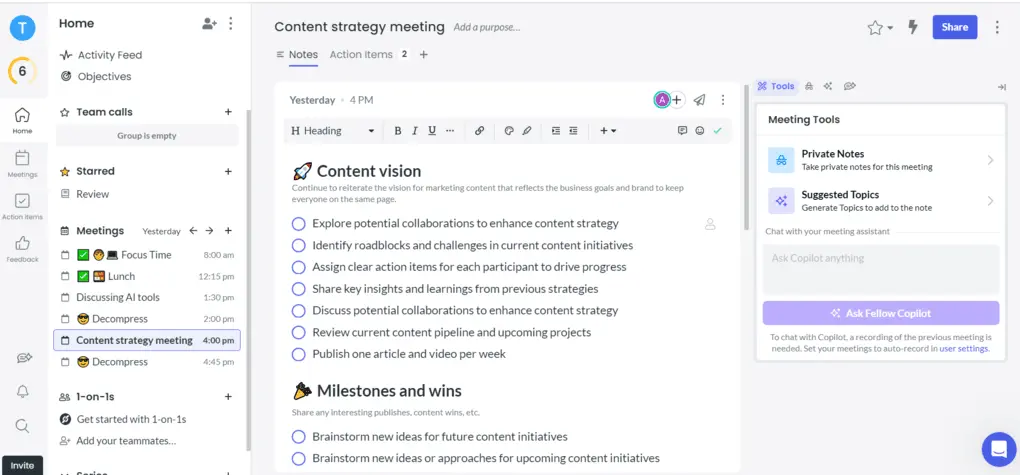
The meeting agenda is a helpful pre-meeting tool for establishing clear talking points and action items to address during the call.
I found it pretty fascinating that Fellow implemented AI not only in the meeting and post-meeting phase but also in the pre-meeting stage, which is a big differentiator from other AI meeting notetakers. You can ask AI for topic suggestions or chat about specific parts of your meeting agenda.
The pre-meeting AI briefs provide information on everyone in the meeting as well as a recap of the last meeting. This was extremely valuable for my back-to-back meetings when I didn’t have time to prepare properly.
Whoever from your team will attend the meeting can also add their thoughts and assign the talking points and action items to others. You can also create a private note that you can see during the meeting.
Clips
Clips are a helpful way to capture and highlight key moments and share them with your team members. When you click on the recording, you will access the full recording, summary, and transcription of the virtual meeting.
Here, you will also see the option to clip a snippet of the call. After selecting the start and end time, you just need to save the clip, and voila, you can save it in the recording library or share it with teammates.
You can even use the “Ask Fellow” chat to ask it to create a clip for you. For example, you can prompt it to “create a clip of when the customer said X” and Fellow will generate the clip automatically!
Ask Fellow
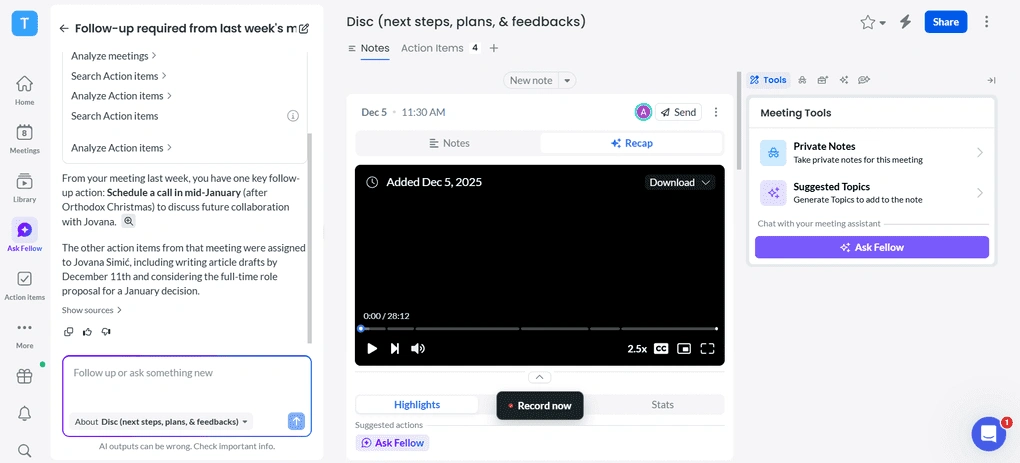
Ask Fellow utilizes your meetings and channels across your organization that you have access to (even if you didn’t attend) to provide up-to-date and comprehensive responses. So, it is more than just an AI chat, as it collects all the critical information from your organization to answer questions. However, you can use it in individual meetings as well.
I found it pretty efficient for getting meeting information and answers to meeting-related questions. You can ask Fellow any questions regarding your meetings, for example, “What did we decide on X topic?” or “What should I follow up on from yesterday?”, and even get insights from meetings you did not or could not attend, if you are a part of the recording channel where that meeting is stored.
Here’s a fuller bullet point list of what Ask Fellow can do for you:
Before the meeting
- Coach you for an upcoming call so you show up prepared
- Recap your top priorities so you know what to focus on
During the meeting
- Offer real-time assistance as the conversation unfolds
After the meeting
- Surface the key themes automatically with Deep Dive Shortcuts — no skimming long summaries
- Draft a complete follow-up email in one click (recipients, subject line, body) ready to send directly from Gmail
- Create and edit documents within the widget and export them to Google Docs, Notion, or Confluence without switching apps
- Generate video clips of key moments with a transcript preview before anything goes out
- Schedule, move, or decline meetings through plain language conversation — no need to open your calendar
Across every conversation
- Remember your preferences and working style so you never have to repeat yourself — tell it you prefer afternoon meetings and it factors that in automatically
- Answer questions about meetings you didn’t attend, surface decisions, and pull follow-up items across your organization’s meeting history
The big idea: Ask Fellow isn’t just a chat tool anymore — it’s an agentic chief of staff that takes you from conversation to action across your entire meeting lifecycle.
Team collaboration features
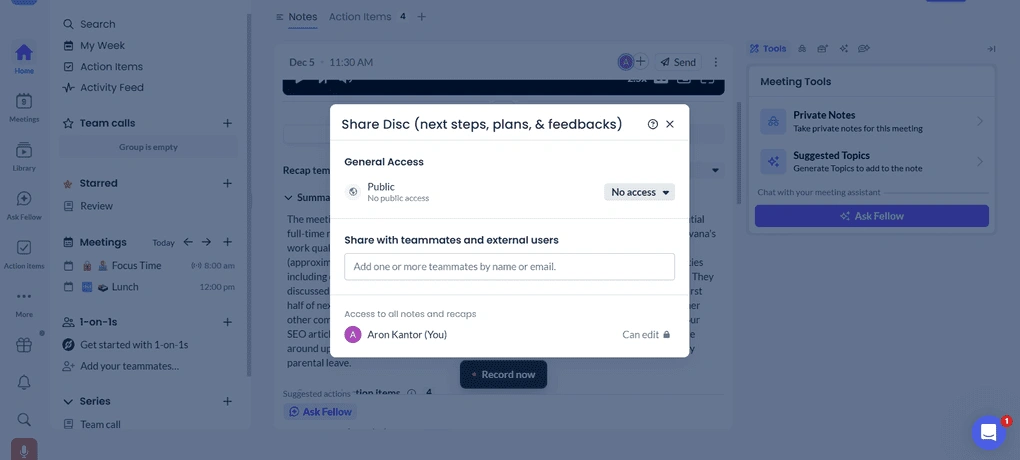
What makes Fellow special is that it was designed for the whole organization’s use cases. Whether it’s sales calls, interviews, or one-on-ones, you can implement Fellow in every team. It offers an excellent way to handle both external and internal calls and provides incredibly helpful collaboration features.
It supports collaborative agenda creation, you can assign action items, and easily share the meeting notes with others. Fellow is built with collaboration in mind, which means that even when you’re using their botless recording functionality, internal attendees in your organization will know that they are being recorded.
Similarly, Fellow will always prompt you to invite attendees to the meeting agenda and AI notes if you are recording an impromptu huddle or meeting, always keeping collaboration and alignment in mind.
🔎 Read my full Fellow Review: My Thoughs After +12 Months (2026)
Short on time? Here’s a quick overview of Fellow
Use this link to sign up and get 10% off the paid plans if you upgrade.
Fathom’s features
Now, it’s time to delve into Fathom’s features!
Meeting transcripts
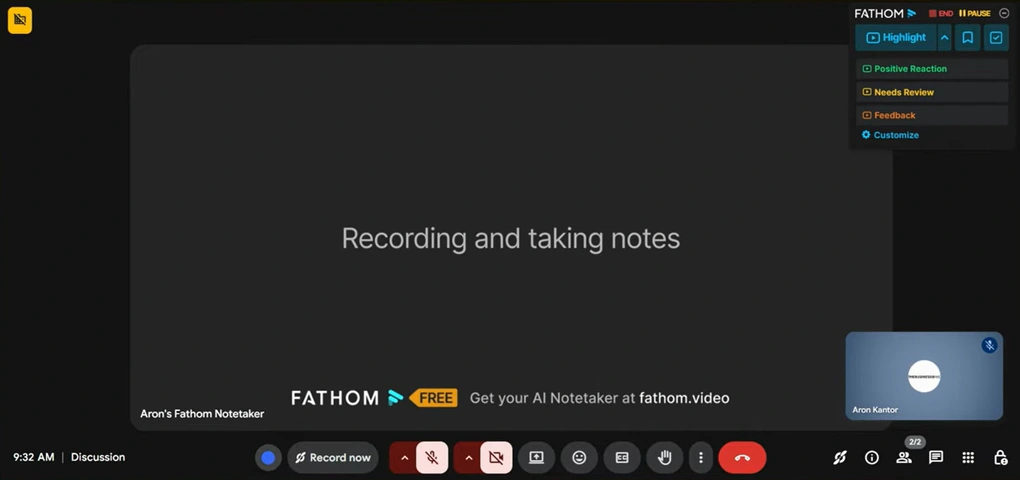
When you join online meetings on Microsoft Teams, Zoom, and Google Meet, you can let Fathom’s bot into the call, and it will automatically transcribe the meetings. But do not worry, you can customize this.
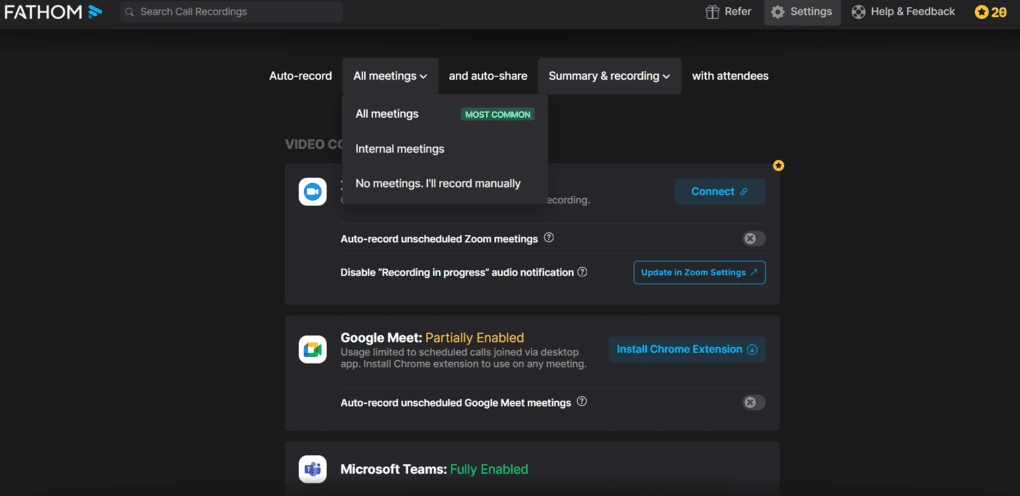
Just go to the settings menu, where you can decide if you want Fathom to auto-join and record all your internal or external meetings. It is also great that you can edit the name of your bot.
Based on my experience, the transcription accuracy is between 85% and 90%. While this also depends on the audio quality and your accent, I reached this accuracy with the built-in microphone of my PC.
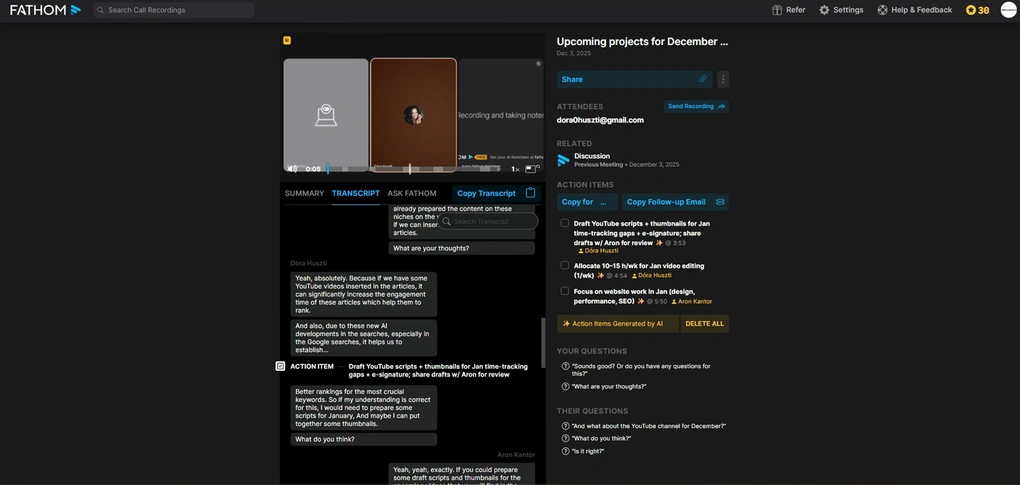
Once the call is over, Fathom will send you the transcription. I love how Fathom designed its transcription feature. Just like in Fellow, if you click on one part of the transcription, it will quickly jump into the recording to that point in the online meeting. Furthermore, it is super easy to trim and edit the transcript if Fathom is not accurate for some reason.
I recommend downloading Google extensions to join Google Meet calls more easily. Also, if you have Zoom calls, connecting Fathom with your Zoom account makes sense before the meeting. However, if you are looking for bot-free recording, you are not going to find it, as Fathom requires a bot to record and transcribe calls.
Overall, Fathom’s transcription feature is accurate and easy to use to save time with your online meetings and focus on what matters.
Recording
Fathom is an excellent tool for recording meetings. Based on your preferences, when you want Fathom to join your meetings, it will also auto-join. It offers a high-quality video recording you can easily share with your team members.
The video recording feature is quite useful for recruiting or customer success teams.
If you want to try out Fathom, use this link to get FREE 3 months of premium features without an extra cost. This way, you can have 3X more time to test Fathom’s advanced features and decide whether to upgrade or stay with the free plan.
AI summary
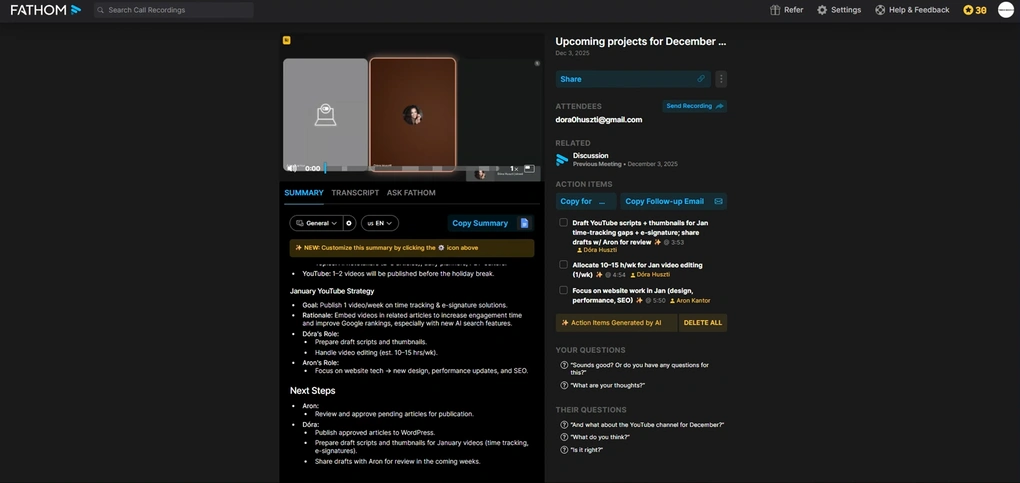
If you do not want to go through the whole transcription or watch the recording, you can quickly review what happened using the automated meeting summaries. Fathom takes notes during the calls and prepares a summary after the meeting is over.
The AI summary shows the key points that were discussed during the online meeting. During this Fathom review, I discovered that the AI summary is shorter and follows a different structure compared to other AI note-takers. But hey, if you like simplicity and short meeting notes, this one can be great for you.
Ask Fathom
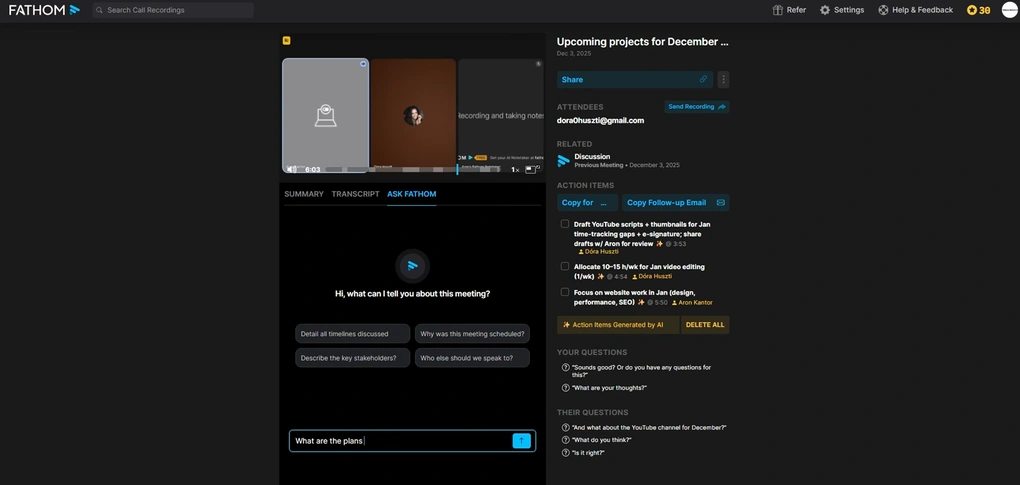
The Ask Fathom is Fathom’s AI assistant feature. Quite frankly, it works like ChatGPT or a personal assistant. With this feature, you can interact with your call recordings easily. For example, you can ask questions regarding a Zoom call or ask it to write a follow-up email.
Ultimately, it is a helpful feature that makes you more productive and saves time.
Clips
You can create short audio clips from different parts of the meeting to share with your team. This feature is awesome if you want to share the key moments from sales calls, for instance. If you integrate Fathom with Slack, the clips feature can work great, as you can easily drop the clip in a Slack message.
Meeting templates
If you subscribe to a team plan, you can access 14 templates designed for different types of online meetings, like customer success, stand-ups, or sales calls. Depending on the template you choose, Fathom will structure the AI summaries accordingly.
However, I would prefer that they implement the meeting templates in the Premium plan for people like me. You see, I have different types of meetings, and I do everything from client calls to collaboration requests without a team. So, the meeting templates would also be pretty helpful for me.
Overall, the meeting templates feature is awesome, but it would be great if I could also access it in the Premium plan.
Team collaboration features
Fathom offers some useful team features to improve collaboration when it comes to online meetings. You can organize your meeting notes and recordings into different folders that your team can access. Also, you can mention and add comments to the meeting notes.
If we look at the advanced team collaboration tools, you can access the coaching feature and the deal view with higher-tier paid plans. Both of them are great for improving your sales process.
🔎 Read my full review: My Honest Fathom Review After Using It For +3 Months (2026)
Short on time? Here’s a quick overview of Fathom
If you want to try out Fathom, use this link to get FREE 3 months of premium features without an extra cost. This way, you can have 3X more time to test Fathom’s advanced features and decide whether to upgrade or stay with the free plan.
Language support
In round 2 of the Fathom vs Fellow clash, let’s take a look at the language support of each AI note-taking app.
Fellow’s language support
Fellow currently supports transcripts in 92 languages, so it’s also a capable AI note-taker for multilingual teams.
Fathom’s language support
Fathom currently supports meeting transcriptions in 38 languages.
Explore our Apps directory
A curated directory of software tools we’ve independently reviewed, with links to full reviews, comparisons, and category guides.
Meeting platforms and integrations
Now, it’s time to compare their integration options!
Fellow’s supported meeting platforms and integrations
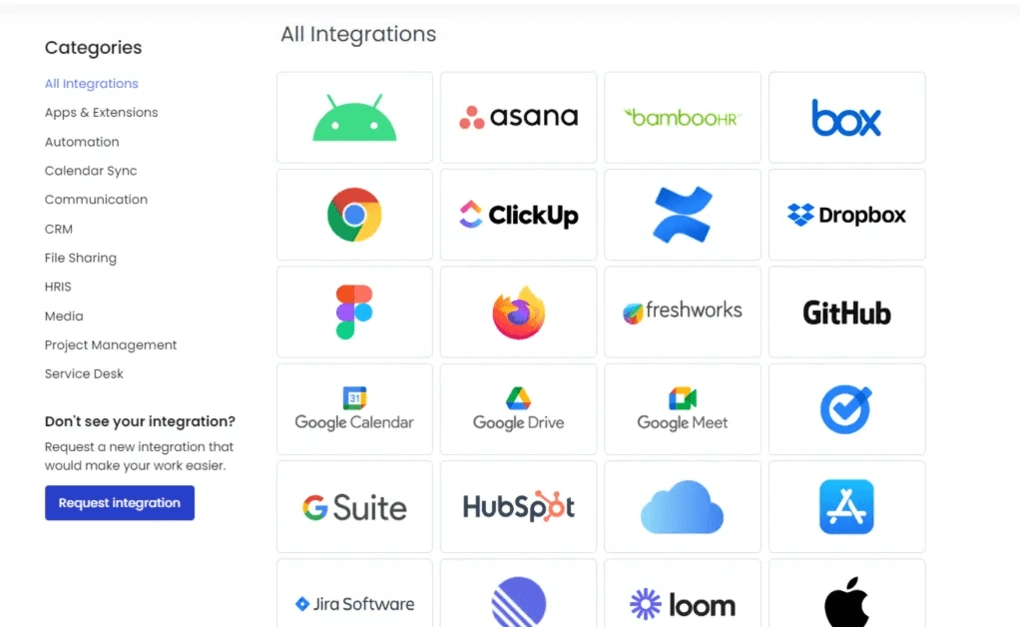
Fellow is known as the most integrated AI meeting notetaker (integrates with CRMs, Project Management tools, and AI automation tools). You can utilize Fellow for virtual meetings on Zoom, Microsoft Teams, Slack, and Google Meet.
Fellow also allows direct integration with over 50 third-party apps, including project management integrations like Asana, ClickUp, and Monday, or CRM integrations like Salesforce, HubSpot, and more. In addition, you can access 8,000 apps with its Zapier integration.
One key differentiator of Fellow is that it offers an MCP Server to connect your AI meeting notes to LLMs like Claude, ChatGPT, and AI apps like Cursor. Technical teams can also use Fellow’s API to build custom workflows.
Use this link to sign up and get 10% off the paid plans if you upgrade.
Fathom’s supported meeting platforms and integrations
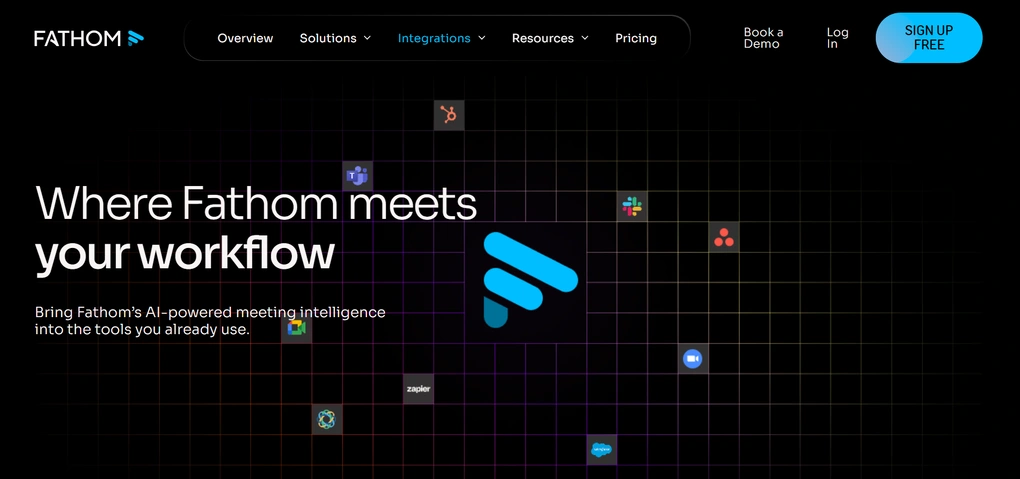
You can utilize Fathom for virtual meetings on the most popular video conferencing platforms (Zoom, Microsoft Teams, and Google Meet).
Thanks to the Zapier integration, Fathom integrates with over 8000 apps. Nevertheless, using the Premium, you only have limited access to Zapier integrations. Besides the Zapier integration, you can connect Fathom with Asana, Slack, HubSpot, Salesforce, Close, and more.
If you want to try out Fathom, use this link to get FREE 3 months of premium features without an extra cost. This way, you can have 3X more time to test Fathom’s advanced features and decide whether to upgrade or stay with the free plan.
Security controls
Security is a crucial aspect when deciding which AI note-taker to use. So, in this step of my Fathom vs Fellow comparison, I will break down both apps’ security controls.
Fellow’s security controls
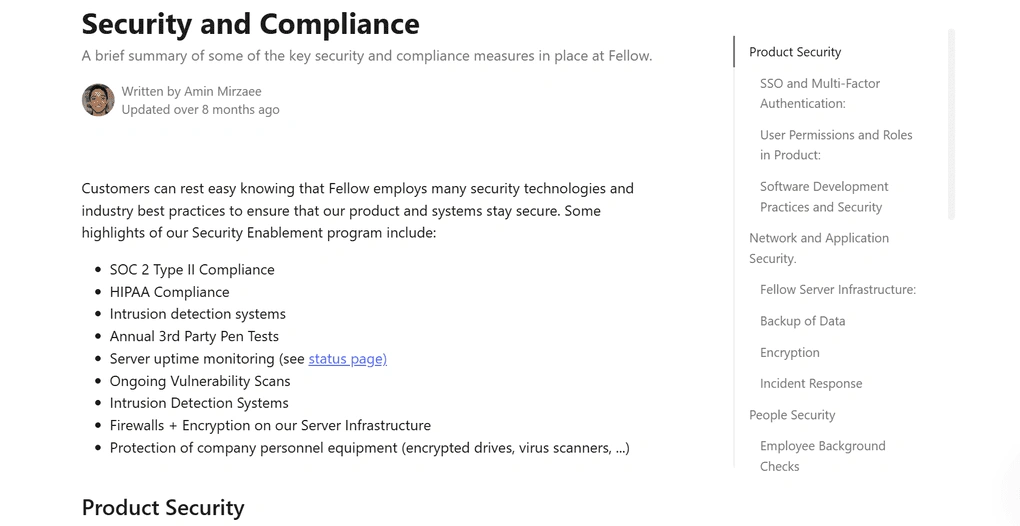
Fellow is an enterprise-ready AI-powered meeting assistant designed for enterprise teams. For businesses, and especially larger organizations and regulated industries, choosing an AI meeting assistant isn’t just about features – it’s about trust.
Fellow is recognized for its data privacy and security features, making it suitable for sensitive discussions. IT and security-conscious leaders appreciate the AI recording policies, transcript redaction feature, and thoughtful UX details, such as the ability to pause and resume the recording during the meeting.
It is SOC 2 Type II certified and GDPR compliant, meaning an independent auditor has verified its data security practices. Fellow also offers HIPAA compliance, signing BAAs for customers in healthcare.
Overall, I found Fellow to be one of the safest AI meeting assistants and did not see any red flags regarding its data privacy.
Use this link to sign up and get 10% off the paid plans if you upgrade.
Fathom’s security controls
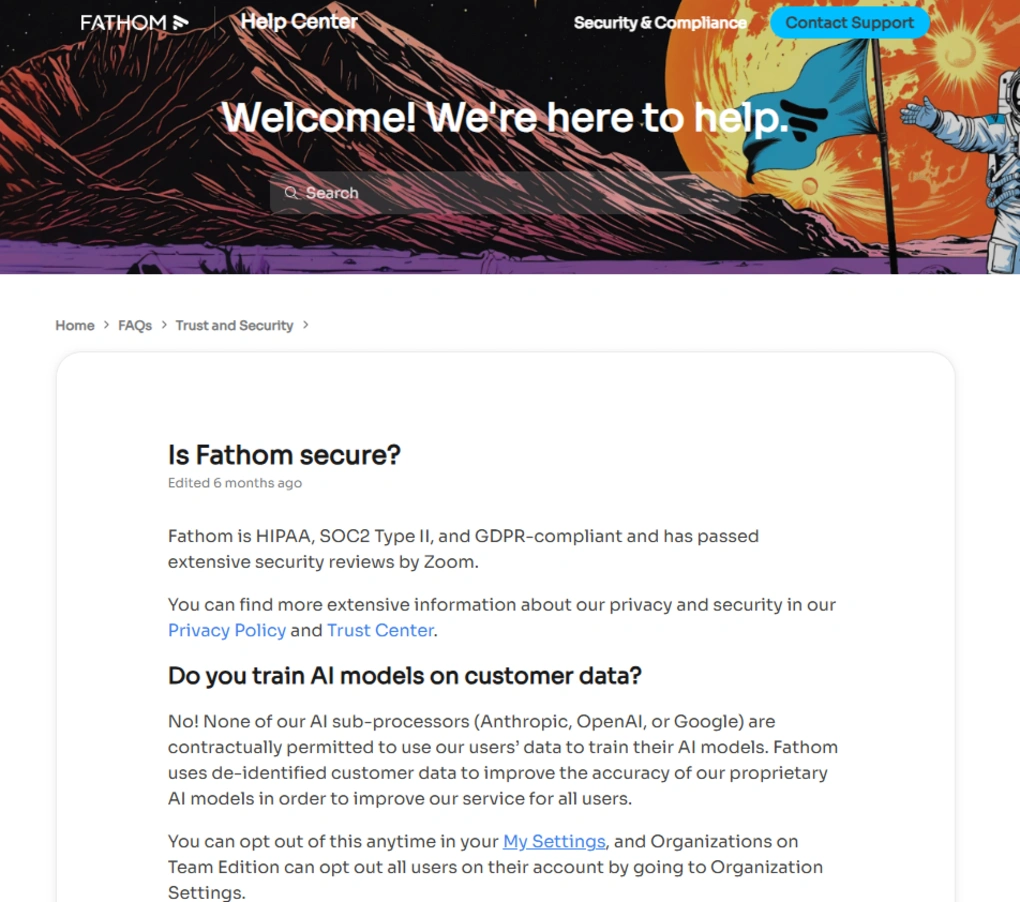
Fathom is HIPAA, SOC2 Type II, and GDPR-compliant, and does not train AI models on customer data. While browsing the internet to check for possible privacy red flags or negative reports about safety, I did not find anything relevant.
Furthermore, I did not experience any safety issues in the past few years while testing this AI-powered meeting assistant for my own meetings.
If you want to try out Fathom, use this link to get FREE 3 months of premium features without an extra cost. This way, you can have 3X more time to test Fathom’s advanced features and decide whether to upgrade or stay with the free plan.
Pricing
In round 4 of the Fathom vs Fellow comparison, let’s take a look at the pricing structure of each AI note-taking app.
Fellow’s pricing
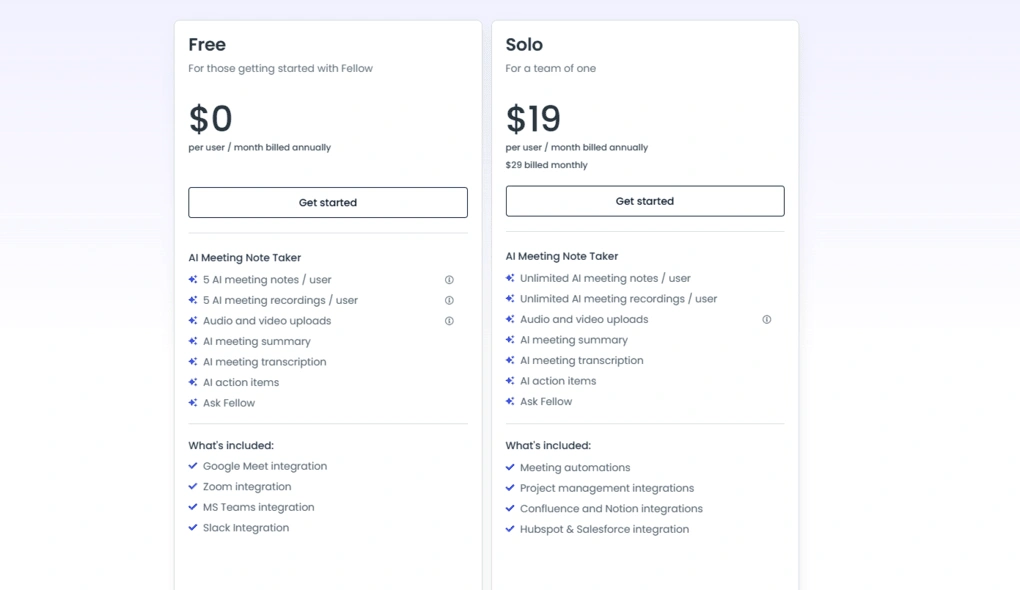
Fellow offers four plans. The Free plan includes access to AI recording, recaps, and transcriptions. Additionally, it provides access to features such as collaborative meeting notes, meeting agendas, meeting timers, and integrations with Zoom, Slack, Microsoft Teams, and Google Meet. The Free plan is perfect for those who want to try Fellow before purchasing it.
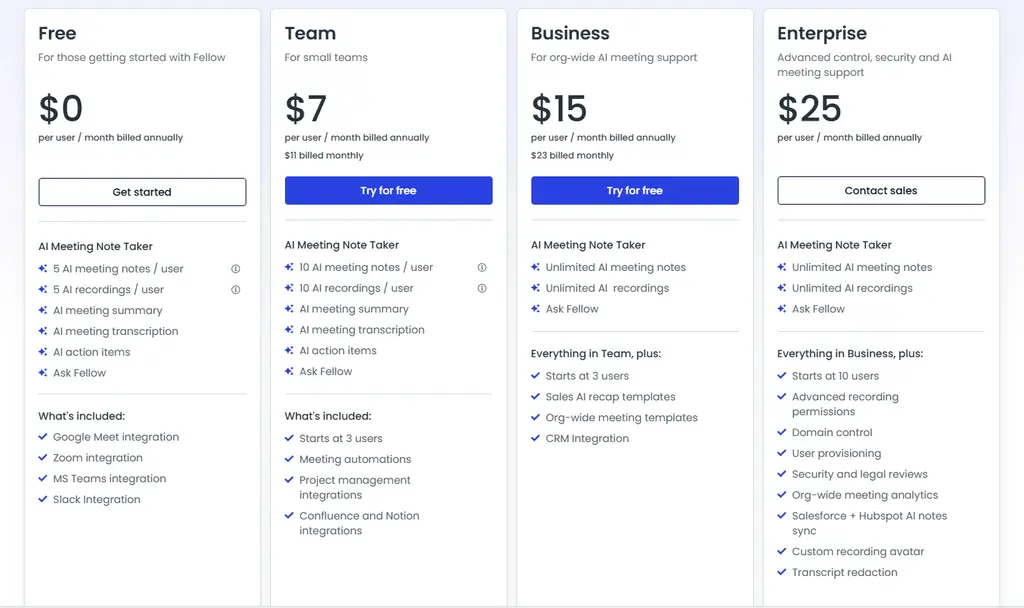
The Team plan was developed for small teams and starts with 3 users. It includes all the features in the Free plan with higher limits and offers meeting automation tools and additional integrations with Notion or project management tools.
The Business plan starts with 3 users and provides unlimited recordings, transcription minutes, organization-wide meeting templates, sales AI recap templates, and more integrations.
The Enterprise plan offers advanced control, security, and AI meeting support. With this plan, you can create customized rules for recording and have more recordings and transcription minutes.
Use this link to sign up and get 10% off the paid plans if you upgrade.
Fathom’s pricing
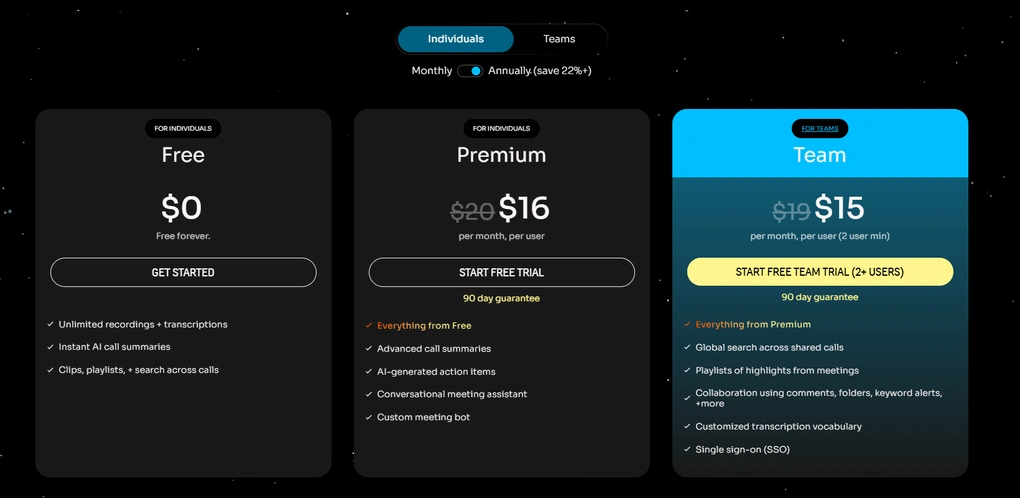
Fathom has a free plan and three paid subscription plans. The free plan includes unlimited recordings, storage, and transcriptions. The free plan offers some integrations, and you can use some basic features like clips. Compared with other apps, Fathom’s free option is outstanding thanks to the unlimited recordings, transcriptions, and storage capacity.
Ultimately, I recommend the free plan for those who do not want to use advanced features or unlimited Zapier integration.
The Premium plan is ideal for individuals who want to utilize more features. It has all the features in the free plan. However, you can use all the AI features with this plan.
The Team plan was designed for small teams. With this plan, you will access team collaboration features like folders, comments, mentions, and keyword alerts.
If you want powerful features like AI coaching and deal view, you have to pay for the Business plan. If you choose this plan, you will have unlimited integrations, advanced security controls, single sign-on integration, and custom data retention policies.
Overall, Fathom has a generous and outstanding free plan compared to other AI note-taking apps. The Premium Plan is also a good choice and offers much value for the money. The Team and Business plans have reasonable pricing and are ideal for small teams.
If you want to try out Fathom, use this link to get FREE 3 months of premium features without an extra cost. This way, you can have 3X more time to test Fathom’s advanced features and decide whether to upgrade or stay with the free plan.
User interface
Fellow’s user interface
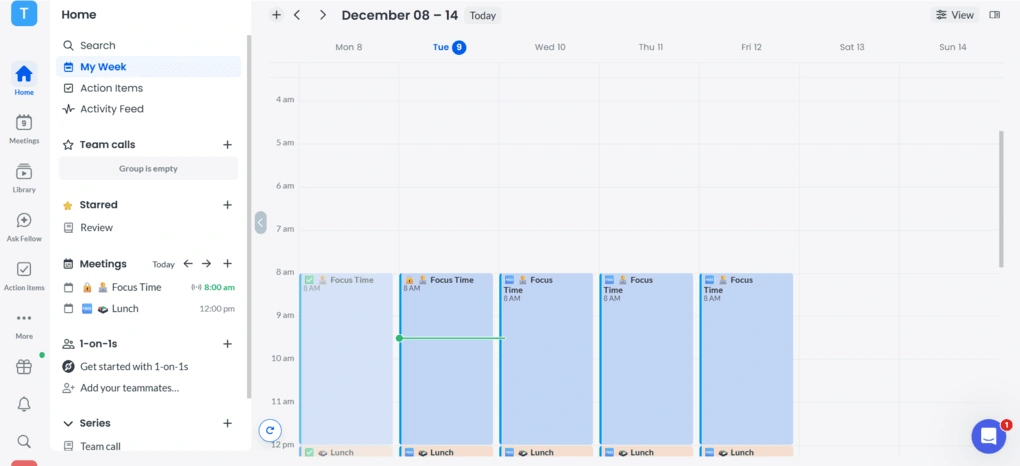
Fellow has a simple and clean user interface. It’s particularly great that you can access many features from the homepage with just a few clicks.
With the launch of Fellow 5.0, the interface has become even more user-friendly and noticeably more convenient to use.
I used this tool’s desktop version, which you can easily download from Fellow’s website. The desktop app helps you make the meeting experience smooth from beginning to end.
Use this link to sign up and get 10% off the paid plans if you upgrade.
Fathom’s user interface
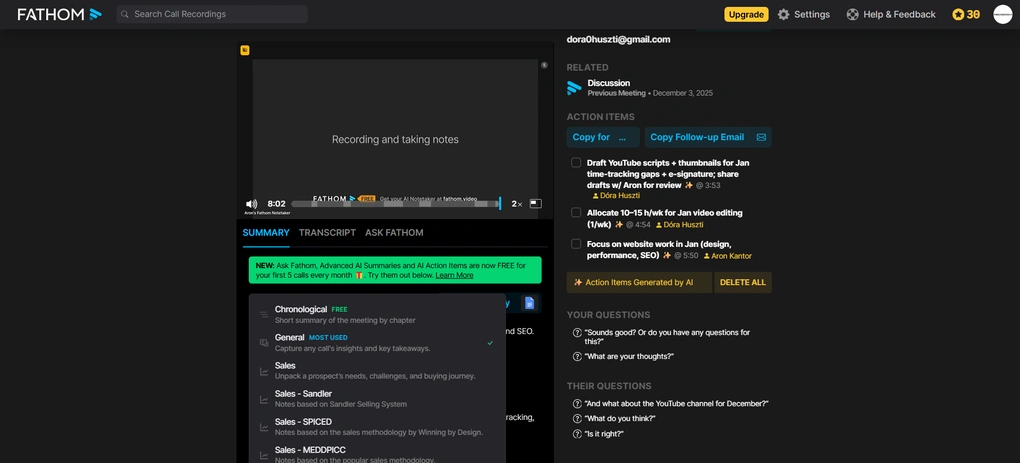
The first word that comes to my mind when I look at Fathom’s user interface is simplicity. Everything is in one place, and you can access all the features with one click.
On the homepage, you can find your previous recordings. If you click on one of your meetings, you will instantly see the meeting transcription, recording, and meeting notes.
Overall, Fathom has an intuitive and simple user interface with a short learning curve.
If you want to try out Fathom, use this link to get FREE 3 months of premium features without an extra cost. This way, you can have 3X more time to test Fathom’s advanced features and decide whether to upgrade or stay with the free plan.
My experience with Fellow
After testing numerous AI note-takers, I found Fellow the most accurate and safest one. It is full of productivity and AI tools to supercharge productivity and save time with your online calls.
Based on my experience, Fellow transcribes my online meetings with 95%+ accuracy. After my video calls, the AI prepares meeting summaries and transcriptions within minutes, so I can quickly review how it went.
One of the most underrated features of Fellow is the meeting agendas. Using this feature, you can collect all the points you want to discuss in the next meeting, and you will see them next to the meeting participants during your calls.
For the meeting agendas, the AI-powered pre-meeting briefs are super valuable for summarizing previous discussions and action items, ensuring that you are fully aware of the context before the meeting.
While Fellow just recently implemented its bot-free AI note-taker feature, it works reliably in the background. It captures conversations effortlessly and securely, whether you’re online, in person, or somewhere in between.
Use this link to sign up and get 10% off the paid plans if you upgrade.
My experience with Fathom
Fathom offers an easy-to-use and simple AI-powered meeting assistance for your online calls. Its AI transcription is accurate and never had issues joining the calls.
While its simplicity is one of Fathom’s main strengths, it can also be a weakness for some of you. It’s because it doesn’t offer the feature-rich AI-powered meeting assistance that Fellow does.
That said, if you prefer to have a more robust and powerful AI meeting assistant, Fathom might not be the best choice for you. This is why I mostly recommend it for individuals and small teams that need a simple solution to transcribe and summarize meetings.
Ultimately, Fathom offers a smooth and straightforward solution for AI meeting notes and transcription. While it’s one of my favorite AI meeting assistants, it has limitations and is probably not suitable for professionals and teams that need a powerful solution for online meetings.
You can read my full experience here: My Honest Fathom Review After Using It For +3 Months (2026)
If you want to try out Fathom, use this link to get FREE 3 months of premium features without an extra cost. This way, you can have 3X more time to test Fathom’s advanced features and decide whether to upgrade or stay with the free plan.
Fellow’s pros and cons
Let’s continue with Fellow’s pros and cons!
Pros of Fellow
Cons of Fellow
Use this link to sign up and get 10% off the paid plans if you upgrade.
Fathom’s pros and cons
Now, I will reveal the pros and cons of Fathom that I discovered.
Pros of Fathom
Cons of Fathom
If you want to try out Fathom, use this link to get FREE 3 months of premium features without an extra cost. This way, you can have 3X more time to test Fathom’s advanced features and decide whether to upgrade or stay with the free plan.
Alternatives to Fathom and Fellow
If you are not sure if Fathom and Fellow are the best choice for you, here are some:
|
App |
Best for |
Description |
|---|---|---|
|
Fireflies AI |
Best budget-friendly option |
A popular and budget-friendly AI meeting assistant for individuals and teams. |
|
Notta |
Best for multi-language transcription |
A unique AI note-taker that allows multi-language transcription, enabling people to speak two different languages during online meetings. |
|
MeetGeek |
Best for multi-language transcription |
A versatile AI note-taking app with the best AI meeting summaries. |
|
tl;dv |
Best simple AI note-taker |
A simple option for individuals with a feature-rich free plan. |
|
Radiant |
Best free AI note-taker for Mac |
It is a 100% free AI bot-less note-taker for Mac users for in-person and online meetings. |
|
Otter AI |
A popular AI note-taker |
One of the most popular AI note-takers for Google Meet, Zoom, and Microsoft Teams. |
|
Granola |
Best for users need a simple bot-less AI note-taker |
Granola is a lightweight AI note-taking app that transcribes and summarizes meetings without bots, with a generous free tier, but it’s basic and lacks advanced features. |
|
Krisp |
Best bot-less AI note-taker supporting high audio quality |
Krisp is a Voice AI platform for clearer communication and more productive meetings, combining real-time audio enhancements with AI note-taking. |
|
Bluedot |
An easy-to-use bot-less AI note-taker |
Bluedot is a straightforward and easy-to-use bot-free AI note-taker. |
|
Zoom AI Companion |
Best for Zoom users needing built-in AI note-taking |
A solid built-in AI assistant for Zoom that offers meeting summaries, basic transcription, and action items, but lacks advanced features. Full Zoom AI Companion review | Quick Zoom AI Companion overview |
My pick: Fathom vs Fellow
Fathom and Fellow are two top AI meeting assistants built for different purposes and use cases. During my Fellow vs Fathom review, I realized that Fellow is a more robust AI meeting assistant offering many features, collaboration tools, native integrations, and more. It’s ideal for teams of any size and professionals.
On the other hand, Fathom provides a simple solution to transcribe and summarize meetings. It has a more generous free plan than Fellow, and is ideal for individuals and small teams looking for a straightforward AI meeting assistant for calls.
Considering all these points, my personal pick is Fellow. I have been using it for more than 6 months now, and it is the one that perfectly fits my meeting workflows. Its features, like shared agendas, accurate transcriptions, and bot-less recording, make it a complete and centralized platform for my online meetings.
Related article:
- Fireflies AI vs Otter AI: A Side-by-Side Comparison In 2026
- Best 5 Otter AI Alternatives | 20+ Personally Tested Apps (2026)
- Otter AI vs Fellow: My pick after +2 years testing (2026)
- 6 Best Meeting Recording Apps 2026 | 2+ Years Testing
- Best 9 AI Note-Takers | My Top Picks After +2 Years Testing (2026)
I hope I was able to help you find out whether Fellow or Fathom suits you the best. As always, I will keep updating this Fathom vs Fellow article to ensure it reflects the reality.
Looking for similar tools?
Visit our AI note-takers library to explore other apps we’ve reviewed in this space and how they compare.
Why you can trust our reviews
At thebusinessdive.com, our team tests, reviews, and compares hundreds of productivity apps every year — from project management tools to note-taking apps. We dive deep into real-world use cases to help you find the right tools that actually improve your workflow, not just add noise.
Our mission? No fluff, no shortcuts—just honest, hands-on insights from productivity pros.
Discover how we stay transparent, read our review methodology, and let us know about any tools we missed.
Frequently asked questions
What is Fathom for meetings?
Yes, Fathom transcribes and summarizes meetings on Zoom, Microsoft Teams, and Google Meet calls. It has high transcription accuracy and ultimately offers a simple solution to automate your online meeting notes.
How much does Fellow AI cost?
Fellow’s Solo plan is $19 per user per month, billed annually, including all the key features you need to run your meetings like a pro. Its Team plan is $7 per user per month with annual billing and includes 10 meeting notes, recordings, Ask Fellow, AI action items, and more.
If you need organization-wide AI meeting assistance with advanced features, the Business plan could be ideal. It costs $15 per user, monthly billed annually.
For enterprise teams, Fellow offers its Enterprise Plan for $25 per user per month, billed annually. It starts at 10 users and covers domain control, advanced recording permissions, user provisioning, transcript redaction, and more.
Is Fellow AI safe?
Fellow is one of the best AI note-takers when it comes to data privacy and security features. It offers AI recording policies, a transcript redaction feature, and thoughtful UX details like being able to pause and resume the recording during the meeting.
It is SOC 2 Type II certified and GDPR compliant, meaning an independent auditor has verified its data security practices. Fellow also offers HIPAA compliance, signing BAAs for customers in healthcare.
Disclosure: I only recommend products I would use myself, and all opinions expressed here are our own. This post may contain affiliate links that, at no additional cost to you, may earn a small commission. Read the full privacy policy here.

Hey! I’m Jovana, a content writer who loves writing, researching, and testing new productivity apps. With a background in philosophy, I bring a thoughtful but no-bullshit approach to everything I do. Let’s connect on Linkedin!