


Monday.com Review 2026: Is the $228 Price Tag Justified?
During my Monday.com review, after testing it against 20+ alternatives, I asked myself: Is its $228 yearly price tag justified for the Pro plan?
My key takeaway after using Monday.com in my own business is that it makes organizing projects remarkably easy, but its more advanced features don’t always justify the additional cost.
Verdict: Excels at Simplicity, but Is It Worth the Price?
🎯 Best for: Teams that want a simple, visual, easy-to-use project management tool
🚫 Not ideal for: Power users needing deep customization or budget-friendly pricing
⭐ Biggest strength: Best-in-class UI and dashboards
⚠️ Biggest weakness: Expensive for its feature depth, especially for smaller teams
⚖️ Verdict: Monday.com is one of the most user-friendly project management tools on the market, but its pricing makes it harder to justify for some teams.
🏆 Score: 4.2 / 5
✅ Tested with our review & scoring methodology ✅ Real-world testing ✅ Unbiased evaluation
Monday.com
Summary
After testing Monday.com alongside 20+ project management tools, I was impressed by its intuitive interface, smooth performance, and customizable dashboards. I could set up a project in just five minutes and rebuild my content workflow in 20–30 minutes. Nevertheless, its high pricing, limited advanced functionality, and mobile issues make it harder to recommend for complex projects or budget-conscious teams.
Intuitive interface and fast setup | |
Highly customizable dashboards | |
Wide selection of project views | |
Smooth performance | |
Easy-to-use task management | |
Useful AI Sidekick and Notetaker |
Expensive for its feature depth | |
Recurring tasks require automations | |
Mobile bugs and syncing issues | |
Limited advanced customization | |
Restrictive AI credits | |
Inflexible seat-based pricing |
How We Tested Monday.com
To keep our reviews & final score for each project management app fair and consistent, we evaluate every tool using the same testing framework based on real-world usage, feature depth, and overall value.
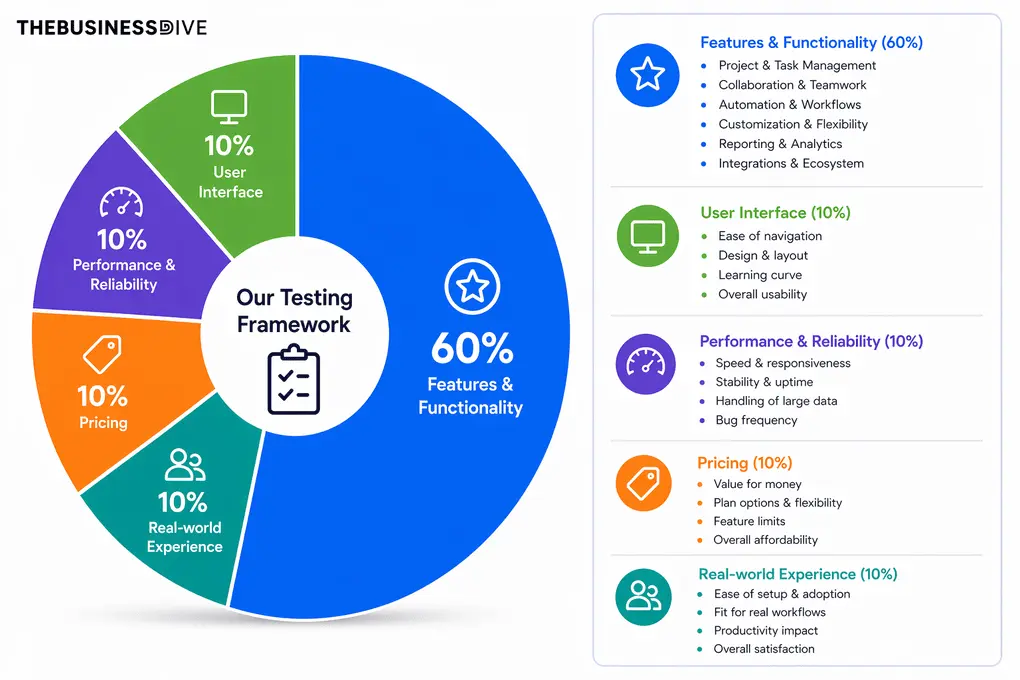
Our scoring breakdown for Monday.com after testing 20+ project management apps:
⚙️ Features & functionality — 60%
🖥️ User interface — 10%
⚡ Performance & Reliability —10%
💰 Pricing — 10%
👥 Real-world experience — 10%
Want a detailed breakdown of how we test each category?
Learn exactly how we test tools → Review methodology
What is Monday.com?
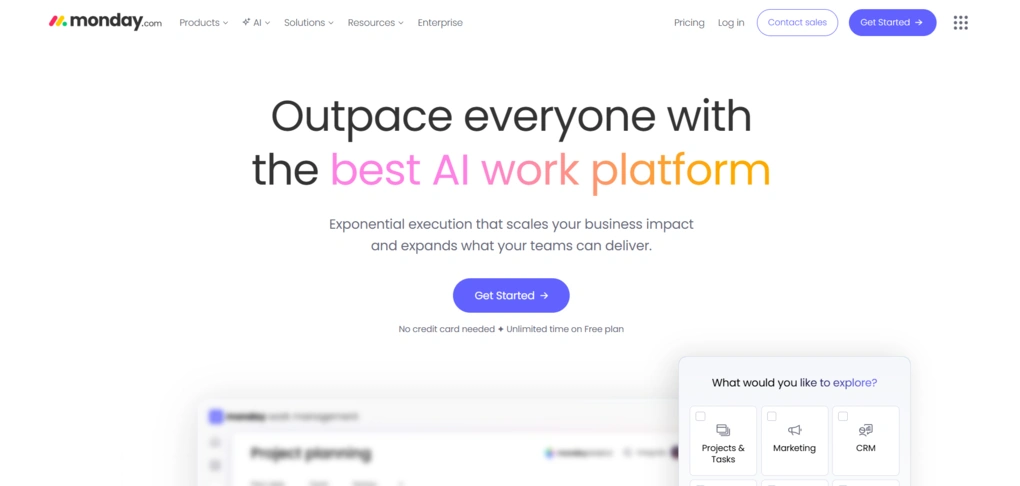
Monday.com is a visual project management platform that helps teams organize tasks, track projects, and automate repetitive work. Unlike traditional list-based task managers, Monday.com uses customizable boards where you can manage everything from task owners and deadlines to project statuses and priorities.
What makes Monday.com different is how easily you can turn the same project into different views, such as Kanban, timelines, calendars, or dashboards, without rebuilding your workflow. This makes it particularly useful for teams managing content production, marketing campaigns, or multiple projects simultaneously.
However, Monday.com focuses more on making project management accessible than on offering deep customization. Compared to tools like ClickUp or Jira, it’s easier to get started, but advanced workflows may require more compromise.
My Testing Experience at a Glance
Test breakdown | My Findings |
|---|---|
What I tested | Content planning, task management, project views, dashboards, automations, AI tools, and mobile functionality. |
Real-world use case | I rebuilt my content pipeline in 20–30 minutes, using Kanban boards to organize upcoming articles and videos. |
Project setup | Creating a project from scratch took around 5 minutes, making onboarding significantly easier than with more complex alternatives. |
Most useful features | Kanban views and customizable dashboards |
Features I rarely needed | Gantt charts and workload views were less useful for my solo content workflow but could benefit larger teams. |
Unexpected limitations | Recurring tasks require automations, subitem checkboxes select tasks rather than mark them complete, the Basic plan’s AI credits can run out quickly with advanced features, and I occasionally experienced mobile syncing issues. |
Starting price | Free plan available; paid plans start at $9/user/month with annual billing and a three-seat minimum. |
My biggest takeaway | Monday.com makes organizing projects remarkably easy, but its more advanced features don’t always justify the additional cost. |
Is Monday.com worth it? | For marketing, PMO, and operations teams that value simplicity and visual workflows, it’s worth it based on my testing, but less so for freelancers and software teams that need advanced features at a lower cost. |
What using Monday.com felt like after testing 20+ alternatives
💡 Key takeaway: Monday.com stands out for its intuitive interface, customizable dashboards, and smooth performance, but its pricing, limited advanced features, and mobile issues hold it back.
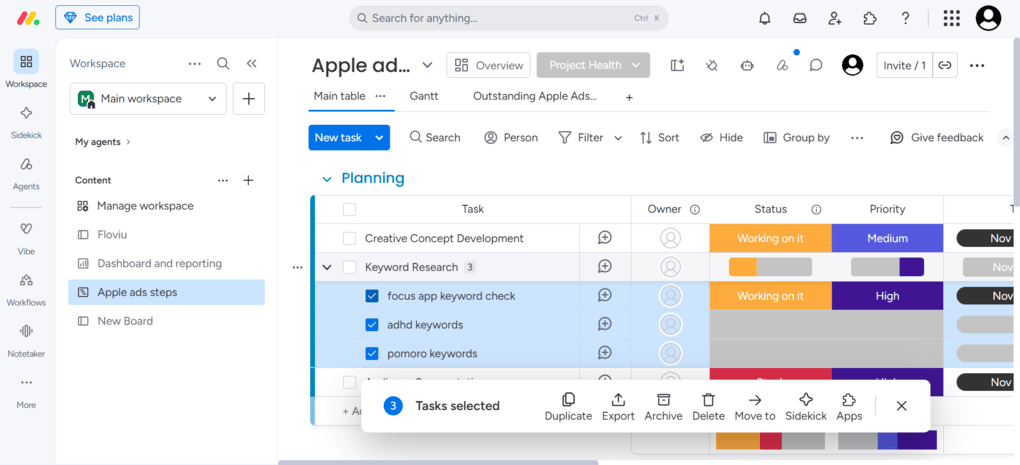
Compared to more robust project management apps like Jira or ClickUp, Monday has a significantly faster learning curve. Monday.com’s task management tools are easy to use, and you can customize the columns and parameters easily.
Another thing that impressed me was its performance. Unlike my experience with ClickUp, Monday.com ran smoothly during testing, even when working with larger projects. I didn’t experience noticeable lag when switching between boards or project views.
The customizable dashboards were another highlight. I could move and resize widgets, rename them, and arrange project information exactly how I wanted. This made it easier to track project progress and see important information without jumping between multiple boards.
On the negative side, I ran into a few bugs while testing the mobile app, and there were also some missing features I genuinely expected to find in a project management tool at Monday.com’s price point, such as recurring tasks.
With this result, Monday earned a spot on our Notion alternatives, Jira alternatives, and best project management software comparison.
🟢 Try Monday.com if: You want an intuitive, visual project management tool with customizable dashboards, smooth performance, and minimal setup.
🔴 Skip Monday.com if: You need advanced project management features at a lower price or rely heavily on mobile functionality.
Where Monday.com impressed me (and where it didn’t)
After testing real workflows in Monday.com, these were the biggest strengths and frustrations I noticed.
Where It Excels
Where It Falls Short
Monday.com vs. Alternatives: What Do You Sacrifice?
This is how Monday.com compares to the most popular project management software.
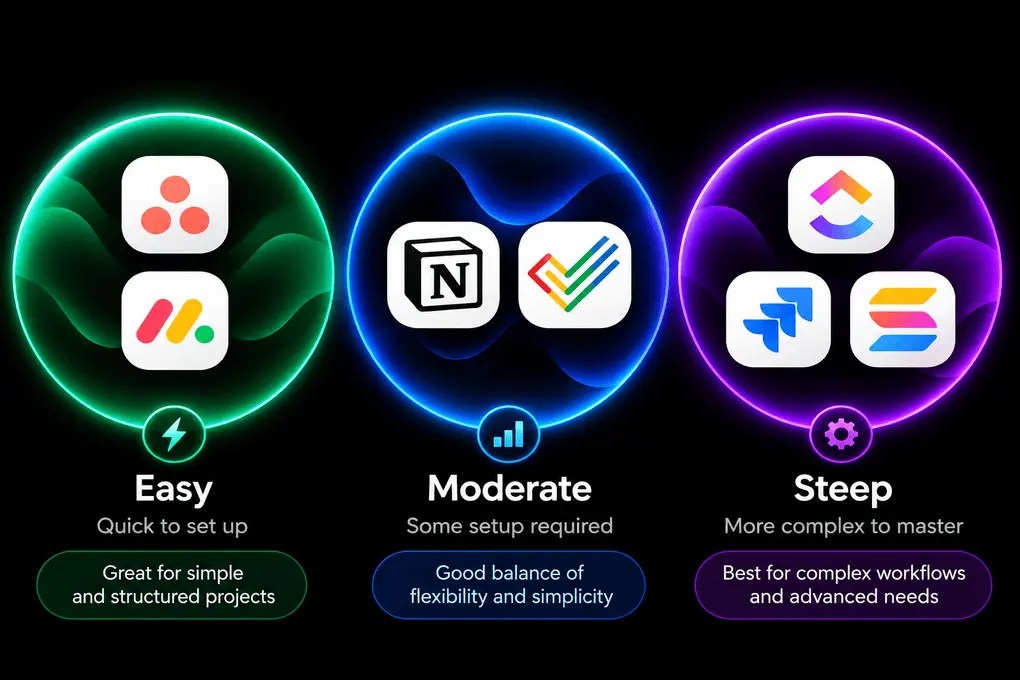
Monday.com is one of the easiest project management tools to set up, alongside Asana. But how does it compare to other popular options?
Here’s a breakdown of what you gain and sacrifice by choosing Monday.com.
App | Main advantage over Monday.com | Main trade-off compared to Monday.com | Best suited to |
|---|---|---|---|
More structured task management | Less emphasis on customizable visual dashboards | Structured team projects | |
More flexible documentation and knowledge management | More manual setup for project management | Notes, docs & simple projects | |
Stronger reporting, built-in time tracking, and lower pricing | Less visual flexibility and a more traditional interface | Structured planning & reporting | |
Deeper customization and database functionality | Steeper learning curve | Custom workflows & databases | |
More advanced features and workflow flexibility | More complexity and slower performance in my testing | Complex, all-in-one workflows | |
Stronger technical and agile project management | Significantly steeper learning curve | Software & agile teams |
Before You Pay for Monday, Consider These 3 Things
Plan | Price | Best for | Key features |
|---|---|---|---|
Free | $0 | Individuals and basic task management | Up to 2 users, 3 boards, 200+ templates |
Basic | $9/seat/month billed annually | Small teams managing simple projects | Unlimited items, 5 GB storage, dashboard based on 1 board, 1,000 AI credits/month |
Standard | $12/seat/month billed annually | Teams needing more views and automations | Gantt and calendar views, 250 automation actions/month, dashboards across 5 boards, 2,000 AI credits/month |
Pro | $19/seat/month billed annually | Growing teams with advanced workflows | Time tracking, private boards, formula columns, 25,000 automation actions/month, 3,000 AI credits/month |
Enterprise | Custom pricing | Large organizations with complex requirements | Advanced reporting, enterprise security, permissions, up to 250,000 automation actions/month |
While Monday.com’s pricing looks straightforward at first, there are a few important details that can significantly affect how much you actually pay and what you get for your money.
Here are three things I would consider before choosing a paid plan:
- AI credits can run out quickly: The Basic plan includes 1,000 monthly AI credits, Standard offers 2,000, and Pro provides 3,000. Advanced features consume credits quickly. For example, Pro’s entire allowance covers just 25 hours of AI meeting transcription or roughly 20–37 complex Sidekick requests.
- You might pay for seats you don’t use: Monday.com sells paid seats in fixed tiers (3, 5, 10, 15, etc.). This means a team of 6 pays for 10 seats, while a team of 11 pays for 15.
- You can’t mix pricing plans within the same product: All paid members of your Monday.com workspace must use the same plan for that product. For example, you can’t have some members on Standard and others on Pro, even if only a few need the advanced features.
⚖️ My take: Monday.com’s paid plans can be worth it for teams with straightforward workflows that need fast setup, an intuitive interface, and visual project tracking. I think it’s a particularly good fit for PMO, marketing, and operations teams, but harder to justify for software development teams and freelancers who need more advanced features or better value for money. Also, keep in mind that limited AI credits, fixed seat tiers, and the inability to mix plans can push the actual cost higher than expected.
The features that mattered during testing
These were the parts of Monday.com I relied on most while testing it.
Monday.com’s Home Page Is Simple, but I Missed the Customization
💡 Key takeaway: Monday.com’s home page offers quick access to projects, but task management happens in My Work, and home page customization is more limited than in ClickUp or Asana.
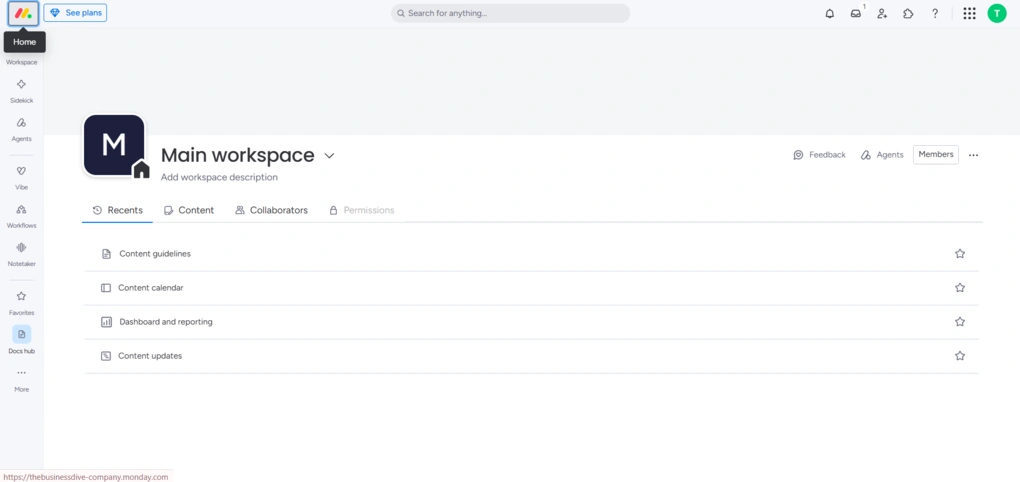
Whenever I test project management tools, I always love to take a look at the home page, as it can provide a quick overview of your projects and tasks. So, a good home page or dashboard can save time and give you the comfort of knowing what you need to deal with today.
Monday.com’s home page is more like a workspace overview that shows your recent projects and gives you quick access to your content, collaborators, and permissions.
If you want to get a better overview of your tasks, you need to go to the My Work tab.
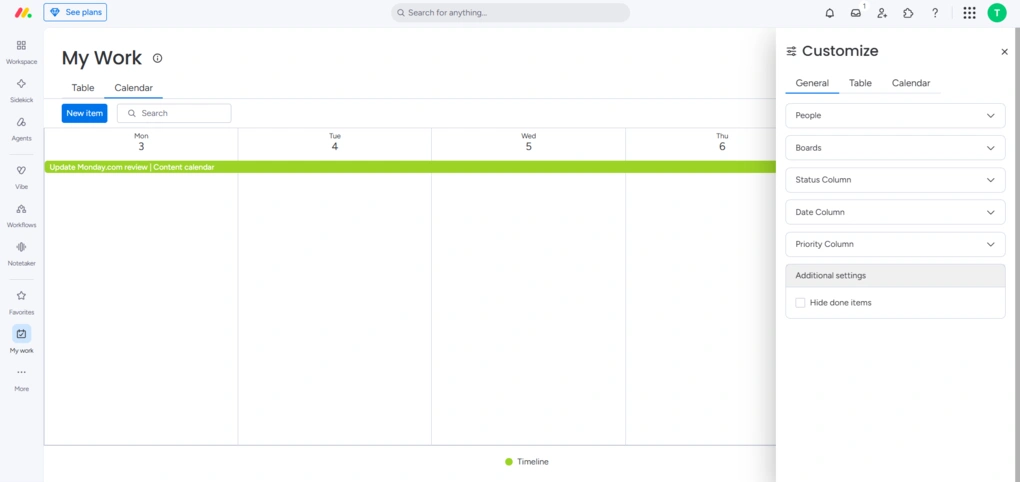
Here, you can view your assigned tasks in a table or calendar view and customize the information displayed using options such as people, boards, status, date, and priority.
Nevertheless, I discovered during my Monday.com review that other software like ClickUp or Asana provides more options to customize your home page. Monday.com offers such customization and a more detailed dashboard view under your workspaces, but I will talk about it later.
Monday.com’s Project Management Tools: Fast Setup and Excellent View Options
💡 Key takeaway: I could set up a project in just five minutes, and Monday.com offered one of the widest selections of project views I’ve tested. I particularly liked the Kanban view and how smoothly I could switch between views, although some felt unnecessary for smaller projects.
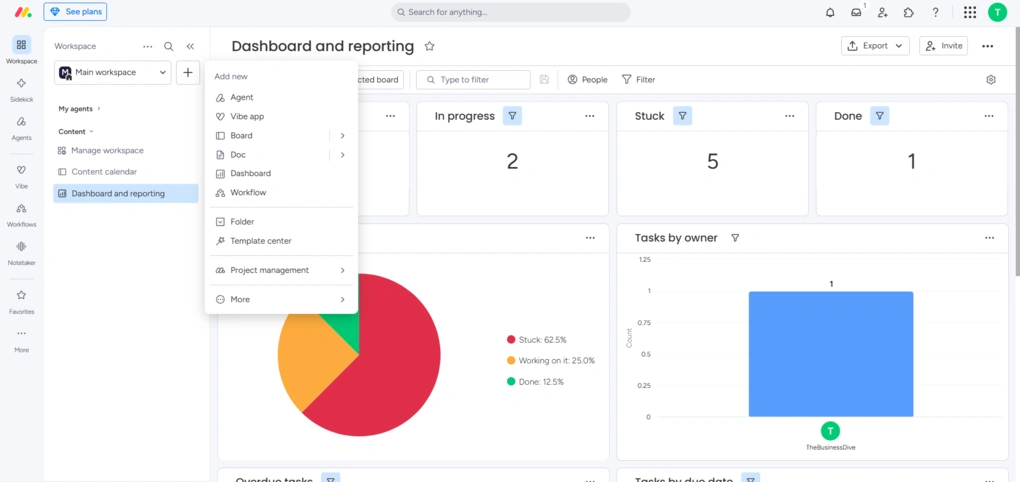
With Monday.com, you can organize your projects into several workspaces. When creating a project, you can decide whether you need a new workspace for it or if you want to involve it in an existing one.
I was honestly surprised by how fast the setup process was. I could usually create a new project from scratch and start organizing tasks in around five minutes.
You need to select the column types you want to include and the project view you want to apply.
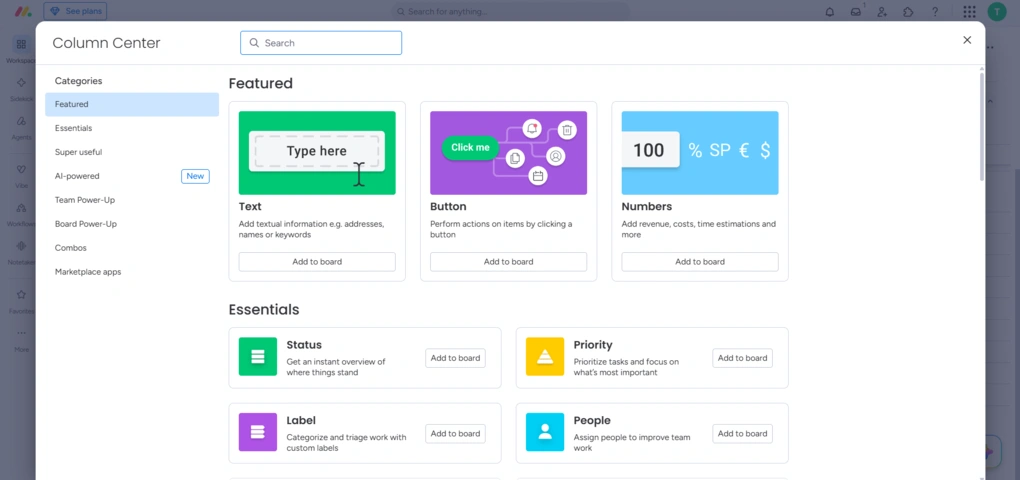
Once you are done with it, you can start adding your tasks and their parameters. Let’s talk about the view options for a minute.
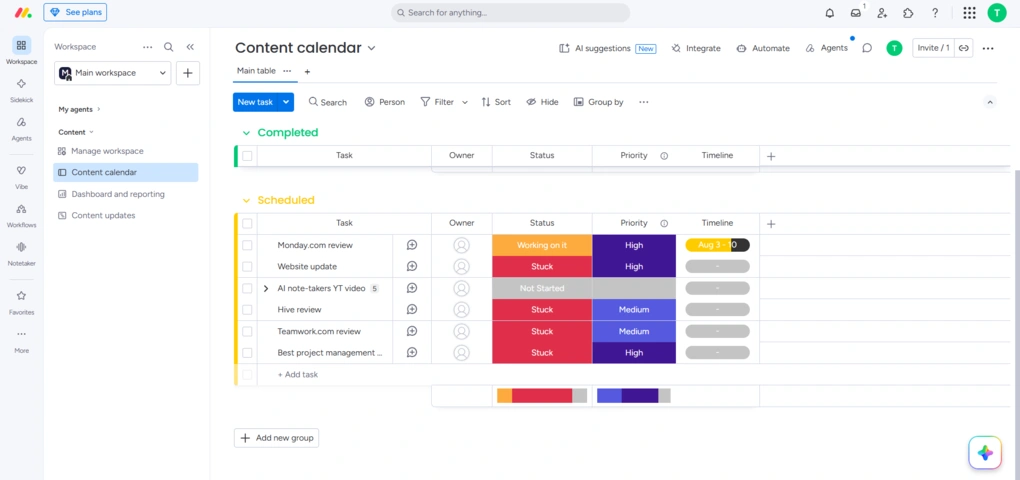
Monday.com offers many view options to visualize your projects from different aspects. You can use Gantt, Kanban, calendar, timeline, workload, chart, files gallery, map, form, cards, and pivot board views.
You can add more views through the plus icon or the Views Center, with up to 100 board views per board!
I ended up using the Kanban, and workload views the most. The Gantt view looked polished, but for smaller projects, it felt unnecessary for me.
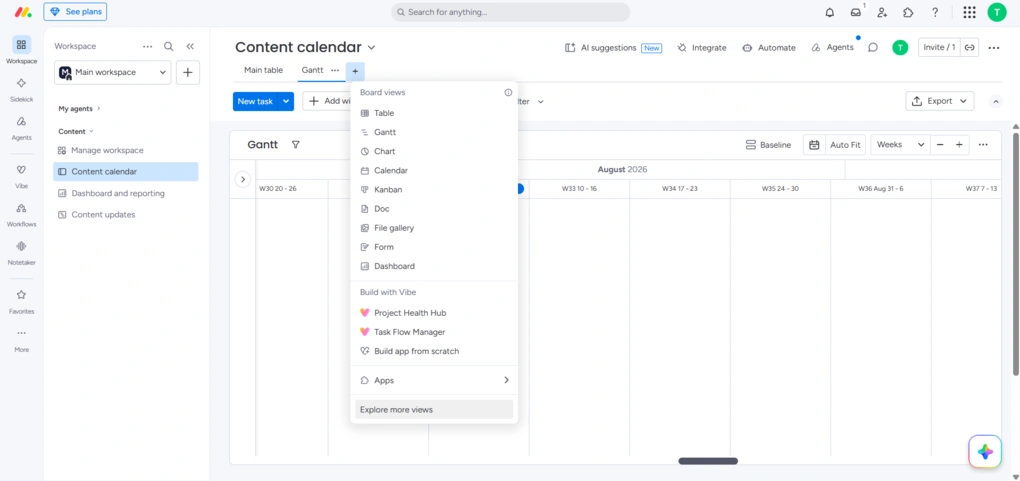
I believe this project management software provides more project views than most of the ones I tried. It is also great that the views do not take too much time to load and that new project view options are added regularly.
But this smooth performance wasn’t limited to project views. I experienced it across nearly all of Monday.com’s features.
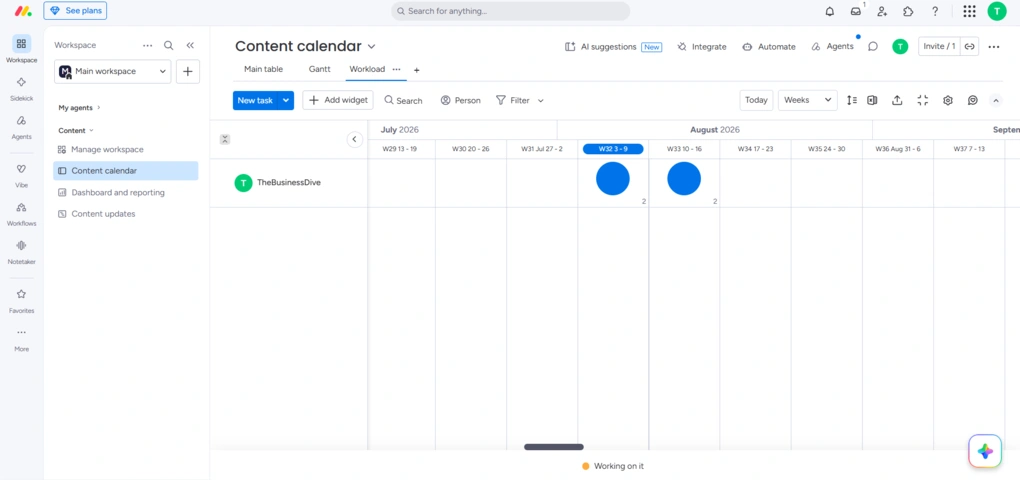
For teams, the workload view could be very helpful in reviewing resource allocation. As I work alone, it is not that useful, but it can clearly represent how the workload is allocated in your team.
Furthermore, Enterprise customers can create portfolios, where you can get a holistic view of all your projects in one place.
One thing I liked was how quickly I could restructure workflows. Using Monday.com’s project views, I rebuilt my content pipeline for the next few months in about 20–30 minutes.
Templates & AI Project Creation: Quick Setup, Minor Limitations
💡Key takeaway: I liked the variety of customizable templates and how AI could generate a project in just 10–15 seconds. However, the Template Center was surprisingly slow to load, and AI-generated projects still needed manual adjustments for more complex workflows.
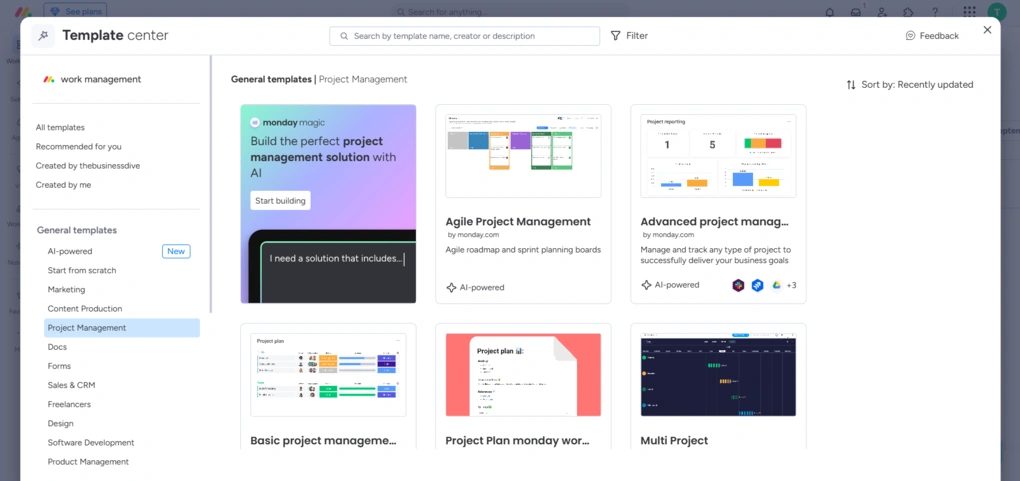
Monday.com offers some templates for different industries and teams. Using such ready-made templates, you can create projects even faster.
Overall, I loved that there are plenty of templates, and you can easily personalize them. Just a quick side note: maybe it is just me, but to access the templates, Monday.com loaded at least a few minutes.
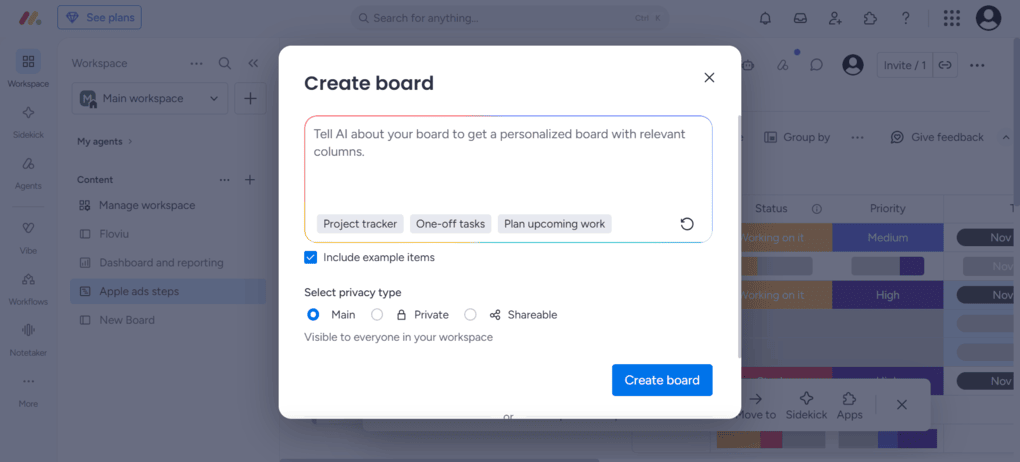
If you don’t want to use a template but want to start from scratch, you can ask the AI to create the project for you. You just describe what you need and whether to include example items, and it will create it in 10-15 seconds.
It’s useful for getting started quickly, but for more complicated projects, you will need more manual work afterward.
Task Management: Intuitive, With a Few Frustrating Limitations
💡Key takeaway: I found Monday.com’s task management intuitive and highly customizable, but recurring tasks require automations, and the checkboxes beside subitems select them rather than mark them complete, which felt surprisingly unintuitive.
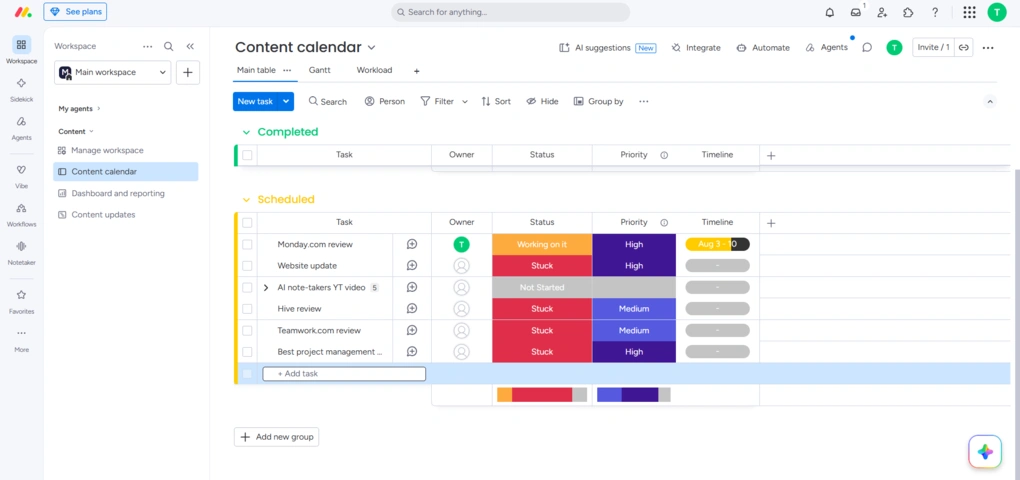
During my Monday.com review, I realized how easy it is to add and assign tasks to others. You can add a new task with one click and select its status, priority level, timeline, owner, and due date.
In addition, Monday.com allows you to drag and drop individual tasks and move them irrespective of the view option you use.
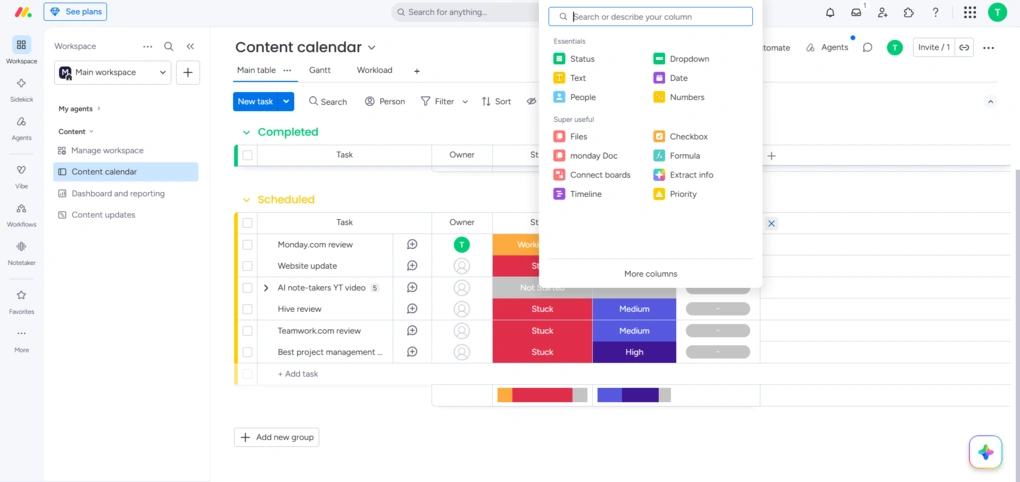
I liked that you can create more columns to track your tasks effectively. Furthermore, you can customize the label or create your own.
Once you have created a task, you can add subitems to break down more complex tasks. As you can see, I added 5 subtasks to my main task called AI note-takers YT video. If you click on the task, it will show the additional tasks under this item.
One small but surprisingly unintuitive detail was how the checkboxes next to subitems worked. I initially expected them to mark subtasks as complete, but they actually just select the items. To mark a subtask as done, you need to change its status instead.
After reviewing Monday.com’s task management tools, I was satisfied, but not perfect. Something that annoyed me repeatedly is that recurring tasks are handled through automation rather than as a dedicated task function.
That said, you can create recurring tasks using Monday.com’s automation, including setting them to repeat daily, weekly, or on a custom schedule.
Custom Dashboards: One of My Favorite Features
💡Key takeaway: Custom dashboards were one of my favorite Monday.com features, offering excellent flexibility and a clear overview of projects without a complicated setup process.
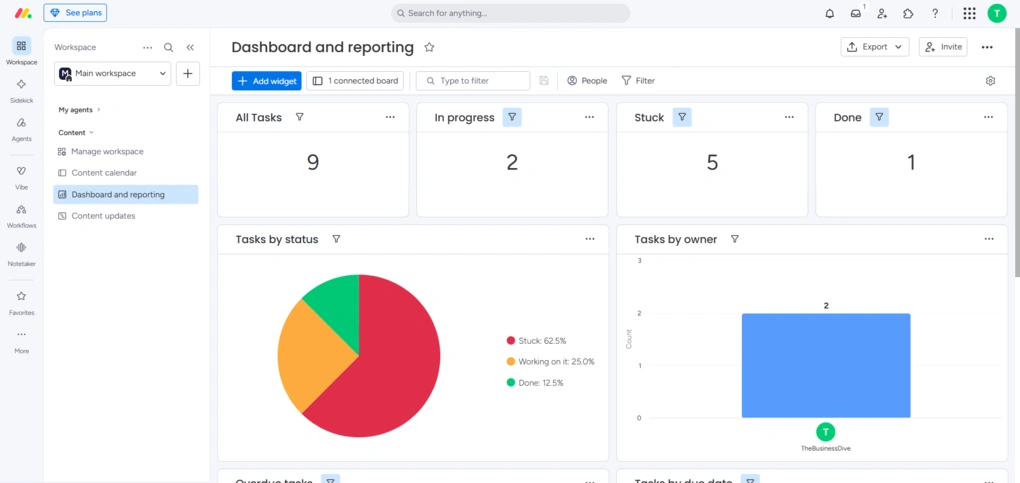
Custom dashboards are useful for displaying the key information of all your projects in a single layout. You can apply up to 30 widgets and apps here so you can better understand project progress, workloads, budgets, and more.
This is exactly what I expected from a good dashboard view, and this is what I missed on the home page.
During my testing, I particularly liked how easily I could move, resize, rename, and organize widgets to create a dashboard that suited my workflow. It felt intuitive, and I could quickly see the information that mattered most without jumping between different boards.
Collaboration Tools: All the Essentials, Nothing Extraordinary
💡Key takeaway: Monday.com covers the essential collaboration features in an intuitive interface, but its tools don’t particularly stand out from competitors.
You can invite your team members to your workspace and start working on projects right away. The first step to getting your team onboard and collaborating is to add them as owners to the tasks.
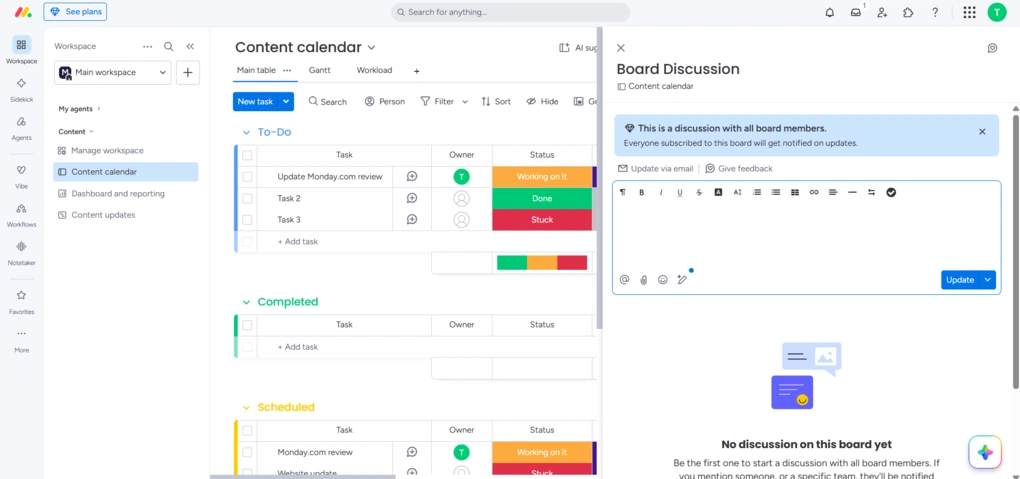
You can start discussions in your projects, mention others, attach files, and leave comments. Furthermore, you can do the same under each task.
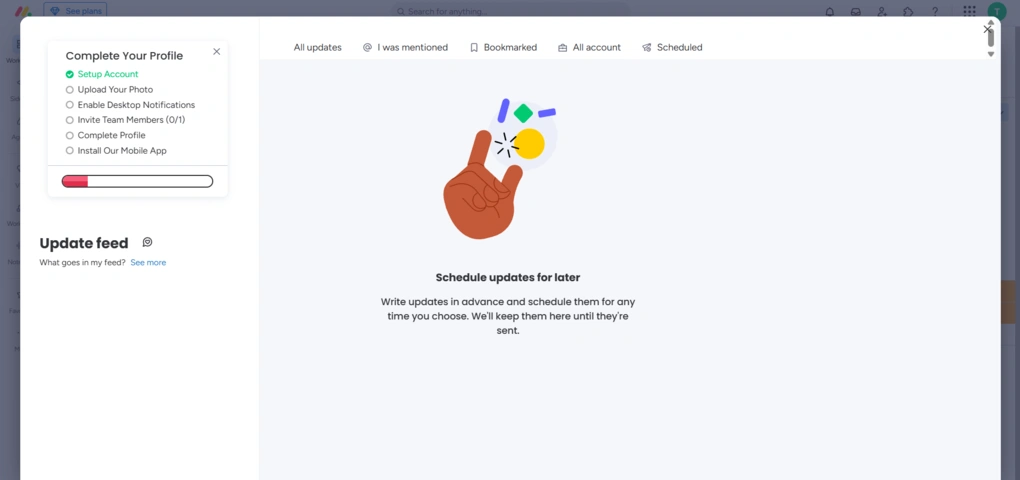
Another useful team collaboration feature is the update feed. Using this Monday.com feature, you get notified when someone mentions or assigns a task to you.
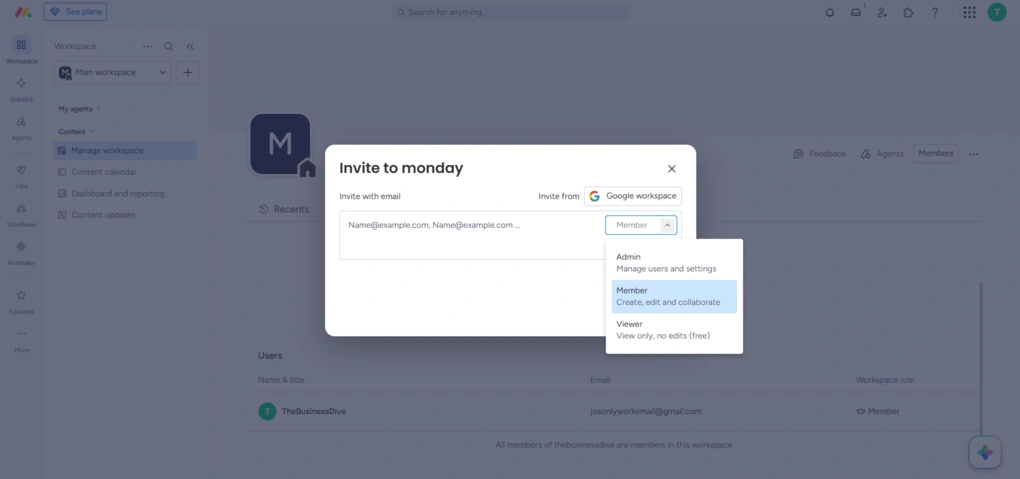
Lastly, you can share projects with your team members and change the permission level to a member, admin, or viewer.
Ultimately, Monday.com has decent team collaboration tools. It has all the essential features a project management tool needs to organize a team’s work.
Automation: Easy to Set Up, but Usage Limits Can Be Annoying
💡Key takeaway: Monday.com’s automation builder is easy to use, but monthly action limits and the need to use automations for recurring tasks can make even simple workflows unnecessarily restrictive.
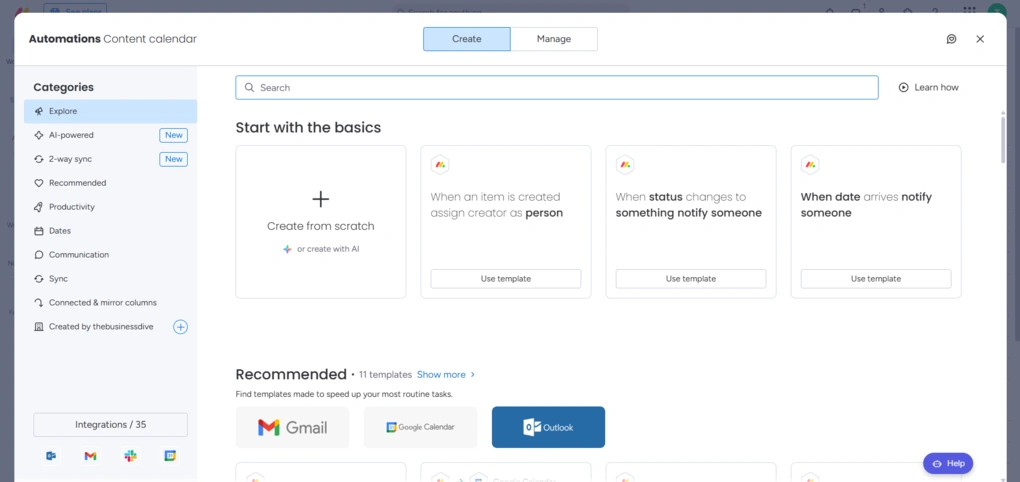
You can manage and create custom automations with Monday.com. The automation feature is quite an intuitive and simple tool.
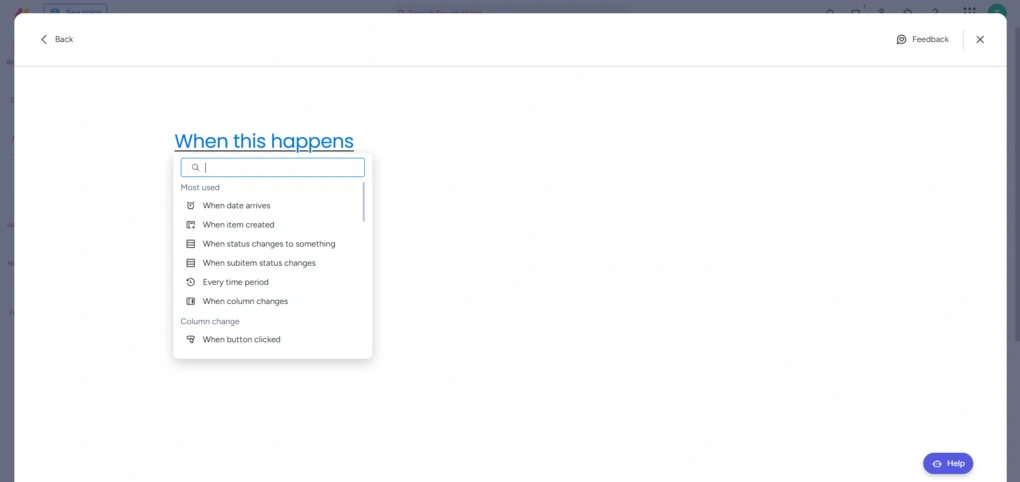
You only need to select the criteria for when the automation should be triggered and the required action in such cases. Depending on the trigger you’ve picked, you might need to select a condition as well.
However, automation limits were also a frustration mentioned in the Reddit discussion I reviewed. One user specifically criticized the fact that recurring tasks require automations, meaning even basic recurring workflows depend on a feature with monthly usage limits.
Docs: Valuable for Team Documentation
💡Key takeaway: Monday.com’s Docs are intuitive and useful for team documentation, but they don’t particularly stand out.
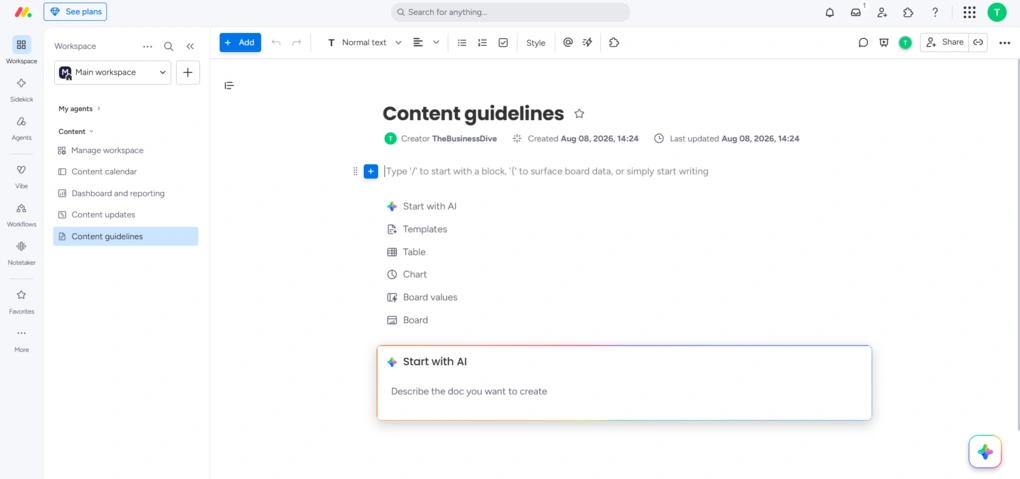
Using Monday.com, you can create and draft documents. You can either start from scratch or use a template.
You can add numerous types of formats, such as text, tables, widgets, lists, and more. Furthermore, you can use Monday.com’s AI Sidekick to create a workdoc, generate and refine text, and summarize the text or the entire document.
During my Monday.com review, I found this an easy-to-use tool, which is completely ideal for creating a company knowledge base or writing meeting notes.
Time Tracking: Simple but Limited
💡Key takeaway: The time tracking feature is easy to use and sufficient for basic needs, but advanced tracking requires a dedicated app, and the feature is only available on Pro and Enterprise plans.
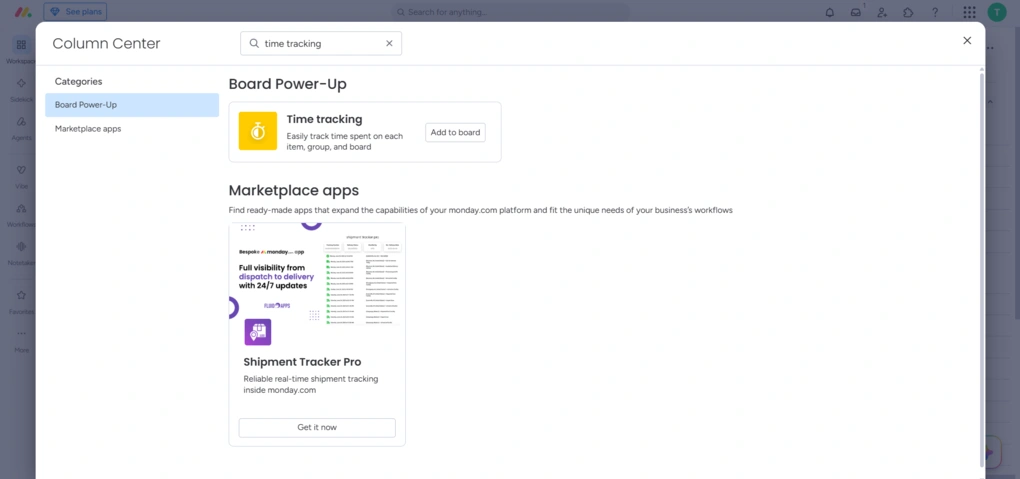
When adding columns to your projects, you can select the time-tracking tool as well. Once you add it to your tasks, you only need to hit the start button, and that’s it. However, the Time Tracking Column is available on the Pro and Enterprise plans.
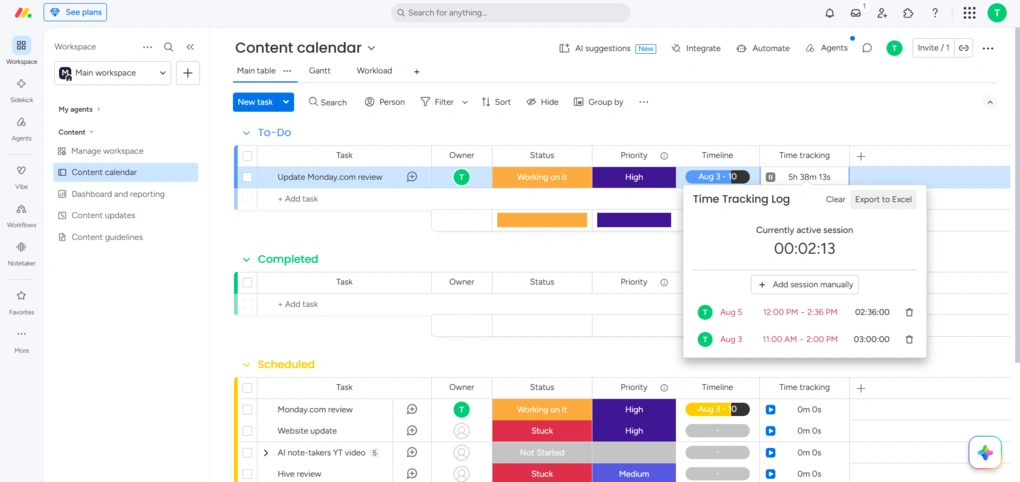
If you need to export the time tracking column to Excel, you only need to click the column title and select “Export Column Data to Excel.” With this, you can collect the time you spend on each task and report it easily.
I think such a tracking feature is sufficient for most people. If you need more advanced time tracking, I typically recommend using a dedicated app for this, as it can give you a much more detailed breakdown of how you manage your time.
AI Features: Better Than Expected
💡Key takeaway: I liked Sidekick’s suggested answers, and Monday.com’s AI Notetaker was the best I’ve tested among project management apps. However, advanced AI features can consume credits quickly.
I was curious whether Monday’s newer AI tools were actually useful or just marketing. Monday.com has started putting much more focus on AI, which is now integrated directly into boards, workflows, docs, and automations.
One feature I found interesting is AI Blocks. These can be added to automations and workflows to perform actions like summarizing text, generating content, translating text, detecting sentiment, assigning labels, or pulling key details from documents.
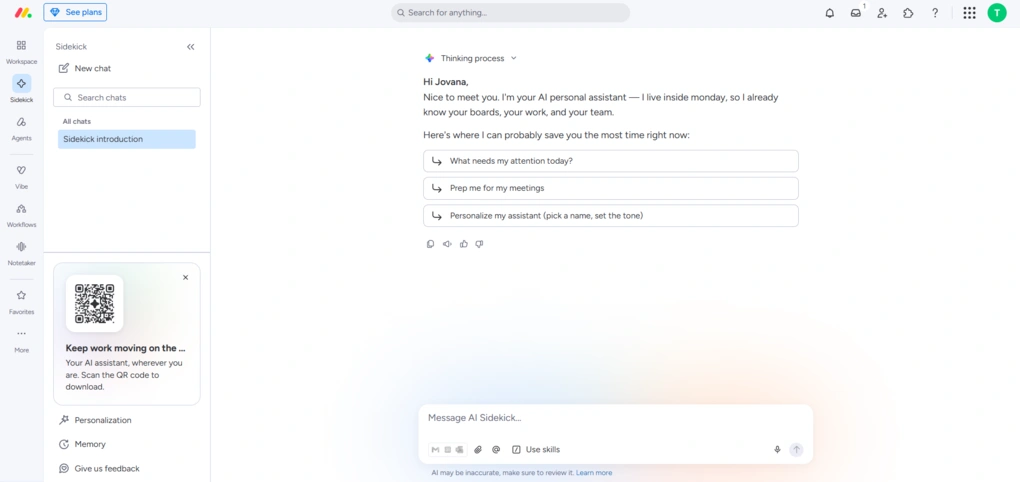
Monday.com also offers AI Sidekick. This works like an assistant inside the platform. You can use it to write updates, summarize discussions, generate content, create workdocs, and take actions such as updating work or creating boards and other items.
One thing I particularly liked during my testing was how Sidekick suggested follow-up questions and recommended answers, including simple yes-or-no options. This saved me from having to type every request manually and made interacting with the AI feel more intuitive.
AI Workflows let you build multi-step, cross-board workflows with AI-powered actions. You can use AI-powered blocks such as Sidekick, web search, and agents within the workflow builder.
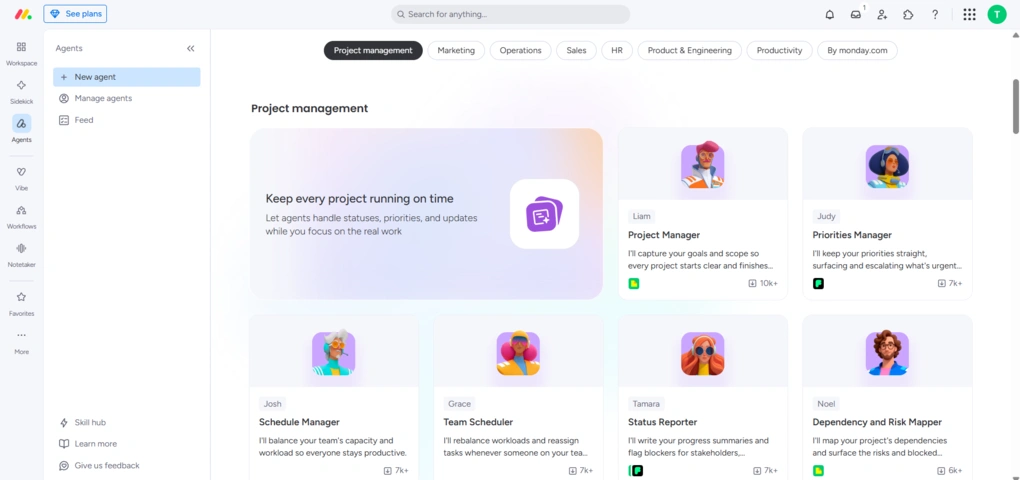
For more specialized tasks, AI Agents can work across teams and workflows based on instructions and context. You can build and customize these agents using prompts without coding.
Monday Vibe takes a different approach, acting as an AI-powered app builder that lets you create custom applications from natural-language instructions.
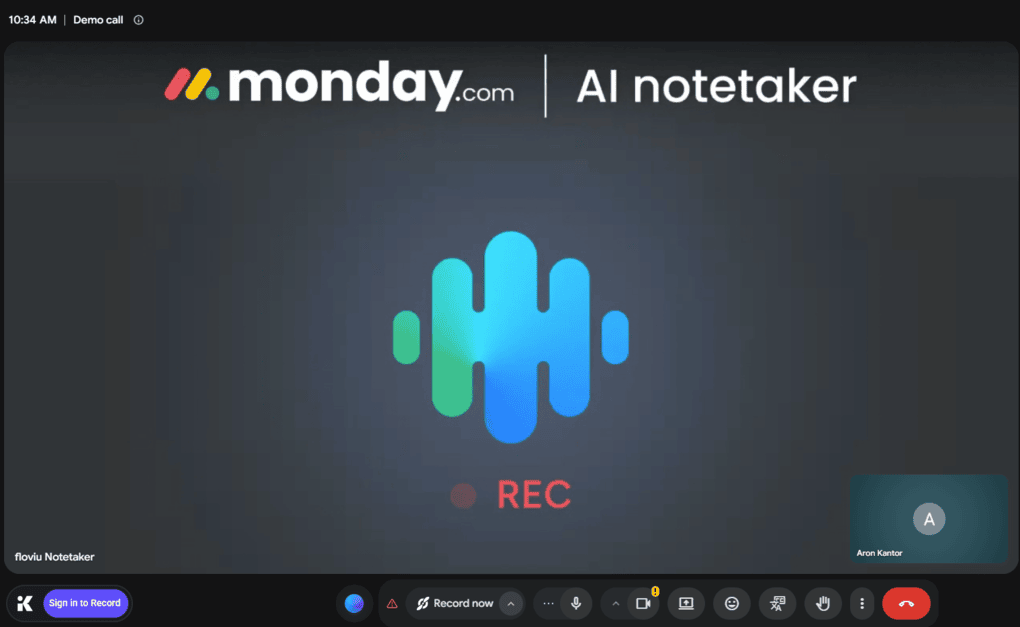
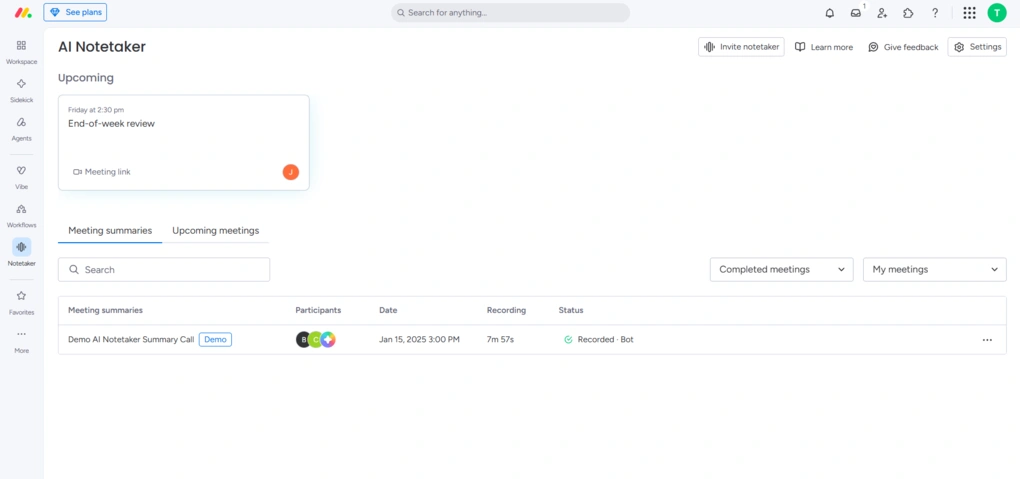
Meanwhile, AI Notetaker can transcribe meetings, generate summaries, and extract action items. It can also link summaries and action items to boards, items, and workflows.
After testing Notion’s and ClickUp’s AI note-takers, I found Monday.com’s solution the most impressive. It achieved around 85–90% transcription accuracy in my testing, supports customizable meeting templates, and works with Zoom, Google Meet, and Microsoft Teams.
You can also record in-person meetings through its mobile app or capture meetings without a bot using the Mac app.
What stood out most was how naturally it connected meeting notes with project management. Using Sidekick, I could turn meeting discussions into tasks, tables, and reports without switching tools.
However, dedicated AI note-takers like Fellow and MeetGeek still offer superior meeting-specific features.
Just a heads-up: All these features run on AI credits, which are consumed whenever you use them.
Connecting Monday.com with other tools
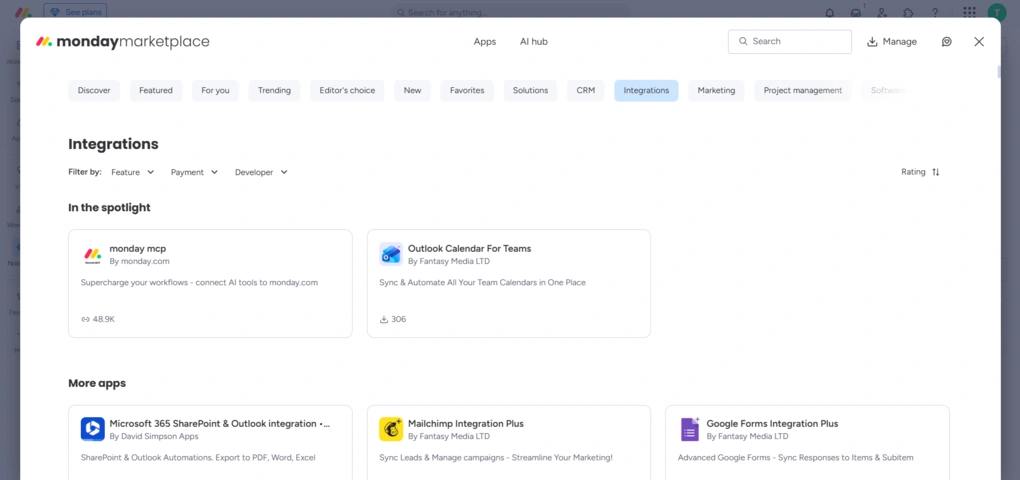
Monday.com integrates with 850+ third-party apps and integrations, making it surprisingly flexible across different workflows and team setups. I found it easy to connect with the tools I already used without needing much extra setup.
It also supports Zapier integrations, which provide access to thousands of third-party apps and automations if you want to build Monday.com into your tool stack.
Monday.com’s user interface
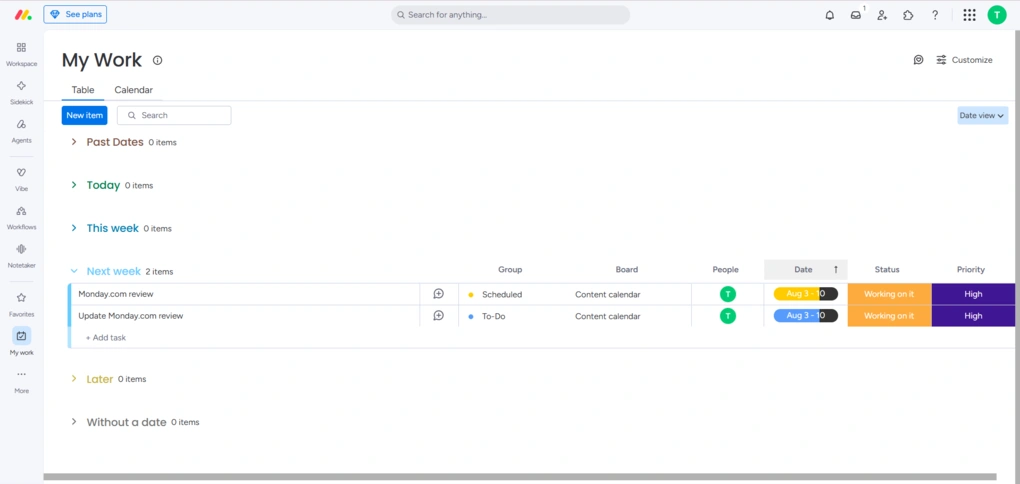
Monday.com has an incredibly intuitive user interface. It is easy to navigate on it, and you can find all the key features with a few clicks. I love that it is simplified, and I do not have the feeling that it is packed.
Explore our Apps directory
A curated directory of software tools we’ve independently reviewed, with links to full reviews, comparisons, and category guides.
Monday.com’s mobile app
Monday.com has a mobile version that is available for Android and iPhone users as well. Its user interface is okay, but it has fewer features compared to the web and desktop apps. The mobile bug happened when I started adding lots of tasks to one of the projects.
Also, during my testing, I occasionally experienced issues with new items not syncing immediately with the desktop or web app.
Monday.com User Reviews: What Real Users Like & Dislike
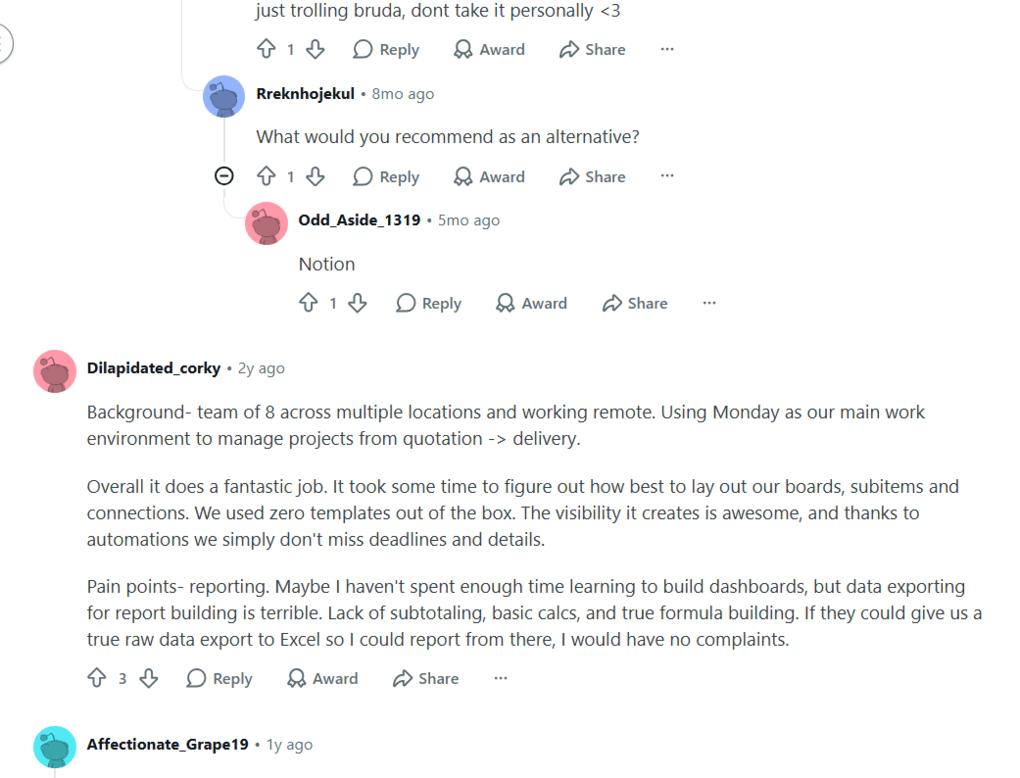
In this Reddit thread, Dilapidated_corky praised the visibility Monday.com offers and highlighted reporting as a pain point. I agree with both points, and I can confirm based on my testing.
Monday helped me track projects easily, and the wide range of project views and fully customizable dashboards also helped a lot.
On the other hand, Monday still doesn’t allow exporting the data to Excel, only to PDF, which doesn’t really make sense to me.
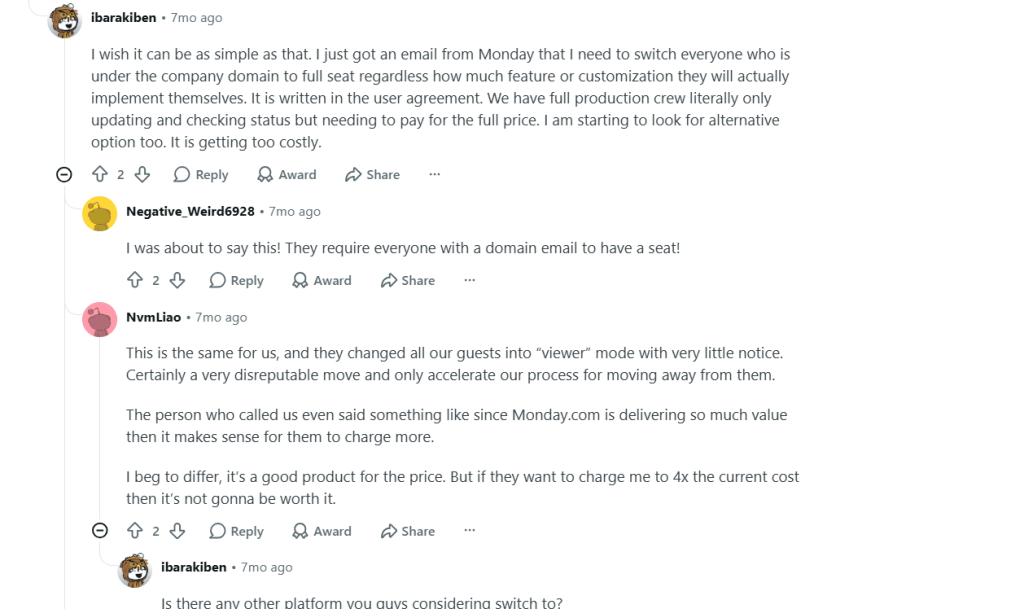
In the same thread, I found an interesting discussion about Monday’s seat-based pricing. A Reddit user, ibarakiben, shared that he received an email requiring everyone with their company’s email domain to have a paid seat, regardless of how extensively they used the platform.
Another user claimed the changes could quadruple their costs, making them consider switching to other options.
While I couldn’t independently verify these claims, they reinforce a concern I raised earlier in the pricing section: Monday.com’s pricing lacks flexibility for teams with different user needs.
Monday.com alternatives
If you need something cheaper, more customizable, or better suited for complex workflows, these alternatives are worth considering.
App | Best for | Description |
|---|---|---|
Hive | Best for small teams | A project management app for small teams with advanced collaboration and AI features. |
SmartSuite | Best for no-code workflow building | A collaborative work management solution for teams to track and manage workflow. |
ClickUp | Best all-in-one | An easy-to-use AI-powered project management software. |
Taskade | Best lightweight AI tool | An AI-powered workflow and lightweight project management app. |
Coda | Best for custom workflows | An all-in-one app that is similar to Notion, however, with more massive project management tools. |
Notion | Best for notes & projects | It provides a centralized workspace where you can organize your thoughts, notes, tasks, projects, and documents in one place. |
Motion | Best for AI scheduling | It is an AI calendar app, but it also works as a project management software. |
Asana | Best for ease of use | A popular and easy-to-use project management tool. |
Teamwork.com | Best for client work | An excellent project management software for client-facing teams. |
Zoho Projects | Best for structured planning | A structured project management tool designed to help teams plan, track, and deliver projects with clear processes and long-term visibility. |
ProofHub | Best for approvals & feedback | A project and team management app with outstanding collaboration, proofing, and customization options. |
Jira | Best for agile teams | An advanced project management and issue tracking tool, built mainly for agile software and IT teams. |
Vaiz | Best lightweight all-in-one | A lightweight project management platform that combines tasks, docs, collaboration, automation, and AI in one workspace. |
Kanera | Best for cross-project visibility | A flexible project management tool with visual scheduling, task dependencies, automations, and cross-project tracking. |
Compare Monday.com vs alternatives



ClickUp VS Monday.com

Notion VS Monday.com

Monday.com VS Asana

Teamwork VS Monday.com

SmartSuite VS Monday.com
Final Thoughts: Who Should Use Monday?
After testing more than 20 project management tools, I understand why so many teams love Monday. Its intuitive interface, customizable dashboards, and smooth performance make organizing projects surprisingly easy.
What impressed me most was how quickly I could get started. I created a project in around five minutes and rebuilt my content pipeline in just 20–30 minutes, without spending hours configuring workflows.
However, pricing remains my biggest concern. While Monday.com covers the essentials exceptionally well, it doesn’t offer the same depth of functionality as ClickUp or Jira. Its fixed seat tiers, limited AI credits, and lack of pricing flexibility make the cost even harder to justify.
Ultimately, I recommend Monday.com for marketing, operations, and PMO teams that prioritize visual project tracking, fast onboarding, and ease of use. For freelancers on a budget or software teams managing complex workflows, I think there are better-value alternatives.
Related posts:
Looking for similar tools?
Visit the link to explore other apps we’ve reviewed in this space and how they compare.
Why you can trust our reviews
At thebusinessdive.com, our team tests, reviews, and compares hundreds of productivity apps every year — from project management tools to note-taking apps. We dive deep into real-world use cases to help you find the right tools that actually improve your workflow, not just add noise.
Our mission? No fluff, no shortcuts—just honest, hands-on insights from productivity pros.
Discover how we stay transparent, read our review methodology, and let us know about any tools we missed.
Frequently asked questions
Is Monday.com actually good?
Yes. After testing more than 20 project management tools, I found Monday.com to be one of the easiest to learn and use. Its customizable dashboards, wide selection of project views, and smooth performance make it particularly good for marketing, operations, and PMO teams.
However, it lacks some of the advanced functionality offered by competitors like ClickUp and Jira.
Is Monday.com actually free?
Yes, Monday.com offers a free plan for up to two users. It includes 3 boards, 8 column types, 200+ templates, up to 3 documents, and access to its mobile apps.
However, the free version lacks many advanced features. Paid plans start at $9 per seat/month with annual billing, with a minimum of three paid seats, bringing the starting cost to $324 per year
What is the difference between ClickUp and Monday.com?
The biggest difference is ease of use versus feature depth. During my testing, Monday.com was significantly easier to set up, offered a more intuitive interface, and performed more smoothly.
ClickUp, on the other hand, provides more advanced project management features, deeper customization, and more affordable pricing.
I recommend Monday.com for teams prioritizing simplicity and visual workflows, while ClickUp is better suited to complex projects requiring extensive customization.
Here is a more detailed breakdown: ClickUp vs Monday: My Findings After +6 Months (2026)
Disclosure: I only recommend products I would use myself, and all opinions expressed here are our own. This post may contain affiliate links that, at no additional cost to you, may earn a small commission. Read the full privacy policy here.

Hey there! I am Aron, the founder of Thebusinessdive. I have been testing productivity apps for almost three years now. I reach 25.000 -50.000 people monthly with the mission to help you find the perfect productivity apps. Subscribe to my YouTube channel, newsletter, and social media to hear more about the best productivity tools. Let’s dive in!