


Akiflow vs Sunsama (2026): An Honest Comparison
If you have a hard time deciding which daily planner applications you should use, you have come to the right place. In this Akiflow vs Sunsama article, I will reveal which is actually better for you.
Both are premium daily planning tools built around time blocking and intentional scheduling. Both pull tasks from multiple apps and place them next to your calendar. And both ask for a serious monthly commitment.
But which one suits you better?
To answer that question, in this Akiflow vs Sunsama article, I will break down every meaningful difference I found between the two, including features, pricing structures, and pros and cons.
Let’s dive in!
Verdict
Here’s the quick verdict if you don’t want to read the full Akiflow vs Sunsama review:
🎯 Best for:
Akiflow: Professionals who rely on time blocking and want to manage tasks and calendar in one focused daily planner
Sunsama: Professionals who rely on time blocking and want a structured daily planning workflow with time tracking
🚫 Not ideal for:
Akiflow: Users looking for a free, lightweight to-do list or full project management tool
Sunsama: Users looking for a free or budget-friendly daily planner
⭐ Biggest strength:
Akiflow: Seamless task capture and calendar-based planning in one unified workflow
Sunsama: Guided daily and weekly planning with seamless task-to-calendar integration
⚠️ Biggest weakness:
Akiflow: Relatively high price and lacks a free plan
Sunsama: Premium pricing and reliance on external calendars
⚖️ Verdict:
Akiflow is better for speed, keyboard-driven workflows, and managing tasks from many apps, while Sunsama is ideal for mindful planning, work-life balance, and guided daily routines.
🏆 Winner:
Akiflow for power users and fast task management, Sunsama for intentional planning and calmer workflows.
✅ Tested with our review & scoring methodology ✅ Real-world testing ✅ Unbiased evaluation
My ratings: Akiflow Vs Sunsama
Akiflow
|
|
Intuitive design and user-friendly interface
|
|
|
Smooth capture and scheduling
|
|
|
Simple, clear task views
|
|
|
Handy integrations
|
|
|
Built-in share availability for quick scheduling
|
|
|
Lightweight AI workflows and statistics
|
|
|
No free plan
|
|
|
Higher price than most to-do apps
|
Sunsama
|
|
Thoughtful, intuitive interface
|
|
|
Excellent daily and weekly planning flows
|
|
|
Built-in time tracking
|
|
|
Strong integrations
|
|
|
Focus Mode and Pomodoro timer
|
|
|
No free plan
|
|
|
On the pricier side
|
|
|
Not a full standalone calendar replacement
|
How We Test Daily Planners
To keep our reviews & final score for each daily planner app fair and consistent, we evaluate every tool using the same testing framework based on real-world usage, feature depth, and overall value.
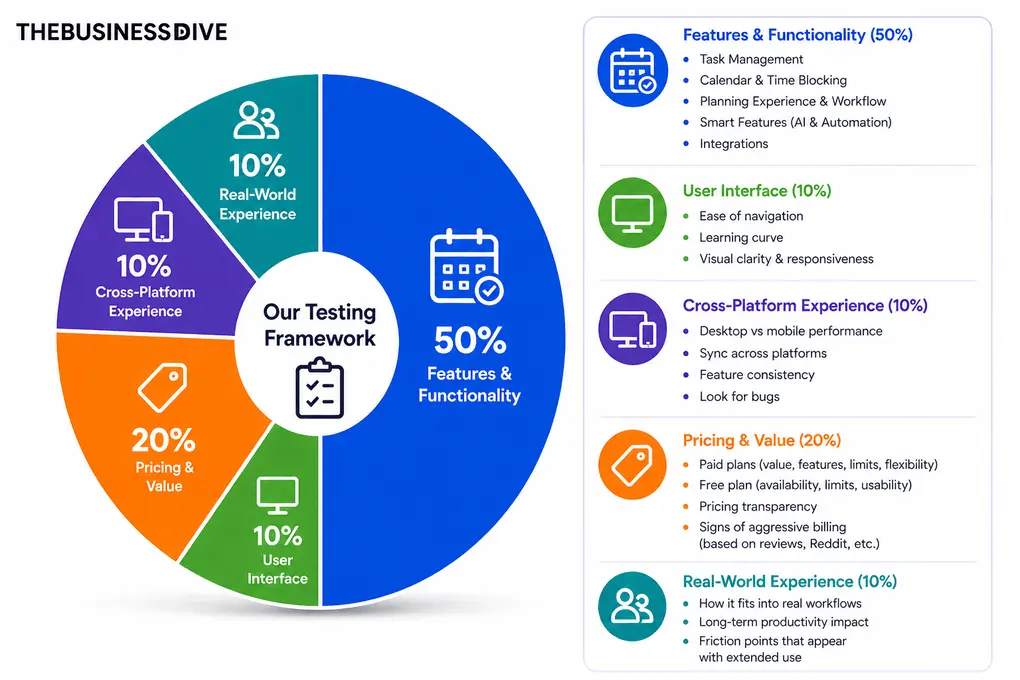
Our scoring breakdown after testing 10+ daily planner apps:
⚙️Features & functionality — 50%
🖥️ User interface — 10%
⚡Cross-platform performance—10%
💰 Pricing — 20%
👥 Real-world experience — 10%
Want a detailed breakdown of how we test each category?
Learn exactly how we test tools → Review methodology
Key differences between Akiflow and Sunsama
Here’s a quick overview of the main differences that stood out during testing:
|
|
|||
|---|---|---|---|
|
Best for |
Professionals using time blocking and calendar-based planning |
Intentional daily planning and work-life balance |
|
|
Core focus |
Calendar-centered task and workflow management |
Guided daily planning with time tracking and focus tools |
|
|
Key strengths |
|
|
|
|
Main limitations |
No free plan and expensive pricing |
No free plan and depends on external calendars |
|
|
Ease of use |
Easy |
Easy |
|
|
Pricing |
|
|
|
|
Integrations |
Extensive integrations |
Solid integrations |
|
|
Cross-platform |
Web / Desktop / Mobile |
Web / Desktop / Mobile |
What is Akiflow?
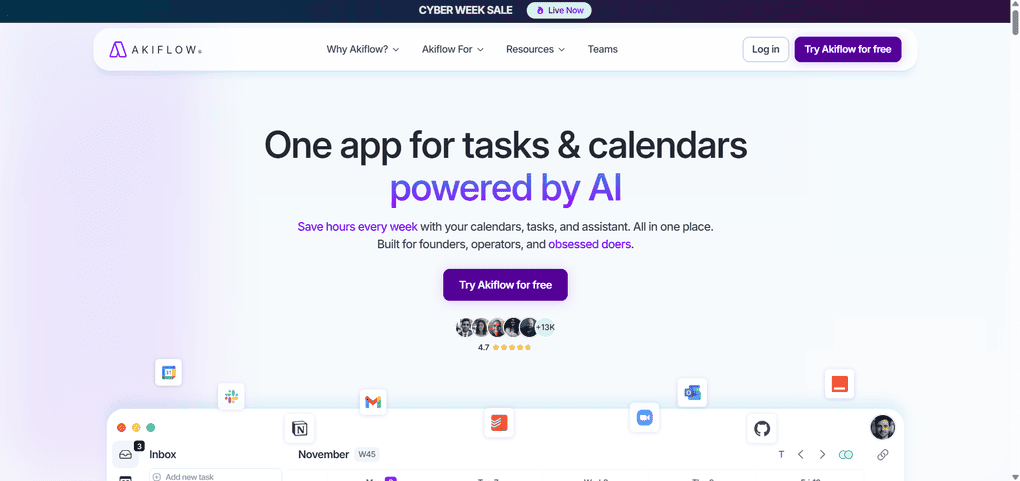
Akiflow is a productivity app built around one idea: keeping all your tasks, events, and plans in a single place. It combines a universal inbox, a fast calendar, natural language task creation, and simple time blocking so you can plan your day without switching between task management apps or calendar tools.
Instead of acting as a traditional to-do list, Akiflow works more like a daily command center. You capture tasks from anywhere, drag them into your schedule, and use lightweight features like AI workflows, statistics, and share availability to keep your day structured.
🔎 Read my full An Honest Akiflow Review 2026: Is It Worth $34 For YOU?
Short on time? Here’s a quick overview of Akiflow
What is Sunsama?
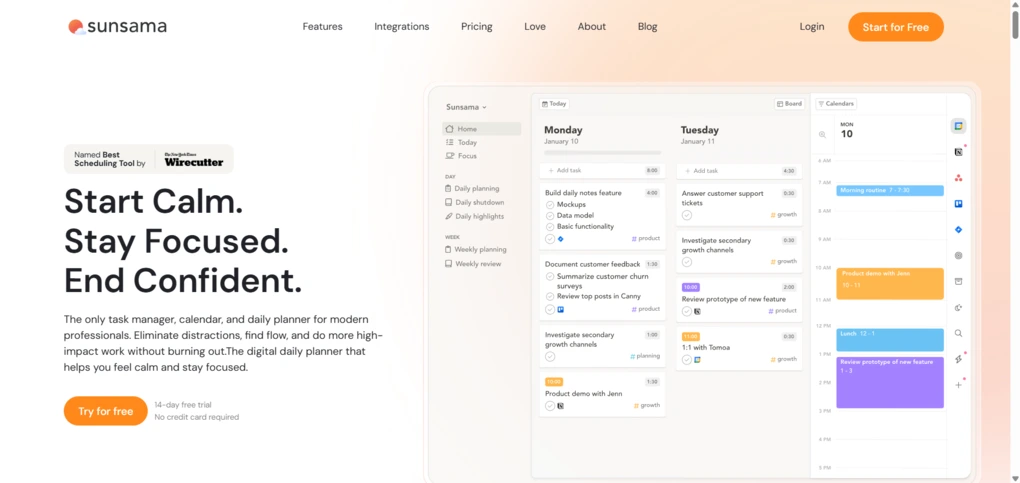
Sunsama is a daily planner app that brings your tasks, calendar events, and time tracking into one organized space. Unlike classic task management apps, Sunsama encourages intentional planning through guided daily and weekly workflows.
Sunsama also supports time blocking, recurring tasks, and focus mode, making it easier to prioritize tasks and manage multiple projects.
🔎 Read my full review: An Unfiltered Sunsama Review (2026): Is It Worth $20/Month?
Short on time? Here’s a quick overview of Sunsama
Comparison: Akiflow vs Sunsama
Below, I’ll walk you through each tool step by step. First, we will break down the features for each tool, then we’ll take a look at the integrations, user interfaces, pricing plans, pros and cons, and finally, I’ll share my personal experience using both.
Features
Let’s start with Akiflow’s features!
Akiflow’s features
Here, I will share the key features and how they performed during my Akiflow review.
Capture and task creation
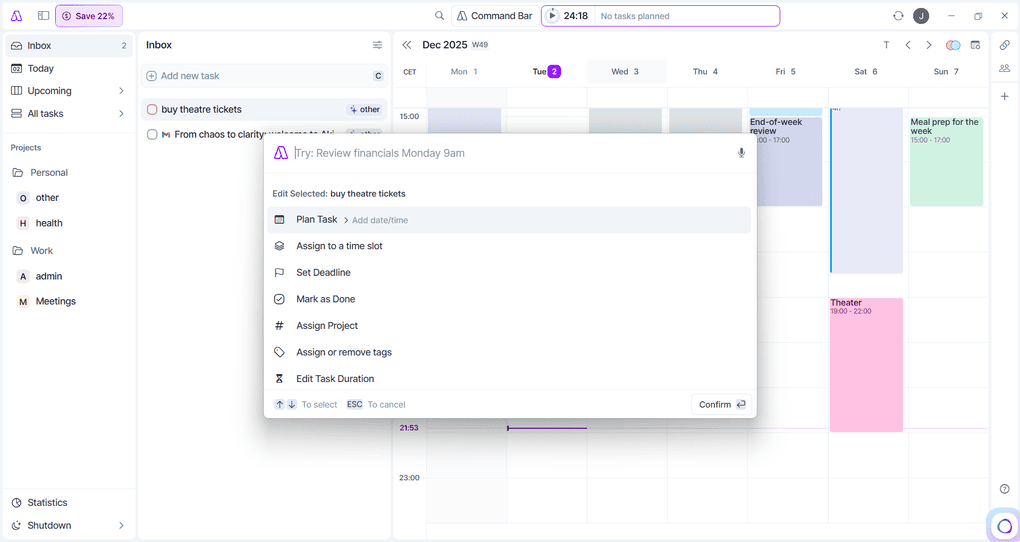
The first thing that I noticed during my Akiflow review was how practical its inbox is. Akiflow’s inbox is built to catch everything you need to act on, no matter where it comes from. Emails, calendar invites, saved links, Slack messages, and browser tabs all land in one place.
Every item can be processed in seconds. You can turn it into a task, schedule it, snooze it, or send it to a project. Task creation is quick whether you use the Command Bar at the top, click directly on the calendar, or convert something from the inbox.
It all feels smooth and consistent and works well as a quick capture tool for consolidating tasks from other tools.
Planning and time blocking
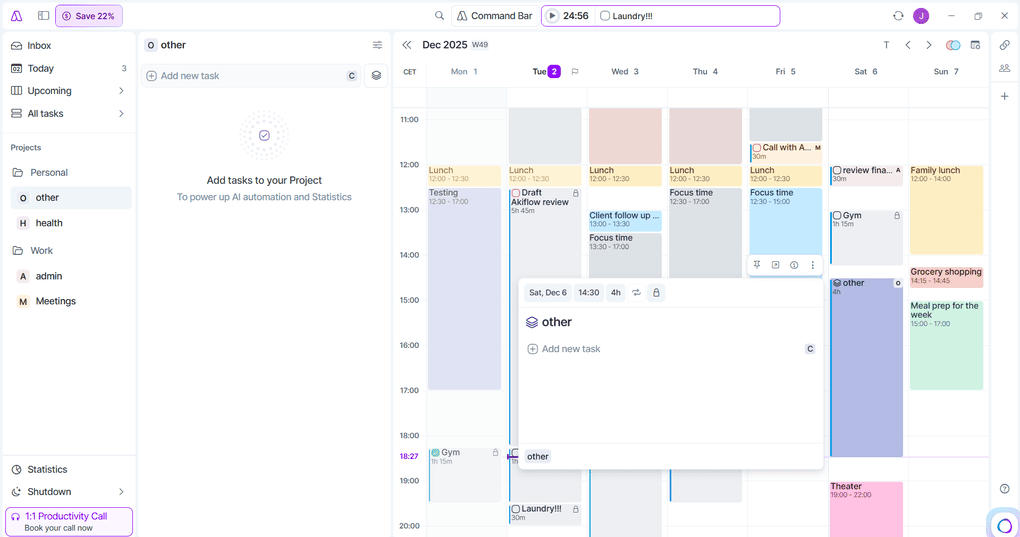
If you prefer visual planning, dragging a task into the calendar instantly turns it into a time block. The block takes your project color, shows the duration, and becomes part of your schedule, which is great if you want more control over how you plan calendar tasks.
You can also plan from list views like Today, Upcoming, or Inbox. Assign a time slot, set a deadline, or leave the task flexible. Tasks behave like events when placed in the calendar, but they stay easy to move and adjust, which keeps the day from feeling rigid.
The Today view brings everything into one screen. It brings tasks, calendar events, and time blocks in a way that makes it easier to see what realistically fits in your day and how your daily tasks line up with your daily routine.
Calendar management
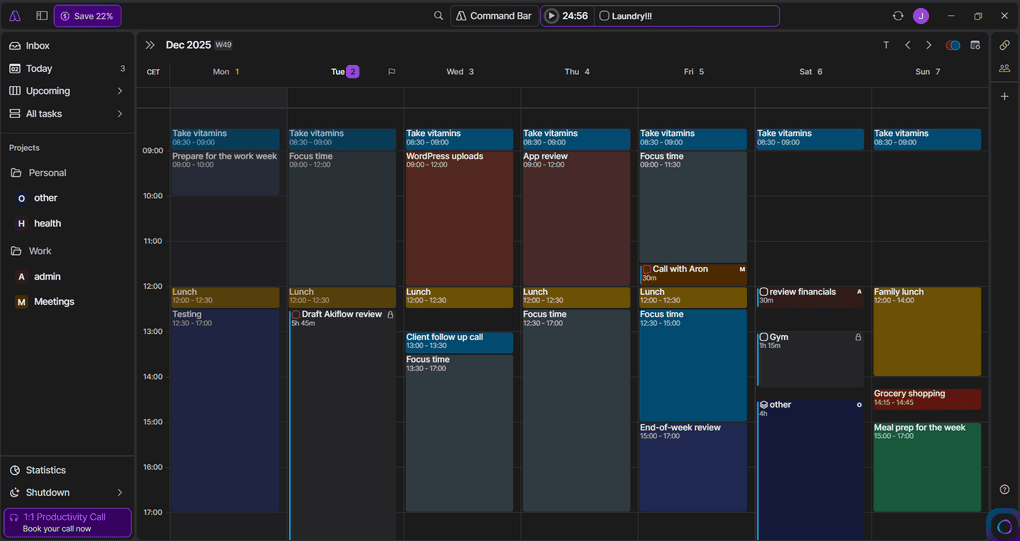
Akiflow’s calendar supports multiple accounts, including Google Calendar & Outlook, and keeps your meetings, personal plans, and deadlines in one place.
Events and tasks appear side by side, but only tasks stay flexible until you schedule them. Tasks with deadlines show up as small flags at the top of the calendar, which makes due dates visible without filling your day with fake events.
The calendar sits next to every major view rather than living in its own tab, which makes it feel more integrated into the workflow.
It is also customizable. You can show the whole month, a few days, or the full week, and resize the panel however you like. Color coding helps the layout stay readable at a glance and gives you a clear calendar experience.
Navigation is simple. You can jump through days and weeks quickly or return to Today with a single click. Dragging tasks into the calendar turns them into time blocks instantly, and everything syncs across your accounts without delay.
For basic meeting scheduling and everyday calendar management, Akiflow covers the essential features most people actually use.
Natural language input
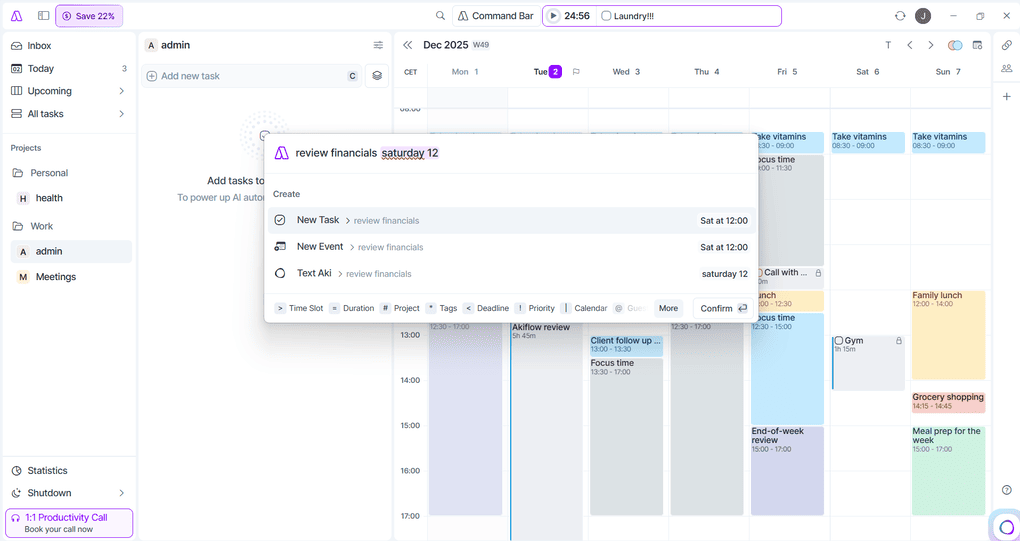
Akiflow lets you create tasks the way you would say them out loud. You can type “Call the vet tomorrow at 9” or “Pay rent on the first of every month,” and the app turns that into a scheduled task. It feels more like capturing a thought than filling out a form.
The same logic works inside the Command Bar, which is always visible. You can type or use voice input, speak a sentence, and Akiflow will parse it on the spot.
It understands simple phrases like “tomorrow,” “next week,” or “every weekday,” which is enough for everyday task entry and makes new tasks quick to add.
Task Management
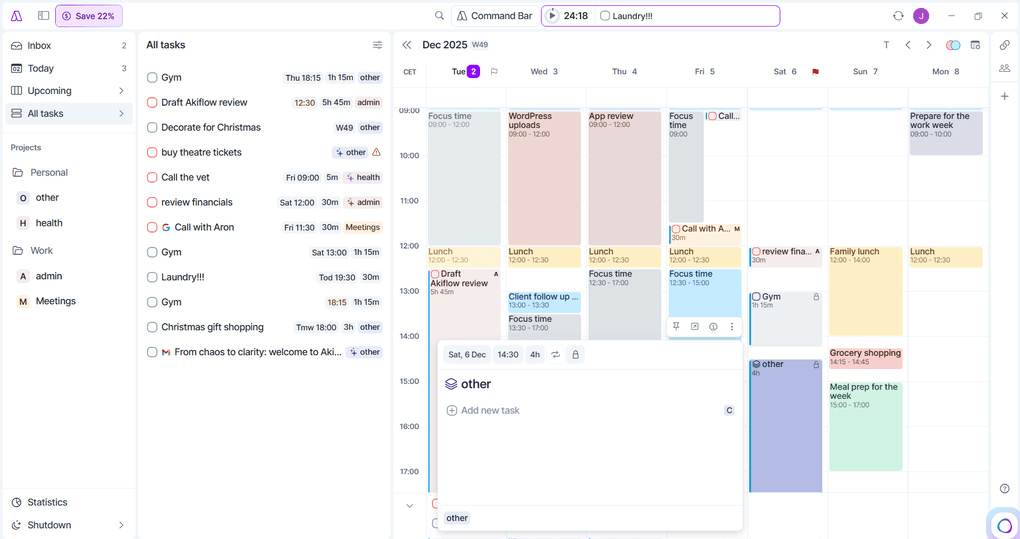
Akiflow keeps task management straightforward. Tasks sit in four main views: Inbox, Today, Upcoming, and All Tasks. This makes it easy to see what needs attention now, what is coming up next, and what still needs to be processed in your task list.
Each task can be scheduled, snoozed, assigned a project or label, or turned into a time block. You can also convert a task into an event or keep it flexible until you decide where it fits. No matter where the task comes from, the actions are predictable and fast, which helps when you are managing tasks across many tools.
Projects and labels help you group related work without becoming full project management boards. Akiflow is not designed to manage projects at the same depth as a dedicated project management tool, and it does not try to replace larger projects that live in ClickUp or Notion.
Priorities stay simple. Instead of multiple priority levels, Akiflow uses pinning to highlight the few things you truly want to focus on.
AI Workflows
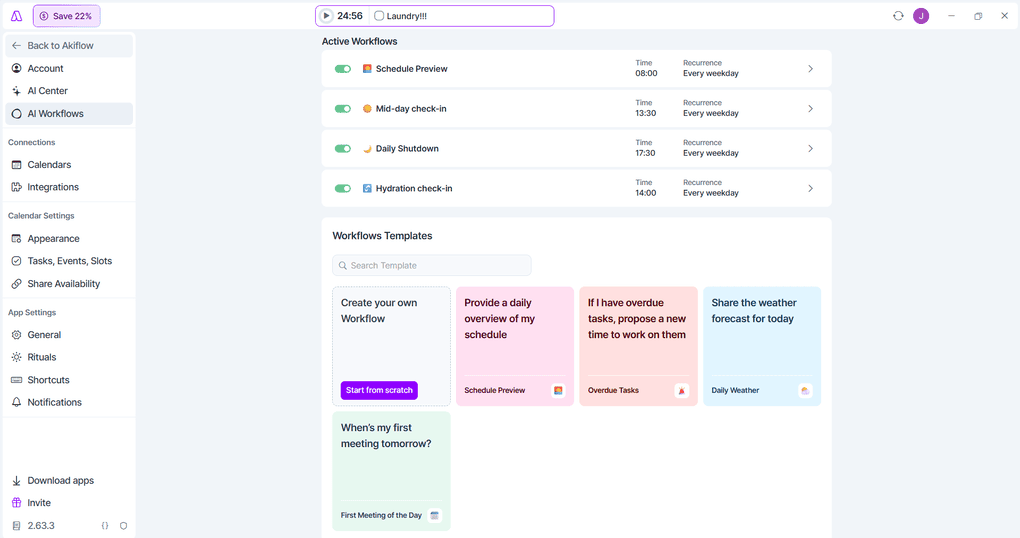
Akiflow includes several AI workflow templates that automate small parts of your day, like schedule previews, weather updates, or reminders about overdue tasks. You choose the time and recurrence, and Aki sends the message when it is most useful.
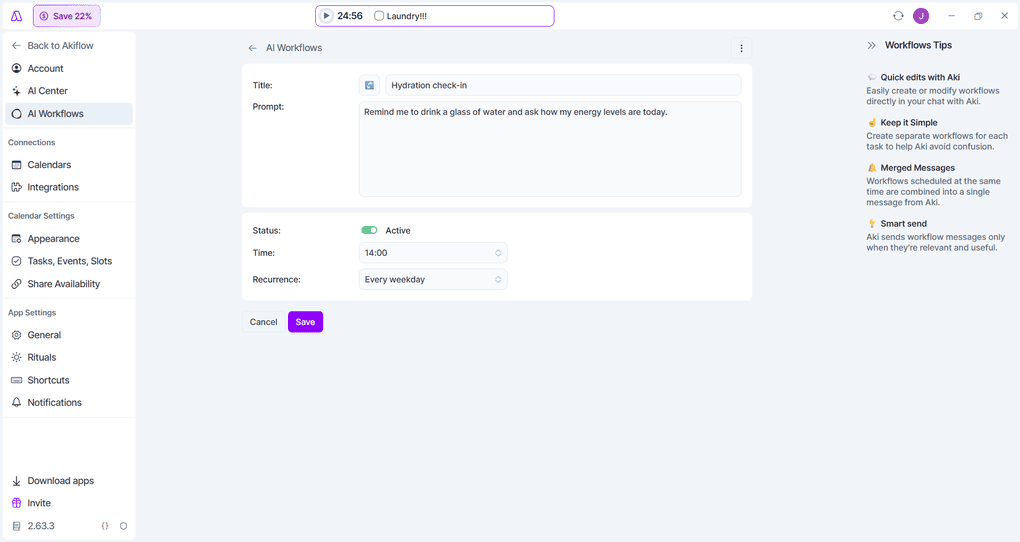
If you want something more personal, you can create a workflow from scratch. Write your own prompt, set when it should run, and Aki turns it into a recurring message. It works well for simple routines and habit check-ins.
The workflows stay lightweight and do not try to plan your day for you, but they add basic AI capabilities on top of your existing time management system.
Focus and Timer
Akiflow includes a simple focus timer that helps you stay committed to one task at a time. You can start a session directly from a task or from a time block in the calendar. The timer shows your progress, stays out of the way, and mutes distractions while you work.
It is not a full Pomodoro system, but it pairs naturally with time blocking. Drag a task onto the calendar, lock it, start the timer, and you have a small routine that keeps you grounded in the work you want to finish and helps you stay focused during focused work sessions.
Share availability
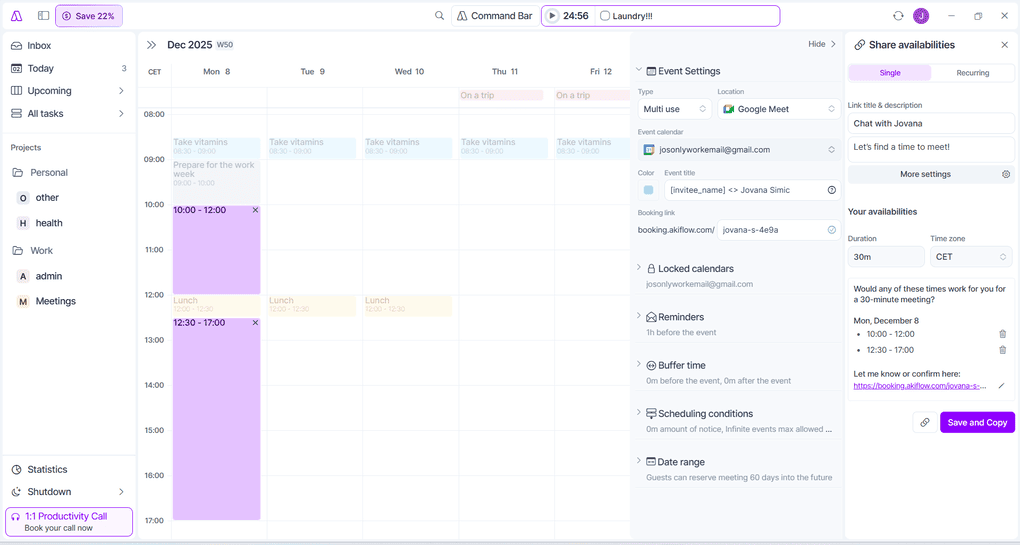
Akiflow also covers basic scheduling through its Share availability feature. You choose a few time slots, set the meeting duration, and Akiflow generates a simple booking link. The other person picks one of the times you offered, and the event is added to your calendar automatically.
The setup panel is easy to use. You can customize the event title, choose the meeting location, such as Google Meet, set reminders, add buffer time, and decide how far into the future people can book. Locked calendars help keep private events protected while still showing your real availability.
Other Features
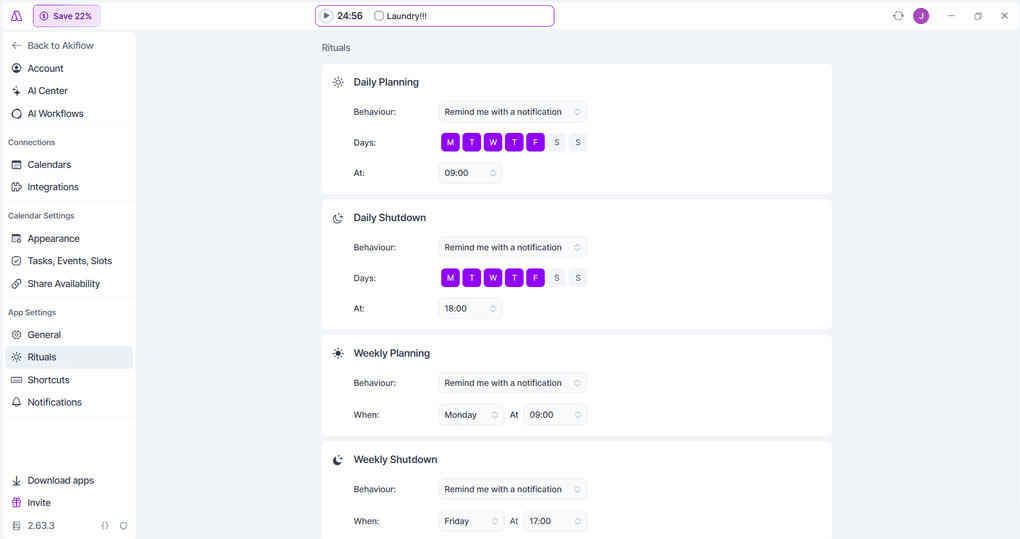
Akiflow includes a long list of keyboard shortcuts that make the app quick to navigate. You can move between views, create tasks, open the Command Bar, or start a focus session without lifting your hands from the keyboard, which is especially nice for power users.
The universal search is fast and flexible. You can jump to tasks, projects, labels, or calendar views with a few letters. Search also doubles as a command launcher, which helps when you do not remember the exact shortcut.
Notifications and reminders stay simple. Tasks can be snoozed, overdue items surface naturally, and deadlines appear as small calendar flags. You can enable desktop notifications or keep everything inside the app if you prefer a quieter workflow, without adding cognitive overload on top of your existing productivity system.
Sunsama’s features
Now, it’s time to delve into Sunsama’s features!
Task management
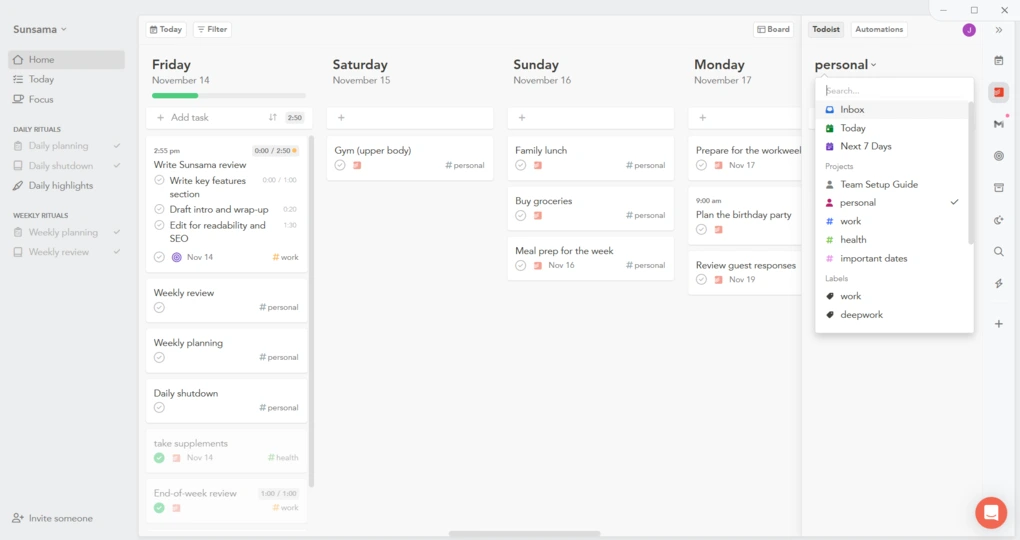
I started testing Sunsama by connecting my Todoist account, and the transition was smoother than I expected. You can also import tasks from other platforms like Asana or Trello.
My task list appeared instantly in the sidebar, and I could pull tasks into the calendar with simple drag and drop. This made it easy to schedule tasks and reschedule them without breaking my workflow.
Not everything was perfect, though. One task did not pull its subtasks on the first try, so I had to import it again. The second attempt worked, but it showed me that integrations depend on how consistent your task structure is in other tools.
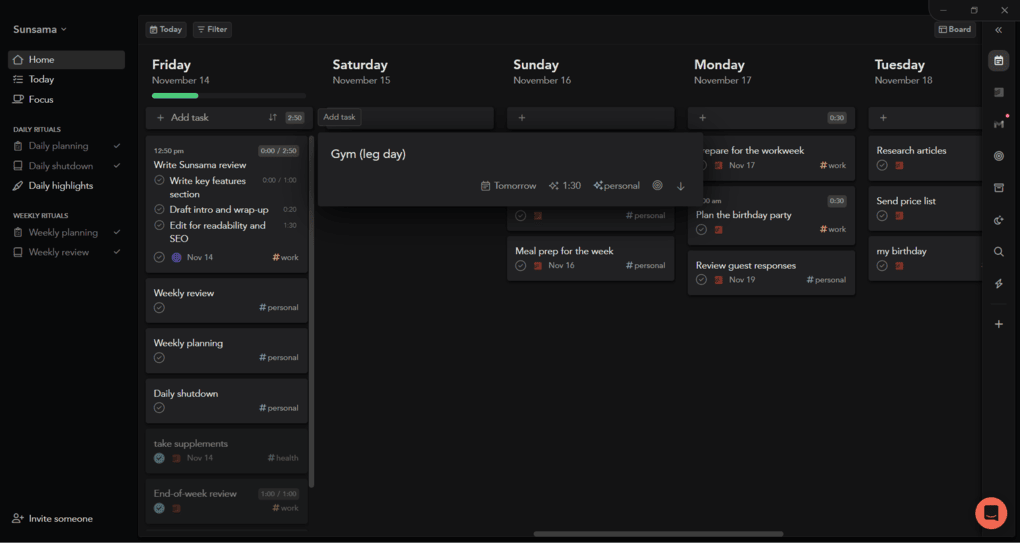
The Home tab is essentially a board view, and it is one of the cleanest layouts I have seen in a task management app. Adding tasks is quick. Users can manually add tasks or pull them in from weekly objectives, backlog, or third-party calendars.
To add a task, click Add Task or press A, type the name, and Sunsama will suggest a channel and planned time. These suggestions were usually accurate during my review.
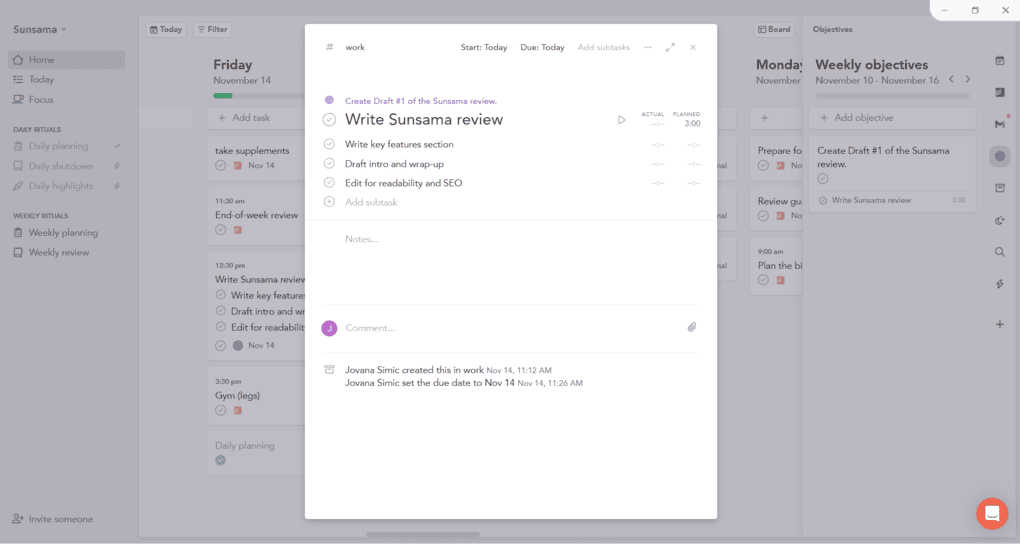
Every task can have an objective, planned time, subtasks, tags, and a channel. Channels and contexts are especially helpful because they let you categorize all your tasks, projects, and personal tasks in a way that mirrors real life. Contexts group several channels so you can focus on one area at a time.
Sunsama supports recurring tasks, but I loved most how it balances both tasks and events. The board view shows everything, while other views display only items with planned time. It is worth keeping this in mind so you do not lose track of important tasks.
Daily planning workflow
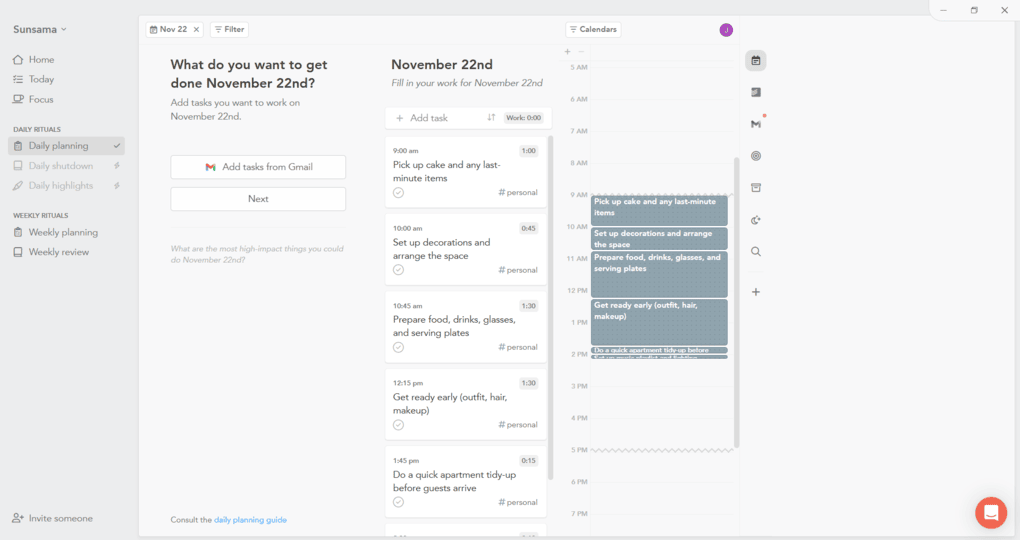
Daily planning is one of Sunsama’s strongest features. Hover over a day and select Plan to open a guided workflow that walks you through your daily tasks. It helps you prioritize tasks, schedule them realistically, and share your daily plan on Slack or Microsoft Teams.
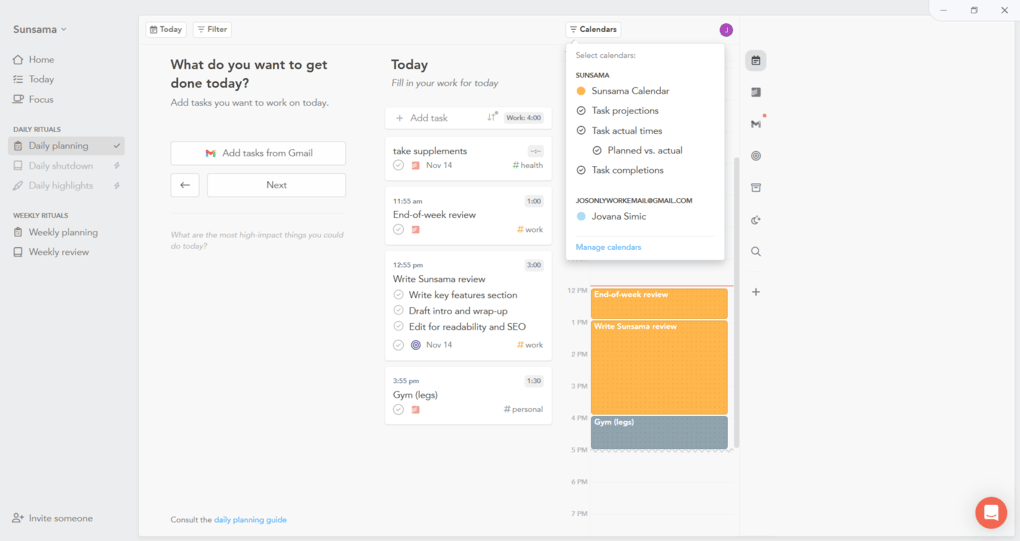
Once tasks are placed on the calendar, the timestamped day overview appears in the sidebar. You can drag items around to adjust their planned time or shift your schedule if something takes longer. This keeps daily planning flexible and intentional.
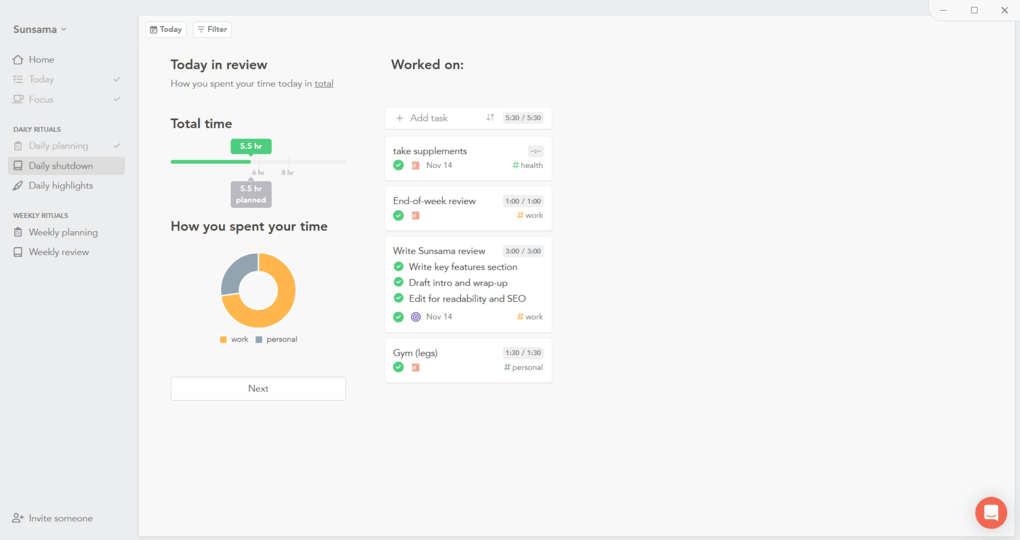
At the end of the day, Sunsama encourages a daily shutdown routine. You can review completed tasks, check what still needs attention, and write a short reflection. Previous days show a Reflect option when you hover, allowing you to revisit your day and see a clear summary.
These daily rituals are part of what makes this app unique. During my Sunsama review, I found that it encourages consistent daily planning routines, helping you maintain structure and avoid decision fatigue.
Weekly planning & review
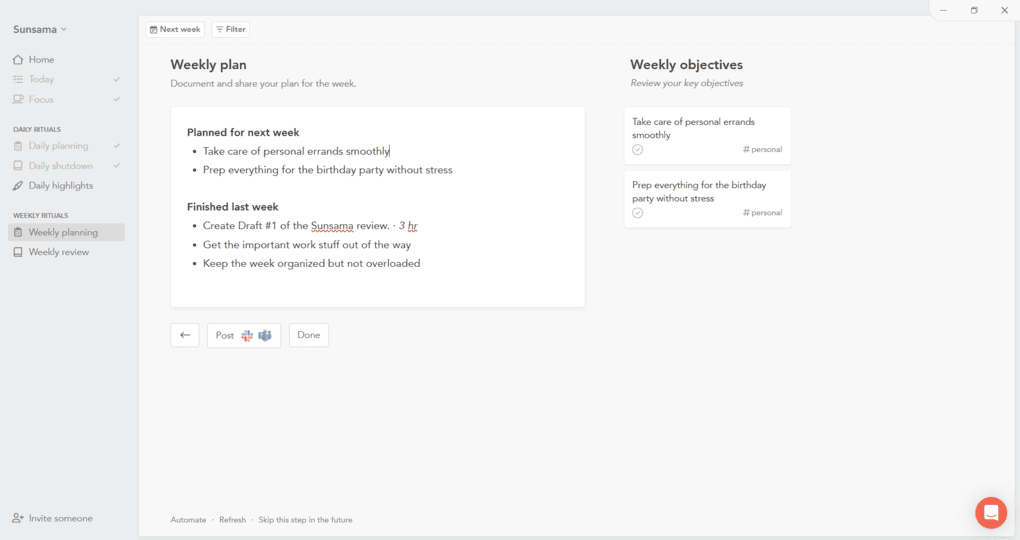
Weekly objectives were one of my favorite features during testing. You can set goals for the week and instantly assign them to tasks. The sidebar shows everything in one place, making it easier to stay focused on what matters.
Sunsama promotes weekly planning through simple rituals. Users often mention that this planning process helps manage workload and prevent burnout, and I found that to be true. It gives you a clear sense of where your time should go before the week starts.
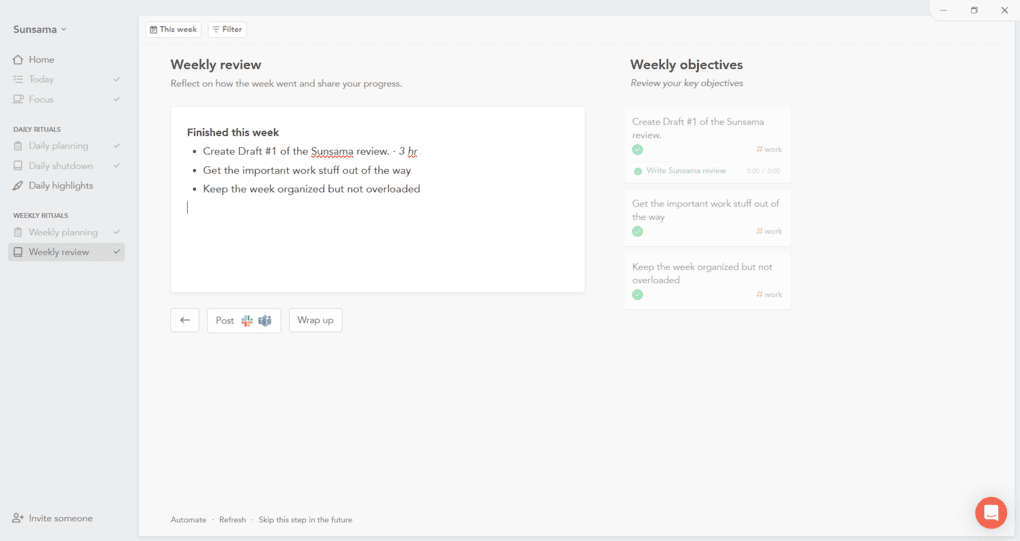
The weekly review feature helps you see how your week went. It shows completed tasks, time spent on different channels, and highlights your productivity patterns. Many users describe this as essential for long-term improvement, and I agree.
Time tracking & focus mode
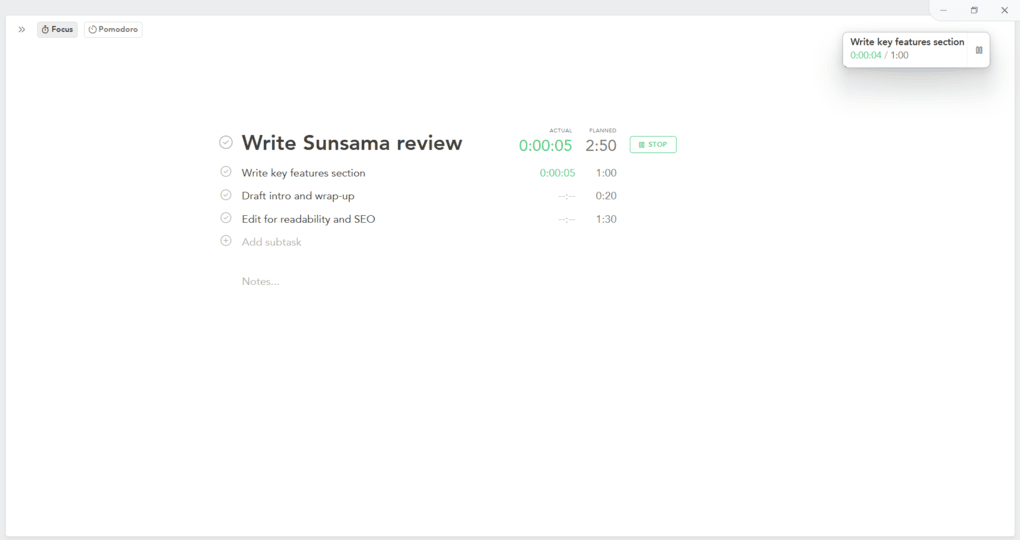
Sunsama surprised me with its built-in time tracking. Each task can have a planned time, and once you start working, you can activate the timer to track actual time. This feature helped me understand how much time I spent on tasks and how accurate my planning was.
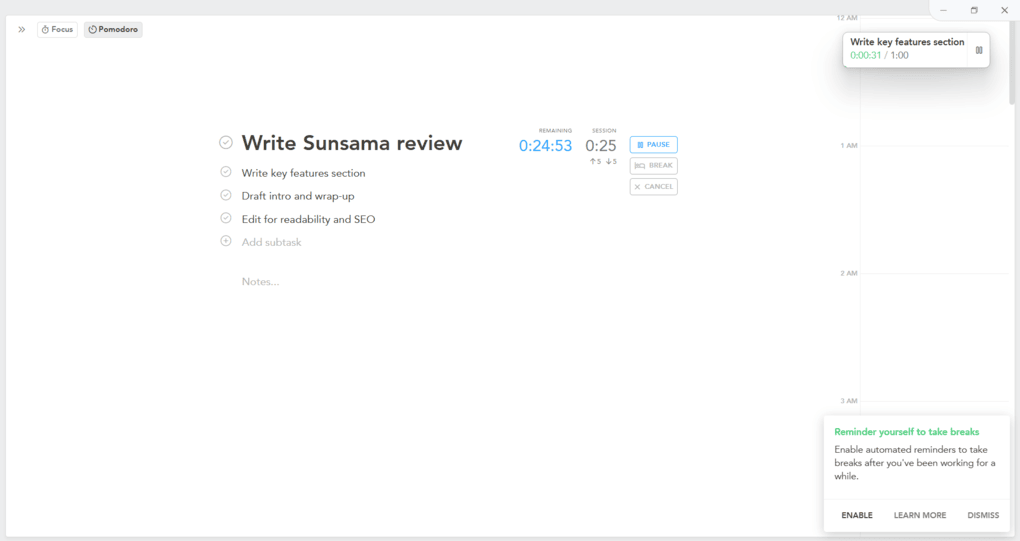
You can track time spent on subtasks as well, which is great for multiple projects or detailed work. At the top of each channel, Sunsama shows how much planned time you still have left for the day. This makes it easier to avoid overcommitting and stay realistic.
Focus Mode and the Pomodoro style timer help you stay in deep work. These tools reduce distractions and support mindful work sessions. Sunsama also provides analytics and time distribution graphs so you can see exactly how your days were spent.
Customization & settings
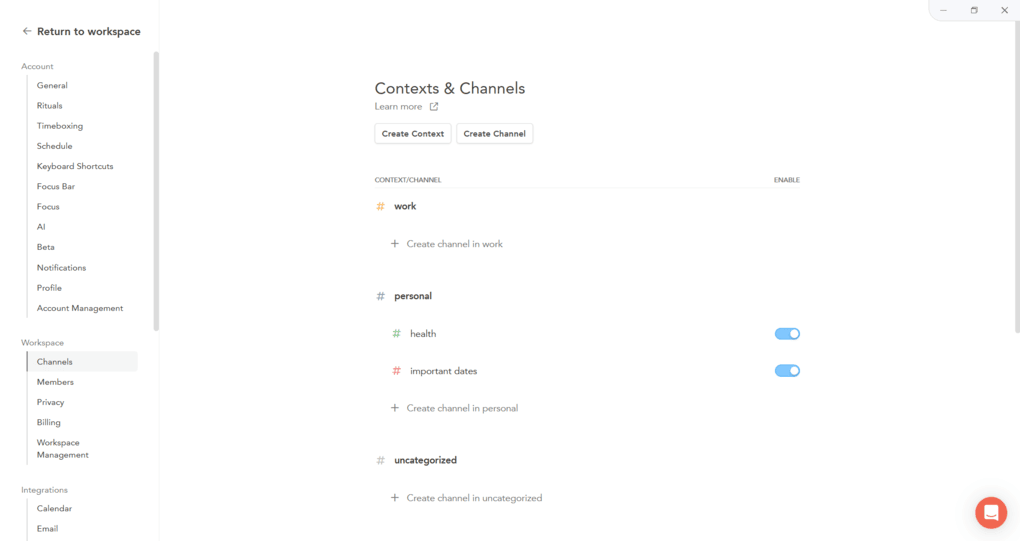
Sunsama gives you a lot of control over your planning process. You can customize channels, contexts, task views, colors, filters, and workflows. Everything is designed to help you stay organized without feeling overwhelmed.
Channels categorize your work so you can understand where your time is going. Contexts group multiple channels so you can focus on specific areas like work or personal life. This structure makes Sunsama feel intentional and easy to navigate.
The Settings menu is extensive. You can adjust rituals, planned time behavior, notifications, integrations, and daily or weekly flows. With so many options, Sunsama can fit different working styles and planning habits.
Integrations
Now, it’s time to check the integrations in our Sunsama vs Akiflow comparison!
Akiflow’s integrations
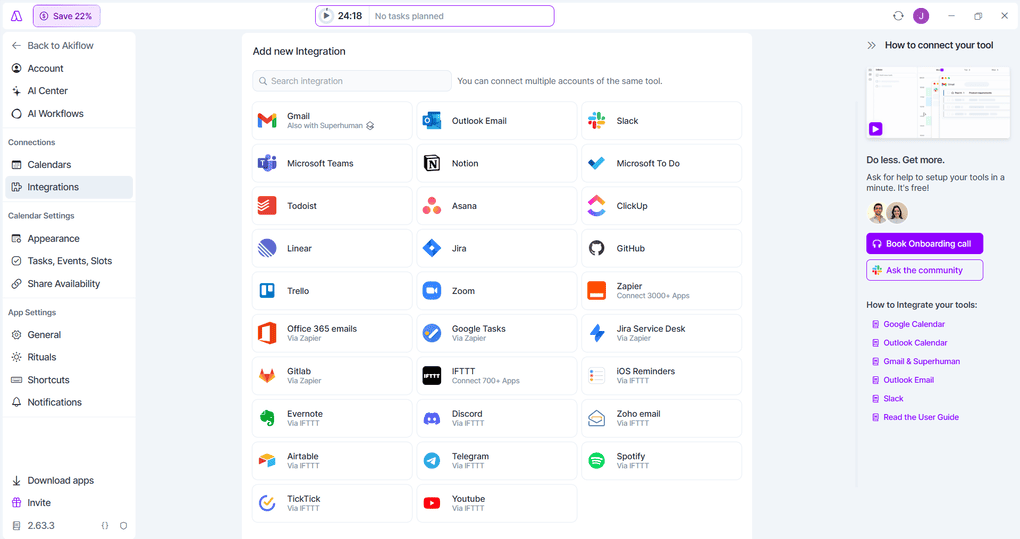
Akiflow offers seamless integration with most tools you probably already use, such as Google Calendar, Outlook Calendar, Gmail and Outlook email, Slack, Zoom, and more. Multiple accounts are supported, so it is easy to keep both personal and work setups in the same place and integrate tasks from different systems.
With Gmail, you can simply star an email and have it show up in Akiflow as a task. You can even send a quick WhatsApp message to Aki, the built-in assistant, and turn that into a task.
For everything else, Akiflow leans on Zapier and IFTTT. That is where the more unusual options show up, such as Spotify and YouTube. These are not native integrations, but simple automations you set up once.
They exist for one purpose: capturing tasks from anything you are doing online. If you hear something useful in a podcast or want to save a video for later, you can turn it into a task with one click. Everything flows into your central inbox, so you never lose track of content you want to revisit.
Sunsama’s integrations
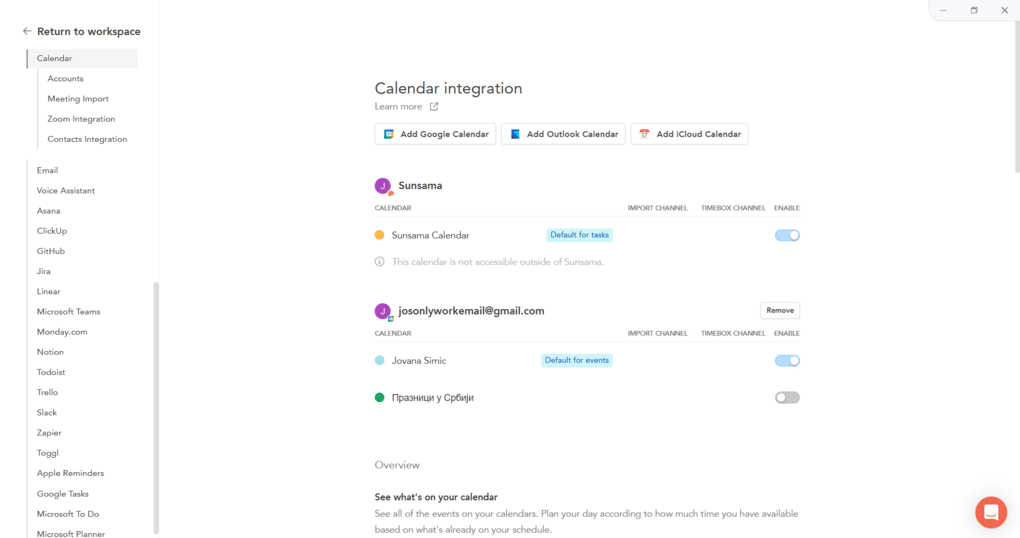
Sunsama integrates with major calendar apps, including iCloud, Google, and Outlook Calendar. Personally, I connected my Google Calendar to Sunsama, and it was quite quick. You can set defaults for tasks or events and control what gets imported.
Beyond calendars, Sunsama works with many productivity tools and task management apps. Tasks from these tools appear in the sidebar, so you can pull tasks into the calendar with drag and drop. This keeps all your tasks and projects together in one planner app.
Explore our Apps directory
A curated directory of software tools we’ve independently reviewed, with links to full reviews, comparisons, and category guides.
Pricing
In this round of the Akiflow vs Sunsama comparison, let’s take a look at the pricing structure of each daily planner app.
Akiflow’s pricing
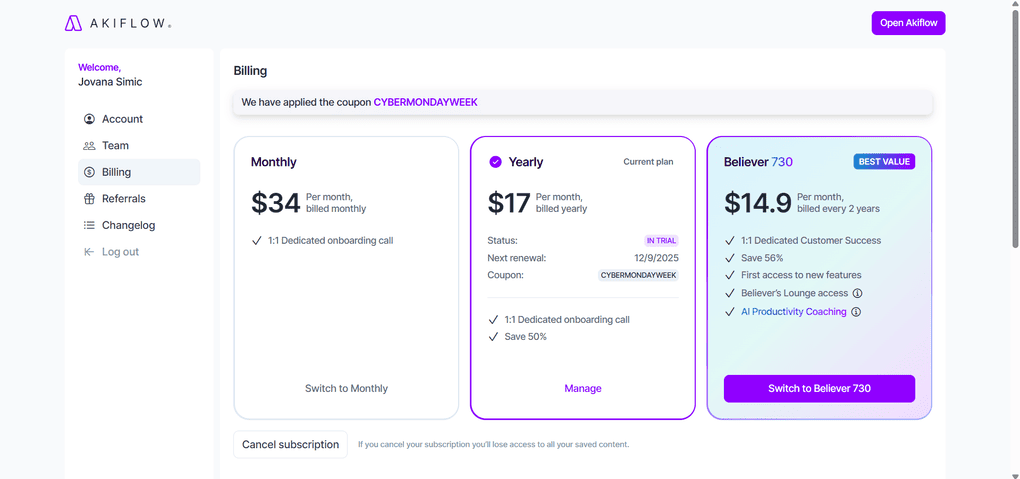
In the course of my Akiflow review, I found that it has one feature set with three billing options.
The monthly subscription costs $34 per month, the yearly subscription drops the price to $17 per month billed yearly, and the Believer 730 plan goes down to $14.90 per month billed every two years.
All three include unlimited tasks, integrations, meetings, full access to Aki, and a 1:1 onboarding call, while the Believer plan adds perks like priority customer success, early access to new features, and AI productivity coaching.
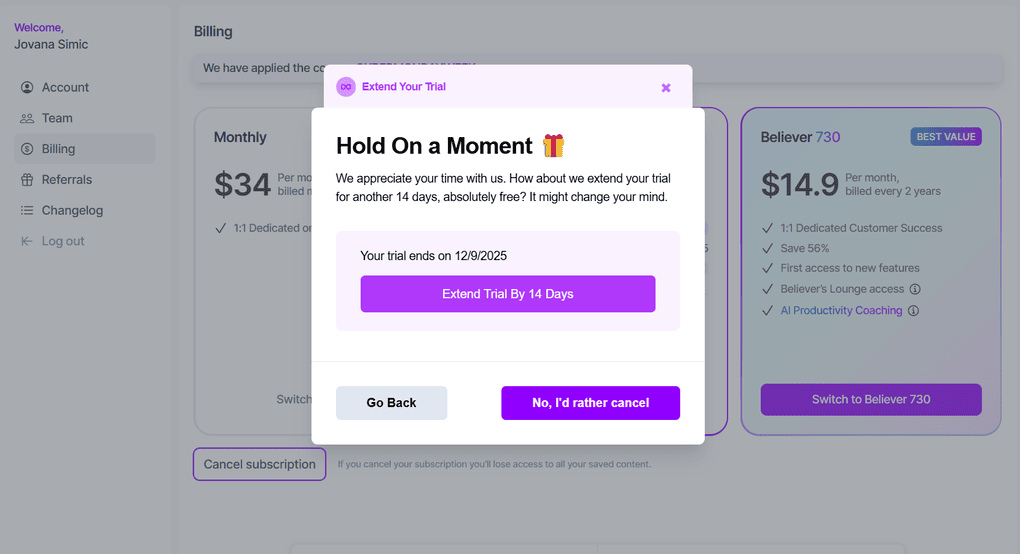
Akiflow offers a 7-day free trial for new users, and the subscription can be canceled at any time. When I clicked to cancel during my trial, Akiflow offered to extend it by another 14 days for free, and I have seen other users report the same experience, so this seems to be a common safety net rather than a one-off gesture.
Students, researchers, and teams can also request special pricing, which is helpful if you are testing Akiflow in a professional or academic setting. Still, the price is higher than most to-do lists and simple task management apps, and there is no free plan.
Akiflow positions itself closer to time-blocking and workflow tools like Sunsama. It is aimed at people who want to run their whole day from one place, not just manage a basic task list.
Sunsama’s pricing

Sunsama does not offer a free plan, but you can try it with a 14-day free trial, no credit card required. The trial unlocks the full planner app, so you can test daily planning, weekly review, time blocking, and focus mode before paying.
After the free trial, Sunsama has a single paid plan: $20 monthly subscription, or $16 per month when billed annually. All features are included in this one tier, from calendar integration and time tracking to recurring tasks, weekly objectives, and analytics.
If you want to bring others in, teammates are billed separately at $20 per user per month. Sunsama pricing is definitely on the premium side compared to other productivity tools, but many users feel the intentional planning workflow and better work-life balance justify it.
User interface
In this round of our Sunsama vs Akiflow comparison, let’s take a look at their user interfaces!
Akiflow’s user interface
The first thing that stood out to me with Akiflow was how polished it feels. This is easily one of the better-designed apps in this category, in my opinion. It looks like a serious tool, but not a heavy one.
The onboarding and everyday guidance are very well done. I always felt like the app was quietly showing me what to do next. Everything is highly customizable in a practical way, and most things worked exactly how I expected the first time I clicked on them.
Sunsama’s user interface
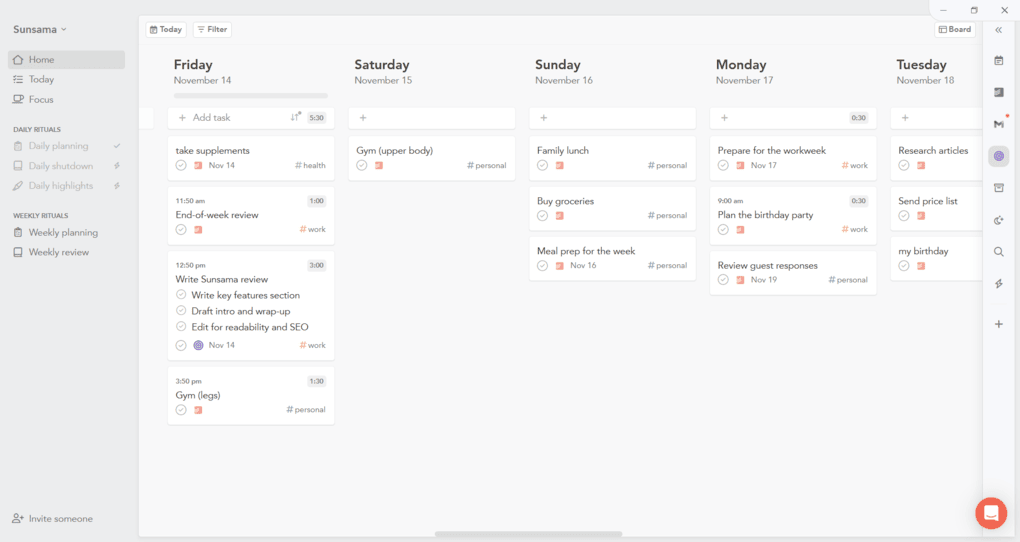
Sunsama’s user interface feels thoughtfully designed, with lots of small details that show how much attention was given to real user needs. The left sidebar, main calendar, and right sidebar work together nicely, so tasks, channels, and settings always feel close at hand.
There is both a light and a dark theme, and I enjoyed using each one. Everything can be personalized and color-coded, which keeps even a busy week visually simple and easy to scan.
What I especially liked is that the desktop app feels complete. I never had to jump to the web app to change important settings or find hidden options.
Overall, I had the feeling that Sunsama’s design focuses on a minimalistic interface to enhance usability while planning.
My experience with Akiflow
I tested Akiflow on the Windows desktop app during the free trial, and it felt smooth from the start. The inbox, calendar, and Command Bar work together in a way that makes capturing and scheduling tasks feel natural. I did not have to learn anything twice, and most actions became automatic after a day or two.
What stood out the most was how easy it was to keep my day realistic. Dragging tasks into the calendar, adjusting time blocks, and checking the Today view helped me see very quickly when I was trying to fit too much into one day and when all my tasks simply did not fit in the available time slots.
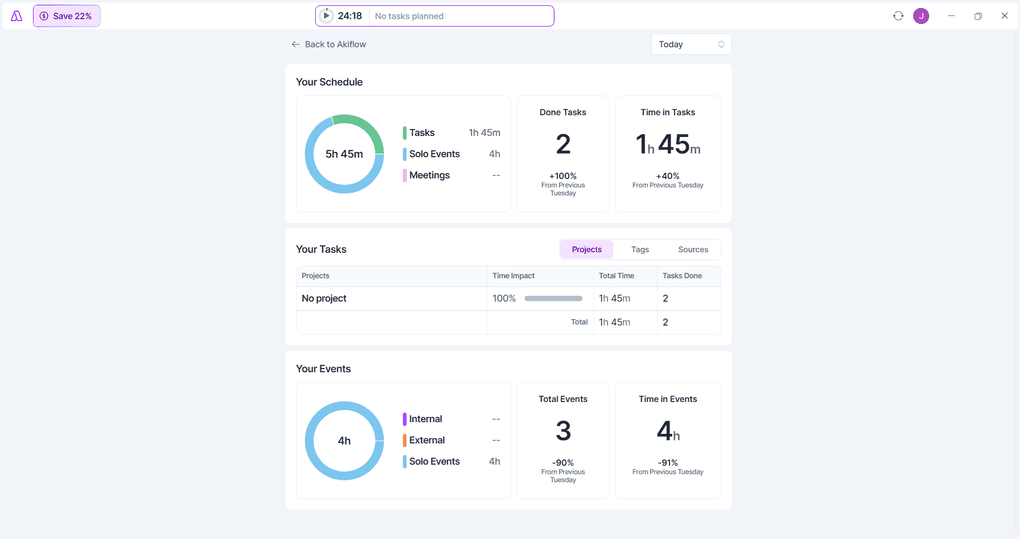
I also liked the Statistics view more than I expected. It shows how much time actually went into tasks and events, and how many tasks I finished, without overcomplicating things. It gave me just enough feedback to notice patterns in my time management, but not so much that I felt analyzed instead of helped.
Overall, Akiflow felt reliable and thoughtfully designed, especially for planning my day in a realistic way. It did not radically change how I work, but it made the parts I already do like scheduling, reviewing, and committing to tasks noticeably smoother.
You can read my full experience here: An Honest Akiflow Review 2026: Is It Worth $34 For YOU?
My experience with Sunsama
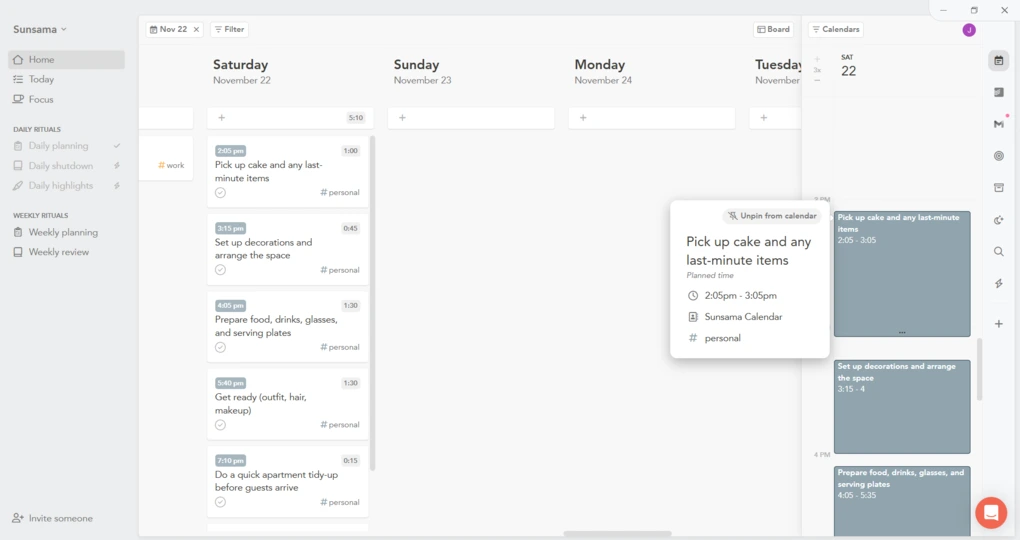
After a few weeks of planning my days in Sunsama, I understood why many people see it as a mindful productivity tool. What I appreciated most was how it encouraged intention without feeling restrictive. Weekly objectives, focus mode, and daily shutdowns helped me stay organized without burning out.
The price is on the higher side, but the overall experience felt polished and genuinely helpful for daily planning.
You can read my full experience here: An Unfiltered Sunsama Review (2026): Is It Worth $20/Month?
Akiflow’s pros and cons
Now, I will show you Akiflow’s pros and cons I discovered.

Pros of Akiflow
Cons of Akiflow
Sunsama’s pros and cons
Let’s continue with Sunsama’s pros and cons!

Pros of Sunsama
Cons of Sunsama
Alternatives to Akiflow and Sunsama
If you are not sure if Akiflow and Sunsama are the best choice for you, here are some worth considering:
|
App |
Best for |
Description |
|---|---|---|
|
Morgen |
Best for calendar-based planning |
A daily planner that prioritizes your most important to-dos, events, and projects in one app. |
|
Todoist |
Best for task management |
A popular alternative to Sunsama that offers a free plan and is great for task management and collaboration. |
|
Notion Calendar |
Best for flexible planning |
A flexible calendar built into Notion’s workspace, great for users who already manage projects, notes, and tasks there and want task integration within one platform. |
|
Reclaim AI |
Best for smart calendar automation |
Reclaim is half the price of Sunsama and offers similar task management and time blocking capabilities, but is only available for Google Calendar. |
|
ClickUp |
Best for complex workflows |
It is another alternative that provides extensive features for project management, but has a steeper learning curve. |
|
Routine |
Best minimalist planner |
Routine is a minimalist productivity app that combines calendars, tasks, notes, and simple journaling in one place. |
My pick: Akiflow vs Sunsama
If I had to choose, the decision comes down to how you want to plan your day.
Akiflow is the better choice if you want speed, flexibility, and a calendar-first workflow that adapts quickly as your day changes. Sunsama is the better option if you value structure, reflection, and intentional planning rituals that help you maintain balance over time.
Related article:
- 11 Best Daily Planner Apps | 20+ Personally Tested Tools (2026)
- 9 Best Motion Alternatives | I Tried 20+ Apps (2026)
- 7 Best Productivity Apps I Use In 2026 | 100+ Tools Tested
- 15 Best AI Tools | 200+ Apps Tested By A Skeptical (2026)
- Akiflow vs Motion (2026): My Honest Opinion
I hope I was able to help you find out whether Akiflow or Sunsama suits you the best. As always, I will keep updating this Akiflow vs Sunsama article.
Looking for similar tools?
Visit the link to explore other apps we’ve reviewed in this space and how they compare.
Why you can trust our reviews
At thebusinessdive.com, our team tests, reviews, and compares hundreds of productivity apps every year — from project management tools to note-taking apps. We dive deep into real-world use cases to help you find the right tools that actually improve your workflow, not just add noise.
Our mission? No fluff, no shortcuts—just honest, hands-on insights from productivity pros.
Discover how we stay transparent, read our review methodology, and let us know about any tools we missed.
Frequently asked questions
Is Akiflow or Sunsama better for manual task planning and daily planning?
If you prefer manual task planning and full control over how you plan your day ahead, Akiflow usually feels more flexible. It works as a fast task manager where you can quickly capture tasks in the Akiflow inbox, use the Command Bar, and then drag tasks onto your calendar to build your schedule.
Sunsama, on the other hand, helps guide your daily planning through structured routines, which works better if you want the app to slow you down and help you prioritize important tasks intentionally instead of reacting to them.
How does Akiflow vs Sunsama handle Google Calendar integration and calendar sync?
Both tools offer strong Google Calendar support, but they approach it differently. Akiflow focuses on tight calendar integration with a clear calendar view, using two-way sync so tasks and events stay aligned across multiple calendars. Sunsama also supports calendar sync, but it puts more emphasis on planning rituals, pulling tasks from third-party tools, and scheduling them into realistic time slots.
In short, Akiflow vs Sunsama comes down to whether you want speed and flexibility or structure and reflection.
Which planner app is better for staying focused during the workday?
Sunsama has an advantage here thanks to its built-in focus mode, Pomodoro-style sessions, and time tracking, which helps users stay focused and understand where their time actually goes. Akiflow includes a simpler focus timer and relies more on fast interactions, keyboard shortcuts, and quick scheduling to reduce friction.
Both are strong daily planner apps, but Sunsama helps create deeper focus through routine, while Akiflow helps by removing distractions.
Are Akiflow and Sunsama suitable for personal use or professional use?
Both tools work well for personal use and professional use, but in different ways. Akiflow is ideal if you juggle multiple tools, meetings, and projects and want a single productivity tool to manage everything in one place. Sunsama works best for individuals or small teams who want to plan their week, review completed work, and maintain balance.
In practice, Akiflow works better as a personal assistant for busy professionals, while Sunsama helps create sustainable planning habits.
What are the main differences in the final verdict of Sunsama vs Akiflow?
The main differences come down to philosophy. Akiflow lets you quickly schedule tasks, manage projects, and control your day with speed and flexibility, making it a strong option among the best daily planner apps for reactive workflows. Sunsama takes a more intentional approach and helps users reflect, prioritize, and plan realistically.
In this final verdict, Akiflow vs Sunsama is not about features alone, but about whether you prefer freedom and speed or structure and guidance when planning your days.
Disclosure: I only recommend products I would use myself, and all opinions expressed here are our own. This post may contain affiliate links that, at no additional cost to you, may earn a small commission. Read the full privacy policy here.

Hey! I’m Jovana, a content writer who loves writing, researching, and testing new productivity apps. With a background in philosophy, I bring a thoughtful but no-bullshit approach to everything I do. Let’s connect on Linkedin!