


Why Most Productivity Systems Fail (and What Habit Data Reveals)
A lot of gurus talk about productivity systems. And most of them are built around productivity tools. Nonetheless, besides the productivity apps, the daily habits are as important as, if not more important than, the apps you use.
But still, many productivity systems fail. But why?
I pulled up the research on why people quit and found out the failures are not random. They cluster. Five patterns.
Scroll down, and I will show you every single one of them.
Let’s dive in!
Why Most Productivity Systems Fail And How To Build The Right One
Let’s break down how you can avoid the mistakes most people make when creating their productivity system, and what tricks help you establish the right productivity system for you.
You Built the System Around Motivation Instead of Friction
The average person checks their phone 352 times per day. Three hundred and fifty-two. I did not believe that number when I first read it, so I looked up the source, and then I believed it. That is not a discipline problem.
BJ Fogg at Stanford calls it the motivation wave, and the core idea is that motivation is unstable. It spikes on Sunday night when you are setting up the new system. It is gone on Wednesday afternoon when Slack will not stop, and you have not slept.
But the truth is that the system that survives is the one that works when you are tired. No more than 2 steps between sitting down and starting. If starting requires energy, it will not last. The second pattern is picking the wrong time horizon.
You Picked the Wrong Time Horizon for Habit Formation
Twenty-one days. You have heard this. It is wrong. Phillippa Lally at UCL ran 96 people through habit formation, and the average time to automaticity was 66 days.
The range was 18 to 254. A 2024 meta-analysis confirmed it, with a median of 59 to 66 days, and individual ranges from 4 to 335. If you do a 30-day challenge and stop tracking on day 31, you quit in the middle. I did this with journaling.
Thirty days felt good, stopped tracking, and by day 40, the notebook was under mail. Second attempt, I committed to 90 days with no expectation of it feeling automatic before week 10. That one survived. I still write every morning, two years later.
Lally’s data also showed that exercise habits took 1.5 times longer to reach automaticity than eating or drinking habits, which I did not expect at all.
Do not evaluate early. Track whether you did it, not how it felt. The third pattern is too many tools doing too little.
You Had Too Many Tools Doing Too Little
A study cited in Harvard Business Review found digital workers toggle between apps 1,200 times per day. Four hours per week just reorienting. Nine percent of annual work time, not lost to distraction but lost to the tools that were supposed to prevent distraction.
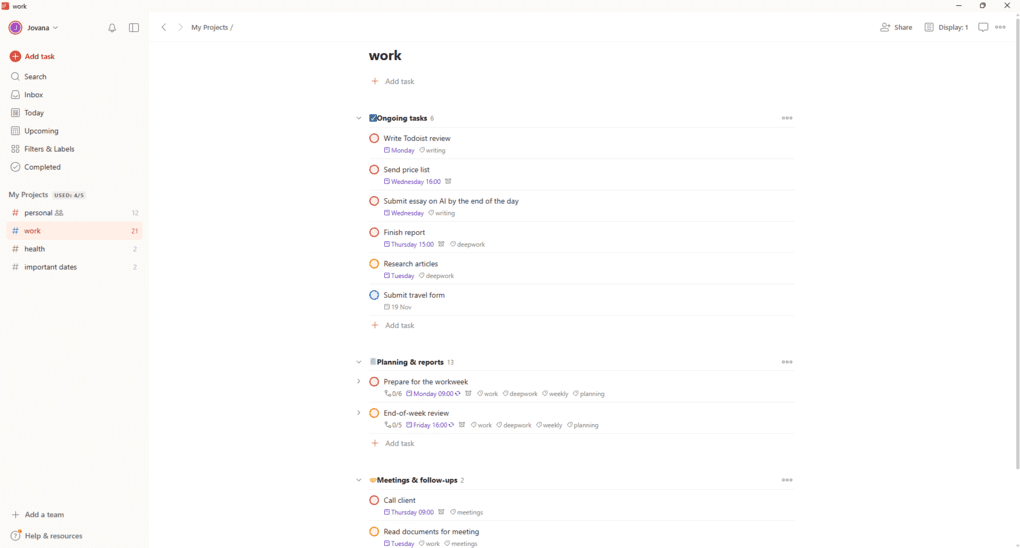
I was running five apps at one point. Todoist, Google Calendar, Notion, Forest, and a separate habit tracker. Starting a focus block meant checking one, opening another, tapping a third.
Three context switches before a single line of code. Gloria Mark at UC Irvine found that the average screen attention span is now 47 seconds, down from 75 in 2012. Every switch eats into that.
This is why it is important to have an integrated system of productivity apps that lets you switch between apps without having to find all your workflows in one place.
Fewer switches. More time for the actual work. The fourth pattern is planning the system without planning the triggers.
You Planned the System But Never Planned the Triggers
I see this constantly with founders and engineers. Categories, color codes, priority matrices, and then no definition of when or where the behavior actually happens.
Kahneman’s research on the planning fallacy showed we systematically overestimate our future discipline. We are imagining a version of ourselves that has never existed. Peter Gollwitzer’s work on implementation intentions is what changed my thinking here.
His meta-analysis covered 94 studies and more than 8,000 participants, and people who wrote specific if-then triggers followed through at dramatically higher rates. Effect size d equals 0.65.
The difference between those two things is the difference between I will meditate for ten minutes after I pour my coffee and I will meditate more this year. One hooks to a physical event that already happens every day. The other floats until you forget. At Life360, I wanted to read more.
Reminders did nothing. What worked was that after I closed my laptop, I read for fifteen minutes before I left my desk. The trigger was the lid going down. One sentence per habit.
After existing behavior, I will do new behavior for a specific duration. If you cannot write that sentence, you do not have a trigger; you have a wish. The fifth pattern is the one I know most personally.
You Optimized for Tracking Instead of Doing
Twenty minutes configuring the tracker. Color coding. Streak dashboards. Feeling productive because the system looks good. The habits have not started.
A friend spent a weekend building a Notion fitness dashboard, templates, progress bars, and linked databases, and it lasted nine days because he burned his startup energy on the container instead of the contents. The tracker is not the system.
The research on why systems beat goals for building routines is about shifting from outcomes to processes, walking after lunch, not losing ten pounds, reading before bed, and not finishing fifty books. Still, people confuse building a system with building a tracker for the system.
More than half of the people who set New Year’s resolutions fail within six months, and the reason isn’t bad goals. Five-minute rule on setup.
One metric per habit, did I do it, yes or no? Blank notebook and a pen if that is what it takes. Sophistication comes after sixty days, not before. The productivity industry sells systems.
The research says those systems fail for five reasons that are predictable, documented, and fixable without buying anything. They depend on motivation.
They assume habits form in three weeks. They scatter attention across too many tools. They skip the triggers. They reward setup over action. I do not know why I kept rebuilding systems without reading the research on why systems fail.
I do not know if knowing this earlier would have actually changed anything or if I needed to hit all five patterns myself before any of this would land. That is the part I have not figured out yet.
What can you do to ensure your productivity system lasts long?
If you want your productivity system to survive the first weeks and months, you need to focus on simplicity and consistency.
As for simplicity, use a straightforward app like Habi to bring routines, timers, and tools like screen time blocking into one organized space. It assists you in growing the habits you want and cutting the ones that hold you back.
And secondly, you need to be consistent. There are no productivity or business apps, even the best ones, that can save you from doing the hard work and take one step ahead every single day.
Wrap-Up: Productivity System
As yoy can see, building the best productivity system for you should not be complicated. One thing you need to take away from this article is that the productivity system does not need to be shiny, complex, color-coded, etc. It has to be simple, and you need to be consistent with your routines.
Data shows that most productivity systems fail after a short period of time. To give your best shot, I recommend using one app or multiple productivity tools that you integrate into a single platform. And be consistent, because it is always easier to break a good habit than to build a bad, comfortable one.
Frequently Asked Questions
What are productivity systems?
The productivity system is a collection of tools and habits to manage work effectively on a day-to-day basis.
What is the 3-3-3 rule for productivity?
It means that you organize your workday into three clear parts: Three hours of focused work. Three important tasks. Three maintenance tasks.
What are the 4 productivity styles?
There are four types of productivity styles: Prioritizer, Planner, Arranger, and Visualizer. Prioritizers prefer logical, realistic thinking, while planners use organized, sequential thinking to complete tasks.
On the other hand, arrangers play a more supportive and expressive role, while visualizers prefer a holistic, intuitive approach.

Hey there! I am Aron, the founder of Thebusinessdive. I have been testing productivity apps for almost three years now. I reach 25.000 -50.000 people monthly with the mission to help you find the perfect productivity apps. Subscribe to my YouTube channel, newsletter, and social media to hear more about the best productivity tools. Let’s dive in!