


How we test AI note-takers at TheBusinessDive
To stay transparent, we want to explain how we test AI note-taking apps at TheBusinessDive.
Our testing framework (at a glance)
- Average testing time per tool: 7–21 days
- Number of tools tested: 20+ AI note-takers
- Test scenarios: team meetings, client calls, and multi-speaker conversations
- Platforms tested: Web, mobile, and meeting integrations (when available)
- Review process: the same framework is applied across all AI note-taker reviews
This structured approach ensures that every tool is evaluated consistently and under comparable conditions.
Our scoring system for AI note-takers
Our scoring system for AI note-takers is built on 3+ years of hands-on testing across 20+ apps and real-world use cases.
The goal is simple: help you quickly decide whether an AI note-taker is for you or not — based on structured, repeatable testing criteria, not marketing claims.
Each AI note-taking app is evaluated across 10 key factors, with a strong emphasis on real functionality and everyday usability.
How we score AI note-takers (quick breakdown)
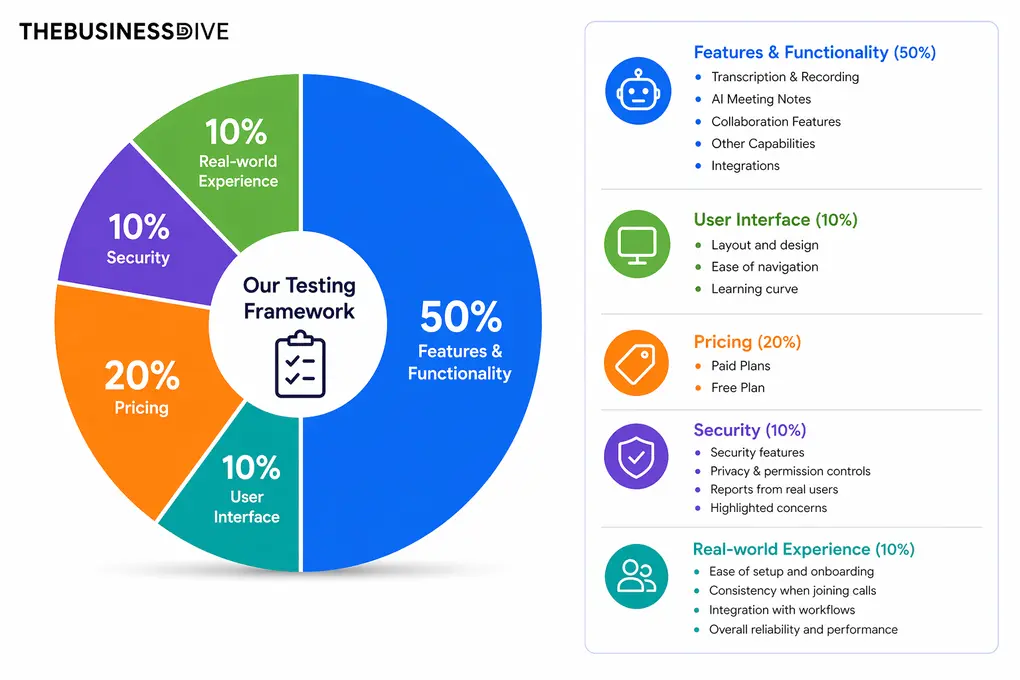
Features & functionality → 50%
User interface → 10%
Pricing → 20%
Security → 10%
Real-world experience → 10%
Features & functionality (60%)
We test each AI note-takers across the following areas:
Transcription & Recording
We test:
Transcription accuracy
Correct speaker identification
To what extent can you edit the transcription
If transcription redaction is available
Whether it has recording capabilities or not
Is it possible to pause or stop the recording
We use each tool for 3-5 personal or business meetings on multiple platforms to see how accurate the transcript is.
AI Meeting Notes
We evaluate:
How the AI note-taker structures the meeting notes
How accurate are the meeting notes
If it offers different meeting templates or not
Is it possible to edit and redact the meeting notes
Collaboration features
When giving our rating for the collaboration features, we consider the following:
Sharing options for AI meeting notes and transcriptions
Is it possible to assign tasks in meeting notes or transcription for team members
Can you organize your call with your team members
Other team collaboration features
Other capabilities
We test:
Built-in Ask AI features (speed, accuracy, handling multiple meetings)
Additional unique features, e.g., noise cancellation, AI reports, meeting agenda
Integrations
We evaluate:
Available integrations with third-party apps
Ease of setup and connection
Effectiveness of integration in real workflows
User interface (10%)
We test:
Layout and design
Ease of navigation
Learning curve for new users
Paid and free plans (20%)
We evaluate and compare the available subscriptions in the following areas:
Paid Plans
We test:
Value for money
Comparison to similar AI note-takers
Transparency and flexibility
Free Plan
We analyze:
Availability and limitations
Overall usability and functionality
Privacy and safety (10%)
Many of you have numerous sensitive meetings and no one wants it data to be leaked
We assess how well the tool protects sensitive data:
Built-in security features
Privacy and permission controls
Reports from real users (Reddit, TrustPilot, reviews)
Highlighted concerns in reviews
If we identify concerns, we highlight them in a dedicated section within the review.
Real-world experience (10%)
Finally, we evaluate how the tool performs in everyday use:
Ease of setup and onboarding
Consistency when joining calls
Integration with workflows
Overall reliability and performance
Our testing approach
AI note-takers are not traditional note-taking tools. Their main role is to automatically capture, process, and summarize conversations.
Because of that, we test them differently from standard productivity apps.
We test AI note-takers by using them in real meetings and conversations. This includes joining calls, recording discussions, reviewing transcripts, and evaluating how useful the generated notes are after the meeting ends.
This testing framework is used across all of our AI note-takers-related content, including individual reviews, comparisons, and “best of” guides. All recommendations are based on this same evaluation process, not on one-off impressions.
Testing duration & depth
Each AI note-taker is tested for at least 1–3 weeks, not just a short trial.
We use every tool across multiple meetings, platforms, and conversation types to understand how it performs over time. This includes testing different audio qualities, multiple speakers, and varying meeting formats.
Why AI note-taking apps are hard to compare
AI note-takers can appear similar, but their output can vary significantly depending on real-world usage.
From our testing, here are the main reasons they are difficult to compare:
- Output variability. Results depend on meeting quality and structure
- Different interpretations of AI features. Summaries and notes vary widely between tools
- Lack of transparency in limits. Usage caps and restrictions are often unclear
- Real versus demo performance. Demos often show ideal scenarios, not real meetings
Because of this, the real value of a tool is only clear after using it in real conversations.
Real scenarios we test
We do not just explore features. We simulate real meeting environments:
- Recording team meetings with multiple participants
- Running client and sales calls
- Testing different audio qualities and speaking styles
- Reviewing transcripts and summaries after meetings
- Checking how easily notes can be shared and reused
This allows us to evaluate how tools perform in realistic conditions.
How we test AI note-taking apps
We do not rely on short demos or a single meeting. We use each tool across multiple real conversations.
We join calls on different platforms, record meetings, and review transcripts and summaries afterward. We evaluate how much editing is required and whether the output is usable without additional work.
During testing, we look for clear answers to questions like:
- Are transcripts accurate enough to rely on?
- Do summaries reflect actual decisions and key points?
- Can someone who missed the meeting understand what happened?
- Does the tool reduce follow-up work or create more?
Testing across different meeting types helps us evaluate consistency and reliability over time.
Proof of testing
All screenshots and videos included in our reviews are:
- created during our own testing
- based on real meetings and conversations
- never taken from marketing materials
This ensures that all visuals reflect real product usage.
Check out some of our reviews to see how it works in practice:
What we don’t do
Just as important as what we test is what we intentionally avoid:
- We do not rely only on demos or promotional examples
- We do not rank tools based on affiliate commissions
- We do not test tools for only a few hours
- We do not assume AI-generated notes are always correct
AI note-takers require careful evaluation, especially when used for important conversations.
How we make recommendations
Instead of calling one tool “the best,” we focus on specific use cases, such as:
- Best for team meetings
- Best for sales or client calls
- Best for detailed transcripts
- Best budget option
This makes it easier to choose a tool based on how it will actually be used.
How often are reviews updated
AI note-takers evolve quickly. Models improve, features change, and pricing structures shift.
We revisit reviews when:
- transcription quality improves
- major AI features are released
- pricing or usage limits change
Keeping reviews up to date is essential in this category.
Transparency & monetization
Some of our articles include affiliate links. If you sign up through one of them, we may earn a commission at no extra cost to you.
This never influences how tools are tested, ranked, or recommended.