


The 4 Biggest Takeaways From My Copper CRM Review
Copper is often recommended as the CRM for Google Workspace users, but after testing it myself, I realized there’s much more to the story.
During my Copper CRM review, I found four things that most reviews barely mention:
- Teams don’t choose Copper because it has more CRM features, but because it keeps them inside Gmail.
- Copper is especially popular with startups because it’s quick to roll out and easy for new teams to adopt.
- The biggest frustrations aren’t usually about the CRM itself, but about pricing and seat management as teams grow.
- Copper works best for businesses already committed to Google Workspace, but it’s a much harder sell for Microsoft 365 teams.
I wanted to see whether those patterns matched my own experience, so I tested Copper’s contact management, pipeline management, automation, reporting, integrations, and pricing.
For more insights from my hands-on testing, keep reading this Copper CRM review.
Verdict
Here’s the quick verdict if you don’t want to read the full review:
🎯 Best for: Small to midsize businesses already using Google Workspace that want an intuitive CRM with strong pipeline management and automation.
🚫 Not ideal for: Teams looking for a free CRM or advanced reporting on a lower-priced plan.
⭐ Biggest strength: Seamless Google Workspace integration paired with a clean, easy-to-use interface.
⚠️ Biggest weakness: Many advanced features, including Custom Reports, are only available on the expensive Business plan.
⚖️ Verdict: If your team works in Google Workspace, it offers an excellent balance of usability, automation, and integrations, though you’ll need the Business plan to unlock its full potential.
🏆 Score: 4.4 / 5
✅ Tested with our review & scoring methodology ✅ Real-world testing ✅ Unbiased evaluation
Copper CRM
Summary
Copper CRM is an intuitive CRM built around Google Workspace, offering excellent contact management, flexible pipelines, and powerful automation. It stands out for its ease of use and seamless Gmail integration, though the lack of a free plan and Business-only advanced features make it a better fit for teams already invested in the Google ecosystem.
|
|
Clean and intuitive interface
|
|
|
Excellent Google Workspace integration with Gmail, Calendar, Drive, and Contacts
|
|
|
Flexible pipeline templates
|
|
|
Well-organized contact and opportunity records
|
|
|
Built-in email, task, and workflow automation
|
|
|
No free plan
|
|
|
Custom Reports are only available on the Business plan
|
|
|
Business plan pricing increases significantly as your team grows
|
|
|
Fewer advanced reporting and customization options than enterprise CRMs like Salesforce or HubSpot
|
How We Test CRM Apps
To keep our reviews and final scores fair and consistent, we evaluate every CRM app using a standardized testing framework based on real-world sales workflows and hands-on testing.
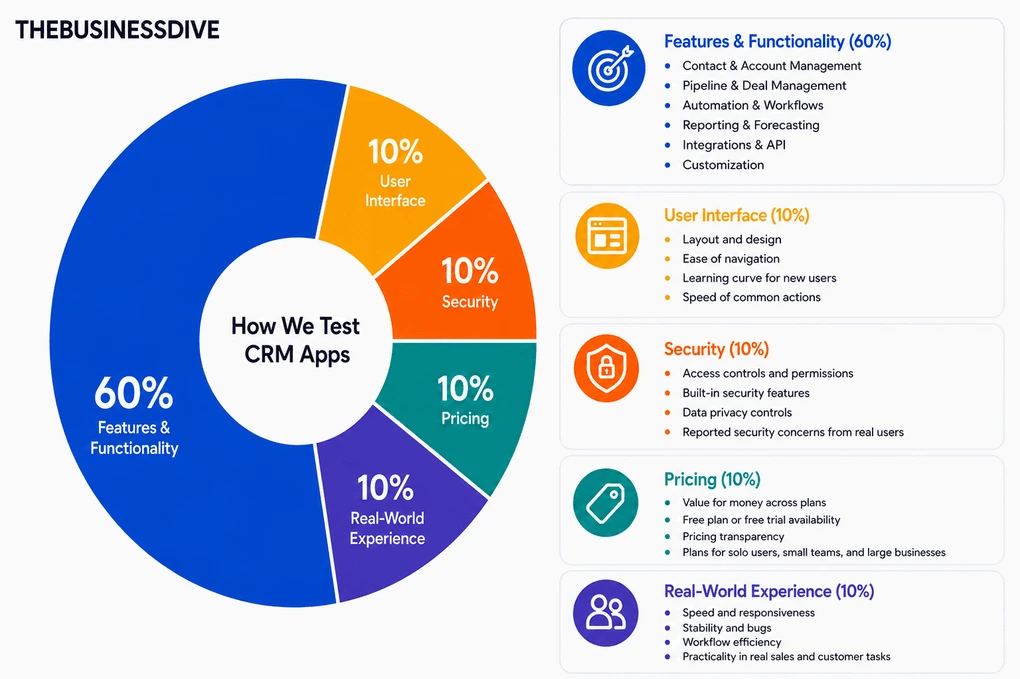
Our scoring breakdown after testing 10+ CRM apps:
🤖 Features & functionality — 60%
🖥️ User interface — 10%
💰 Pricing — 10%
🔐 Security — 10%
👥 Real-world experience — 10%
Want a detailed breakdown of how we test each category?
Learn exactly how we test tools → Review methodology
Short on time? Here’s a quick overview of Copper
What is Copper CRM?
Copper CRM is a cloud-based customer relationship management platform designed to help businesses manage contacts, leads, deals, and projects in one place.
Unlike many traditional CRMs, it’s built specifically for Google Workspace, allowing teams to work directly from Gmail, Google Calendar, and Google Drive.
It’s used by more than 30,000 companies across 100+ countries.
Testing Copper CRM: My experience
Getting started with Copper didn’t take long. After creating my account, I was able to import contacts, build a test pipeline, and start exploring the platform without needing much setup.
As I spent more time with the CRM, I appreciated how consistent the experience remained across different sections. Whether I was managing contacts, working with deals, or exploring automation, the overall layout stayed familiar.
The only limitation I ran into during testing was that some advanced functionality wasn’t included in my trial. Aside from that, testing the platform was straightforward, especially since it’s designed to work closely with Google Workspace.
Why did it get a 4.7 / 5?
Copper stood out for its clean interface, intuitive navigation, and seamless Google Workspace integration. Creating pipelines, managing contacts, and setting up automations all felt straightforward, while the wide range of native integrations adds even more flexibility.
The main drawback is that several advanced features, including Custom Reports, are limited to the Business plan. Combined with the lack of a free plan and the higher cost of Business, these limitations kept Copper from earning a perfect score.
Who should use Copper CRM
Who should consider alternatives
A closer look at Copper CRM
Contact management
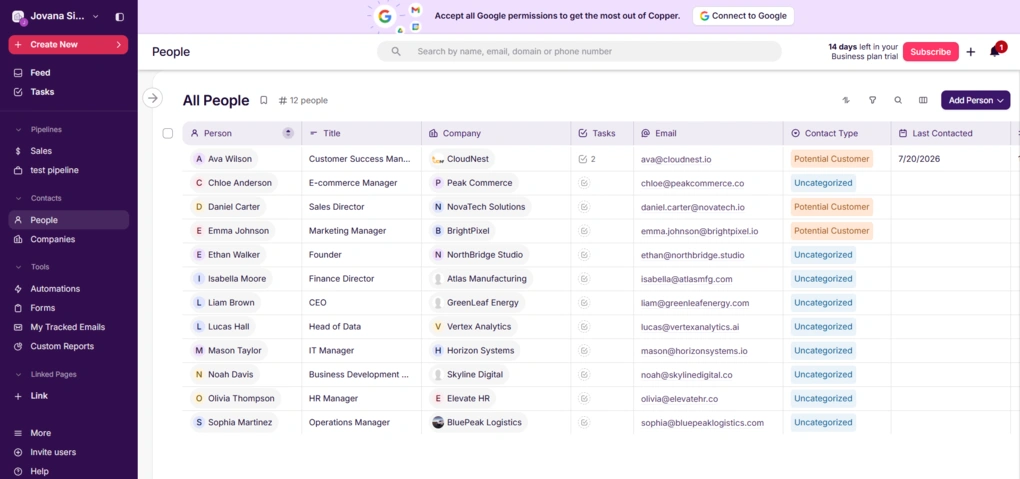
The first thing I tested in Copper was contact management, since that’s the foundation of any CRM.
Adding contacts is straightforward. Copper separates everything into People and Companies, and you can create either one with a few clicks. The form itself is simple, asking for the basics first, while additional information can be added later.
If you’re migrating from another CRM or already have an existing contact database, Copper also supports importing contacts from Excel, CSV, Google Contacts, Google Sheets, and several popular CRMs. I imported my test contacts from an Excel spreadsheet, and the process was easy to follow.
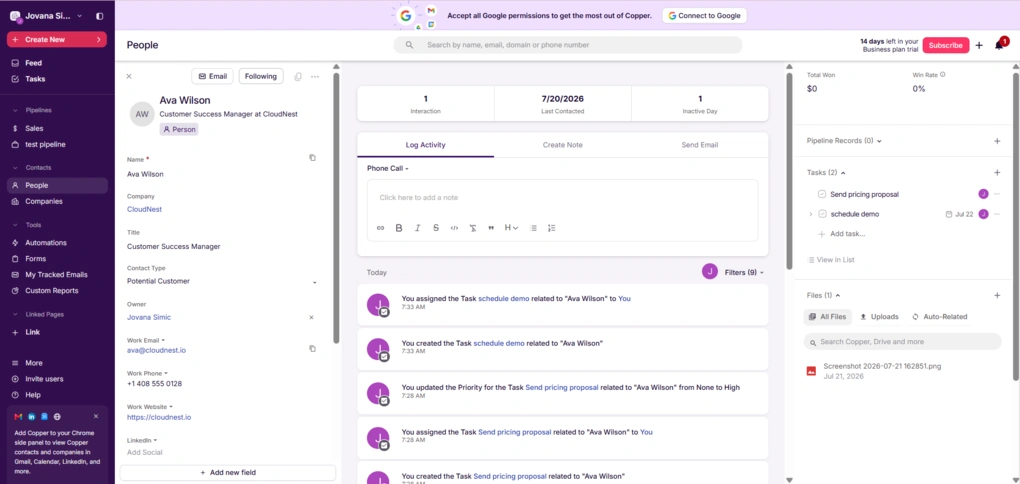
Opening a contact gives you much more than a profile page. Everything is centered around an activity timeline that records what happened and when. From the same screen, I could log phone calls, create notes, send emails, and see previous interactions.
The contact record also displays assigned tasks, pipeline records, and related files, so all the information tied to that customer stays in one place.
Copper also includes email tracking through its Chrome extension, letting you see when contacts open your emails directly from the CRM.
Pipeline management
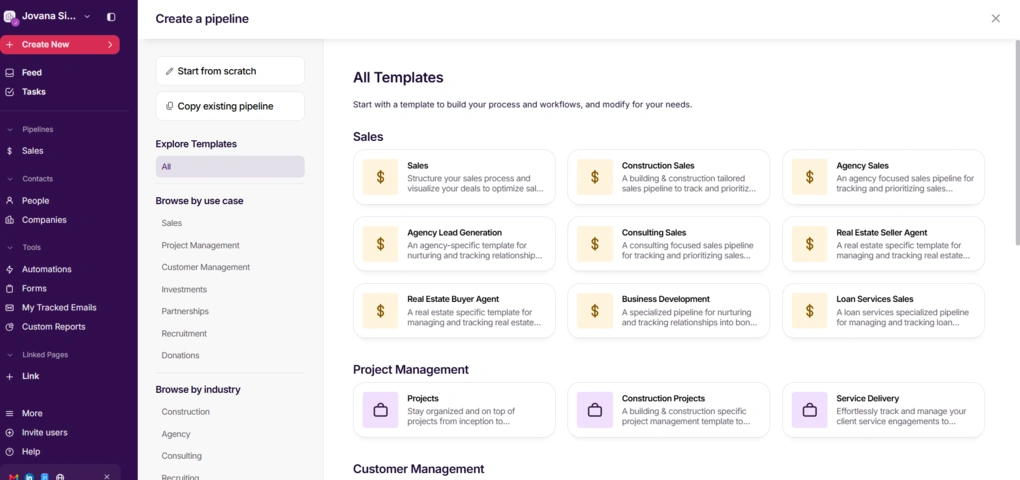
Before building my own pipeline, I spent some time exploring Copper’s templates. There are options for much more than sales, including customer onboarding, account renewals, customer support, project management, recruitment, partnerships, fundraising, and real estate.
I started with the Sales template, then created a Projects pipeline to see how it was structured. After that, I built a pipeline from scratch, which let me customize every stage and get a better sense of how flexible the setup process is.
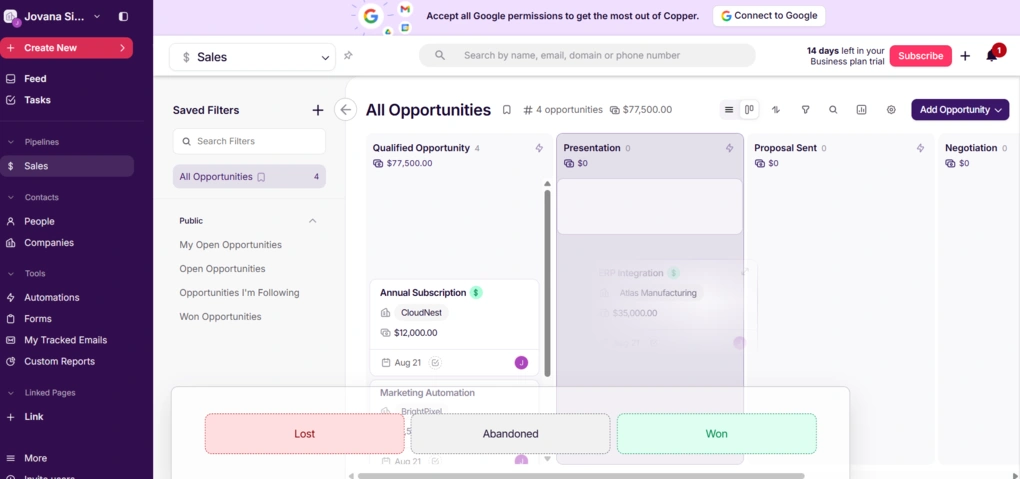
Once everything was set up, I started adding opportunities to see how Copper handles deals. Each opportunity can be linked to a company and individual contacts while storing details like the expected value, close date, owner, and status.
Opening an opportunity gives you the same workspace as a contact record. I could log calls, create notes, send emails, add follow-up tasks, and review previous activity without leaving the deal page.
I also switched between the two available pipeline views while testing. I mostly used the Board to move opportunities through different stages, but the List view made it easier to scan key details.
Task management
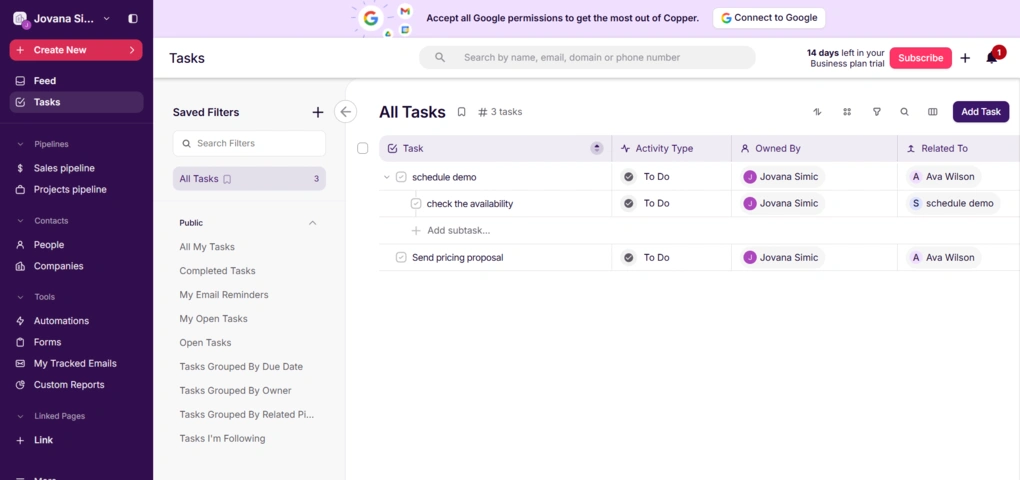
Copper also includes built-in task management, so you can plan follow-ups.
I could create tasks directly from a contact record, assign them, set a due date, and choose a priority level.
I also liked that every task-related action is recorded in the activity timeline. Creating a task, assigning it, or changing its priority is automatically logged, giving you a clear history of what has happened with each customer.
Automation
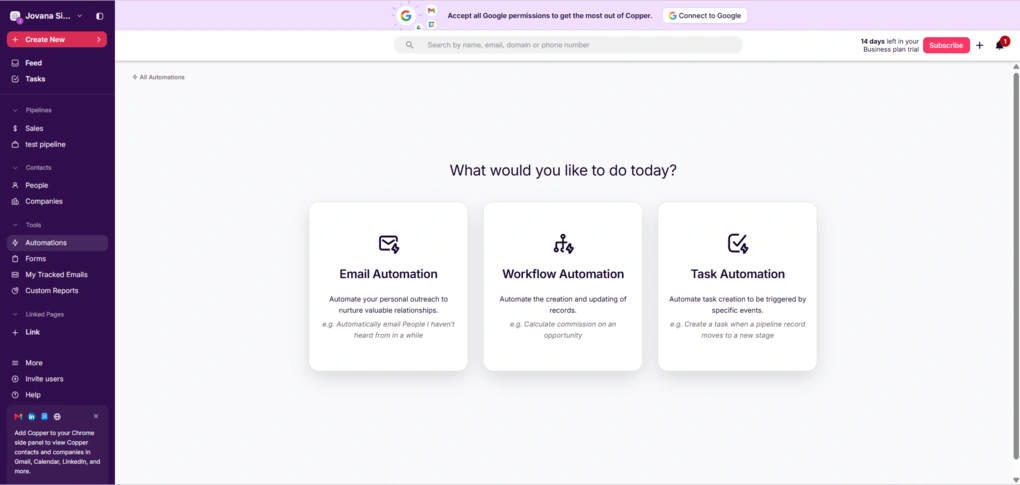
Copper separates automation into three categories: Email Automation, Workflow Automation, and Task Automation, each designed for a different type of workflow.
Email Automation comes with ready-made templates. There are templates for automatically following up with inactive contacts, emailing people in saved filters, reaching out to a company’s primary contact, or sending emails when a pipeline record reaches a specific stage or is closed.
Next, I looked at Task Automation. Instead of manually creating recurring follow-ups, I could define a trigger, choose the entity it applies to, and configure the task that should be created.
The setup also lets you specify details like the activity type, due date, reminder, owner, priority, visibility, tags, and description before the automation runs.
Finally, I tested Workflow Automation, which uses a trigger-and-action builder. In my case, I created a workflow that starts when a pipeline record is created and automatically generates a related task.
Copper also lets you add trigger conditions, combine multiple rules with AND, OR, or custom logic, and configure additional actions from the same workflow.
If your team already uses Gmail, Copper’s Gmail integration makes these automations even more useful by keeping email activity connected to your contacts and workflows.
Reports
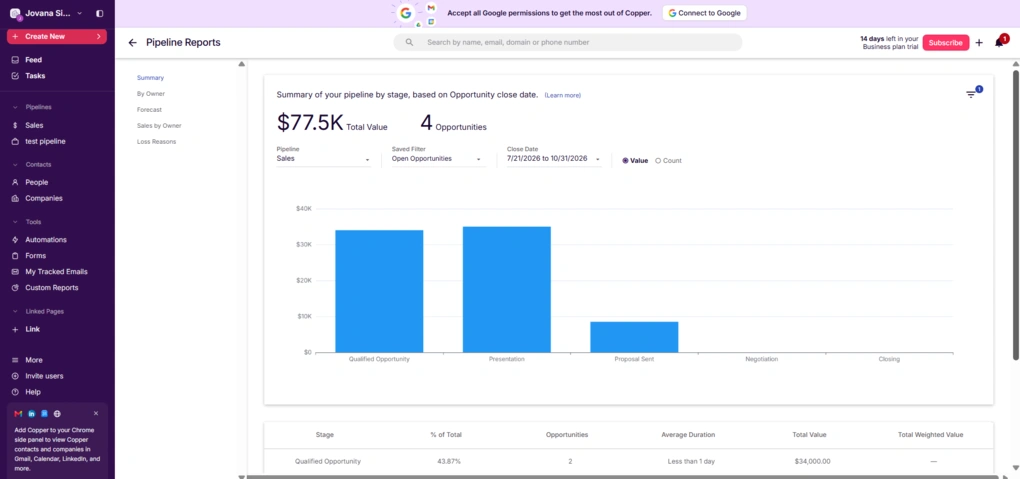
Once I had a few opportunities in my pipeline, I switched to Pipeline Reports to see how Copper visualizes sales data.
The default report gives a stage-by-stage breakdown of your pipeline, showing the total pipeline value, number of opportunities, and how deals are distributed across each stage.
Below the chart, Copper generates a table with more detailed metrics for each stage. Since I had already created opportunities during testing, the reports updated automatically with my sample data.
I also explored the Custom Reports section, but it wasn’t available on my trial account. Copper requires the Business plan to build custom reports, dashboards, and more advanced analytics.
Copper CRM integrations
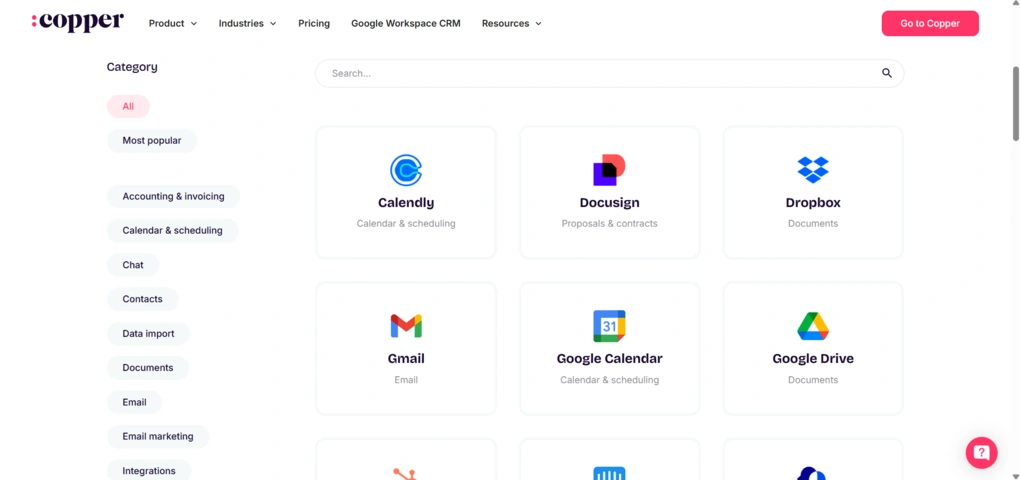
One of Copper’s biggest strengths is how closely it’s built around Google Workspace. Copper integrates with Gmail, Google Calendar, Google Drive, and Google Contacts and available on every plan, so the CRM fits naturally into an existing Google-based workflow.
Beyond Google Workspace, Copper supports integrations with tools like Mailchimp, QuickBooks Online, Slack, DocuSign, PandaDoc, Dropbox, Zendesk, RingCentral, and Xero, with access to 9,000+ additional app integrations through Zapier, plus custom integrations via the Copper API.
Copper CRM user interface
Copper has a very clean interface. The left sidebar keeps every major section within easy reach, while the top search bar makes it quick to find people, companies, or opportunities from anywhere in the CRM.
I also liked that the layout stays consistent across different records. Whether I opened a contact, company, or opportunity, the overall structure remained the same, so I didn’t have to relearn where to find activities, notes, tasks, or emails.
Copper CRM pricing plans
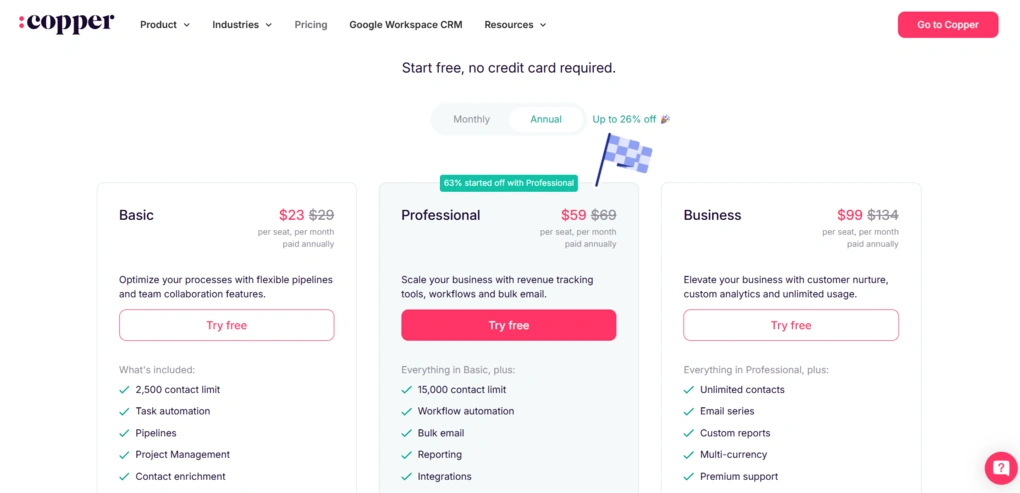
Copper offers three paid plans along with a 14-day free trial.
The Basic plan starts at $23 per user/month when billed annually. It includes up to 2,500 contacts, pipelines, project management, contact enrichment, and task automation.
Upgrading to Professional costs $59 per user/month annually and increases the contact limit to 15,000 while adding workflow automation, reporting, bulk email, and third-party integrations.
The Business plan is $99 per user/month with annual billing. It removes contact limits and unlocks advanced features like custom reports, email series, multi-currency support, and premium support.
What Copper CRM does well and where it falls short
Pros and cons of Copper CRM
Limitations
Copper CRM alternatives
If you’re still unsure whether this is the right CRM tool for you, we’ve got you! Here are some solid Copper CRM alternatives worth considering:
|
App |
Best for |
Description |
|---|---|---|
|
Pipedrive |
Best for sales-focused teams |
Pipedrive is a sales-focused CRM built for managing deals and moving leads through a clear visual pipeline. |
|
Nutshell |
Best for simple all-in-one CRM |
Nutshell is a well-rounded CRM that brings contact management, pipeline tracking, and communication tools into one place. |
|
HubSpot |
Best for all-in-one CRM |
HubSpot is an all-in-one CRM that combines sales, marketing, and automation in one platform, with a strong free plan and solid core features. |
|
Zoho CRM |
Best budget-friendly CRM |
A flexible CRM platform with a wide range of features, including automation, analytics, and customization options. Often used by businesses looking for a more affordable all-in-one solution. |
|
Salesforce |
Best for enterprise teams |
A highly customizable CRM designed for large organizations, offering advanced automation, reporting, and integration capabilities across complex business processes. |
|
Monday CRM |
Best for visual workflows |
A visual CRM built on a flexible workspace, allowing teams to manage pipelines, tasks, and processes in a highly customizable way. |
Wrap up: Copper CRM Review 2026
After testing every major feature for this Copper CRM review, I can see why Copper has built a loyal user base. It’s simple to learn, well organized, and integrates naturally with Google Workspace, though you’ll need a higher-tier plan to access some of its best features.
If your business already runs on Google Workspace, Copper is one of the easiest CRMs to adopt. If not, I’d compare it against HubSpot or Pipedrive before making a decision.
Explore our Apps directory
A curated directory of software tools we’ve independently reviewed, with links to full reviews, comparisons, and category guides.
Why you can trust our reviews
At thebusinessdive.com, our team tests, reviews, and compares hundreds of productivity apps every year — from project management tools to note-taking apps. We dive deep into real-world use cases to help you find the right tools that actually improve your workflow, not just add noise.
Our mission? No fluff, no shortcuts—just honest, hands-on insights from productivity pros.
Discover how we stay transparent, read our review methodology, and let us know about any tools we missed.
Frequently asked questions
Is Copper CRM a good choice for Google Workspace users?
Yes. Copper is the only CRM recommended by Google Workspace and is built specifically for teams that rely heavily on Gmail, Google Calendar, Google Drive, and other Google tools.
Its Google Workspace integration reduces manual data entry, automatically enriches customer data through the Chrome extension, and helps sales teams manage contacts, lead tracking, and client communication without constantly switching between multiple tools.
What does Copper CRM help sales teams with?
Copper CRM helps sales reps manage the entire sales process, from lead management and contact management to tracking multiple deals in a sales pipeline.
It also includes workflow automation, basic automation, follow ups, contact enrichment, and automated reminders for inactive new leads, making it easier to keep track of customer interactions while reducing administrative work.
How much does Copper CRM cost?
The Copper CRM cost starts at $9 per user/month for the Starter plan, followed by Basic, Professional, and Business plans. The Professional plan adds features like reporting and workflow automation, while the Professional and Business plans unlock more advanced capabilities.
As your team grows, pricing can increase significantly, so it’s worth comparing the included features before choosing a plan.

Hey there! I am Aron, the founder of Thebusinessdive. I have been testing productivity apps for almost three years now. I reach 25.000 -50.000 people monthly with the mission to help you find the perfect productivity apps. Subscribe to my YouTube channel, newsletter, and social media to hear more about the best productivity tools. Let’s dive in!