



Team Goal Setting: Step-by-Step Guide To Achieve Success
Setting team goals is super important. It helps us track our progress and increases our chances of success. Team goals provide a sense of direction and purpose, helping to motivate team members to work towards achieving their goals. Without them, team members may lack focus and direction, leading to confusion and disorganization.
The math is simple. Without goals, there is no direction; without direction, there is no long-term success in almost every area of life.
Let’s dive into the best practices for setting team goals and some examples and tools you can use throughout this process.
Why team goals are important?
A survey on job satisfaction revealed that employees who feel confident and connected to their goals are likelier to experience job satisfaction. The survey results show that around 54% of team members who feel confident and connected to their job goals are more satisfied with their work.
Furthermore, around 44% of employees who feel more connected to their work goals will likely stay committed to the company’s goals despite any challenges they might face. The survey also found that 44% of employees motivated to work harder feel more confident when they are connected to organizational goals.
Overall, the survey highlights the importance of setting clear team goals. It helps build strong connections and increases employee confidence, which helps to enhance job satisfaction and motivation.
Difference between team goals and individual goals
Team goals and personal goals are different. Team goals are set to be achieved by a group working together towards a shared goal. These goals usually align with the organization’s more significant business objectives. Also, it requires additional skills like teamwork, coordination, and cooperation among team members to achieve success.
On the other hand, personal goals are those that individuals set for themselves to achieve in their personal or professional lives. Personal aspirations often drive professional goals and may or may not be aligned with the organization’s or team’s goals.
While team goals require a team effort, individuals pursue personal goals independently. However, it is best when there is an overlap between the team and individual goals for two reasons:
- When the goals of individuals and teams are aligned, both can succeed. It is a win-win situation.
- Also, it is essential to remember that team and individual goals are closely connected. For example, an employee wants to buy a new house in three years. His ability to achieve that goal largely depends on how well they perform at work. If he does not meet the work targets, it will be much harder for him to reach their personal goal.
Why SMART goals are important?
The simplest way to ensure your team will achive a goal is using the SMART goal framework. It means that successful team goals need to be specific, measurable, achievable, relevant and time bound.
The simplest way to ensure your team will achieve a goal is to use the SMART goal framework. Deploying the SMART framework says successful team goals must be specific, measurable, achievable, relevant, and time-bound.
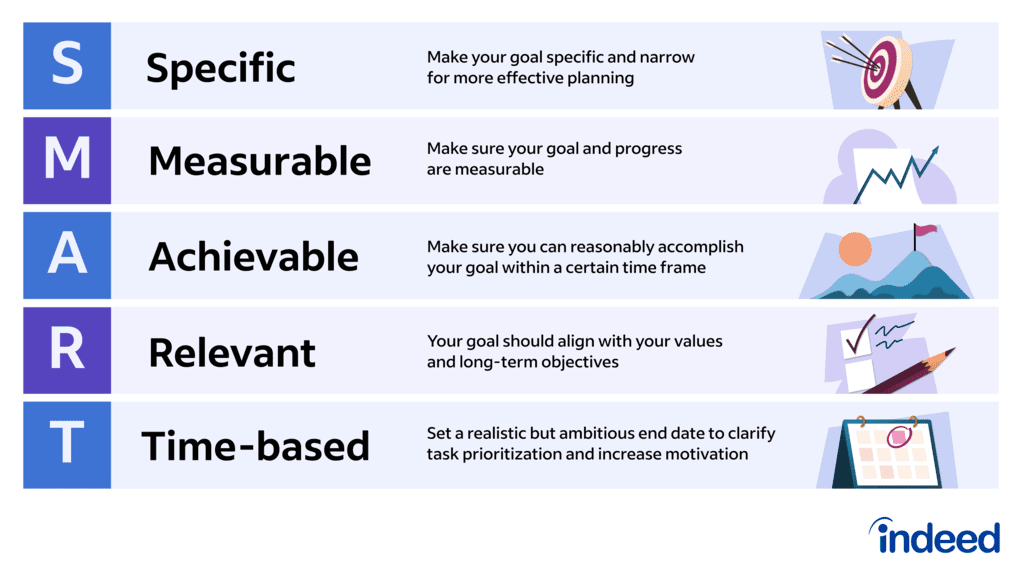
The SMART approach includes the following important details:
Specific
A team goal should be specific, well-defined, and clear for every team member. Avoid assumptions and ensure every employee understands the desired outcomes and the key metrics for success.
Measurable
A team goal should be measurable, which means it should be quantifiable and have a specific target your team can achieve. This helps in tracking progress, identifying areas of improvement, and making necessary adjustments. Establishing clear metrics and KPIs to measure the success of the team goal is crucial.
Achievable
A team goal should be achievable, meaning it should be realistic, considering your team members’ skills, resources, abilities, and capacities. Setting impossible goals can lead to demotivation and decreased productivity.
However, goals that are too easy to achieve can also lead to complacency. Finding the balance between challenge and achievability is crucial in setting team goals.
Relevant
A team goal should be relevant to the company’s overall mission and vision and align with the organization’s values, objectives, and priorities. Setting relevant goals ensures that the team’s focus and effort are on something that contributes to the company’s objectives.
Moreover, a team goal should also be relevant to your teammates. For this, your team members must understand the importance of their work and how it fits into the bigger picture.
Time-bound
A team goal should be time-bound, which means it should have a specific deadline or time frame for completion. This helps you keep your team focused and motivated while also helping them understand what is most important.
Furthermore, a timeline will help team leaders in planning and resource allocation, as well as tracking progress and making necessary adjustments if needed.
Step-by-step guide for goal setting
Here are some easy steps in the goal-setting process to ensure your team members understand their roles and business objectives.
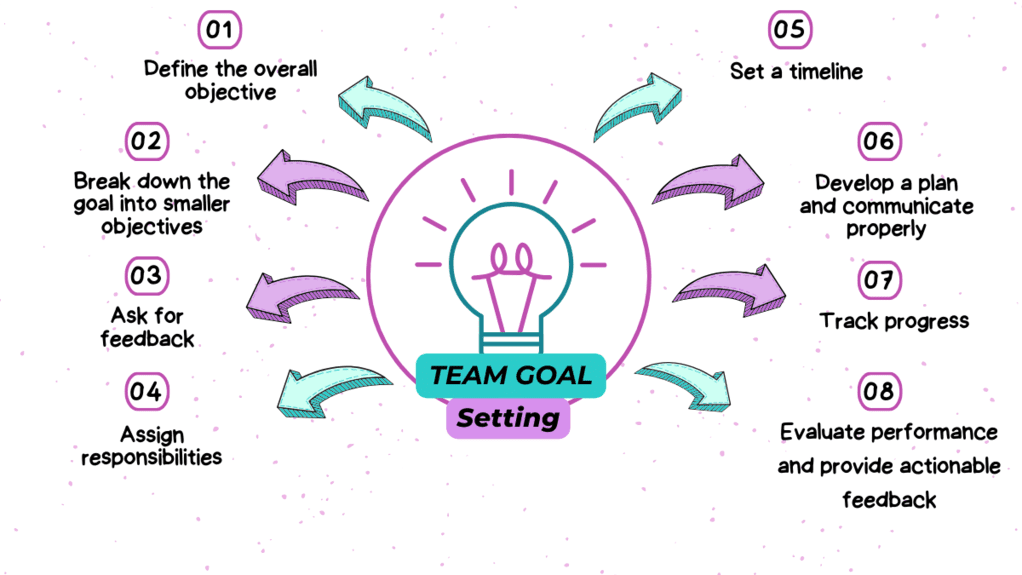
Define the overall objective
After understanding the SMART approach, you should first figure out what you aim for when setting team goals. This is the big-picture goal that the whole team is striving towards. Be very specific about this objective to make sure everyone knows what they are working towards. That way, everyone stays on track and motivated.
Once you have determined the overall objective, it’s time to break it down into smaller goals!
Break down the goal into smaller objectives
Breaking down the overall goal into smaller objectives is crucial for achieving success. You must identify specific targets your team needs to accomplish before reaching the desired goal. Breaking down the objective into smaller goals makes monitoring progress and executing necessary adjustments along the way easier.
To break down the goal, ask yourself, “What steps need to be taken to reach the overall objective?” or What roadblocks might slow progress?
Breaking down the goal into smaller objectives is not just a strategy; it is a necessity for setting successful team goals. It makes the process more manageable, giving your team members a clear sense of direction. It also helps track progress and make necessary adjustments along the way.
Ask for feedback
Let’s pause here for a second. In the previous steps, you took charge of the team goals without being affected by external factors.
Sometimes, as team leaders, we tend to think that we are the ones who clearly see the objectives, but this is not true, at least not in every situation. So, it is a good idea to get some feedback from your team members on whether your understanding and assumptions are right and whether you have set achievable goals.
There are two big reasons why asking for feedback is vital at this stage of team goal-setting:
- Firstly, if your assumptions were wrong, you can tweak your goals based on the feedback you get from your team. This will help you set more accurate goals.
- Secondly, asking for feedback lets your team members know you care about their ideas and thoughts. Being involved in goal-setting can make them more committed to reaching the goals.
Assign responsibilities
Once you have broken down the overall goal into smaller objectives and gathered feedback, it is time to assign responsibilities. Each team member should have a specific role that aligns with the objectives for which they are responsible.
Assign responsibilities based on each team member’s strengths and expertise. It will support each member in giving their best and increasing their motivation and engagement.
Furthermore, It is crucial to clearly communicate each team member’s responsibilities and the timeline for completing them. It will help team members to ensure that everyone is on the same page and that there are no misunderstandings or confusion.
In conclusion, assigning responsibilities is a critical step in achieving team goals. It helps ensure that everyone knows what they are responsible for and how they can contribute to achieving the overall objective.
Set a timeline
Setting a timeline for achieving each objective is essential for keeping your team on track. When setting the timeline, make sure it is realistic and achievable. Setting unrealistic deadlines will demotivate and frustrate your team. Instead, set deadlines that are challenging but achievable.
Just a heads up, unexpected issues may arise while you or your team work on your team goal. So, I suggest you add extra time to your timeline to keep things flexible. Especially when dealing with new challenges, estimating how much time you’ll need to finish the task is challenging.
Setting a timeline gives your team members a clear sense of direction and a deadline to work towards. It helps them prioritize their tasks and ensures everyone is working towards the same objective within the same timeframe.
Develop and communicate team goals
Now, you have all the details needed to develop a plan and assemble the puzzle pieces. If you have more team goals, consider priorities, fair workload distribution, and your team member’s strengths and weaknesses.
At this stage, I recommend deploying a p