


Fellow vs Plaud: The Biggest Differences Between a Virtual and a Physical Notetaker
Both Fellow and Plaud use AI to capture conversations and generate meeting notes, but they solve very different problems.
- Fellow is built around secure AI meeting intelligence for organizations, while Plaud focuses on capturing conversations anywhere.
- Both delivered highly accurate transcription during my testing, but their strengths go well beyond AI meeting notes.
- Plaud requires dedicated hardware (starting at $159) plus a monthly subscription (starting at $8.33/month), while Fellow is entirely software-based, with pricing starting at $ 7/month
- Unlike Fellow, Plaud doesn’t automatically notify others that a recording is taking place
- Fellow gives admins, IT, and compliance teams granular control over recording policies, data retention, and access, with workspace-level ownership that stays with your organization even when employees leave. Plaud is tied to individual users.
Keep reading, and by the end of this Fellow vs Plaud comparison, you’ll know which tool is the better fit for your workflow.
Verdict
Here’s the quick verdict if you don’t want to read the full Fellow vs Plaud review:
🎯 Best for:
Fellow: Enterprise organizations and teams in regulated industries that need an advanced and safe AI note-taker
Plaud: Professionals, founders, and consultants who frequently record in-person meetings, phone calls, and ideas on the go.
🚫 Not ideal for:
Fellow: Free AI note-taking
Plaud: Organizations that need centralized governance, compliance controls, or company-wide ownership of meeting data.
⭐ Biggest strength:
Fellow: Highly accurate AI meeting notes with granular controls over recording, retention, and compliance.
Plaud: Effortless wearable recording with accurate AI summaries and transcription
⚠️ Biggest weakness:
Fellow: The free version is more like a trial
Plaud: Built primarily for individual users rather than organization-wide collaboration and governance.
⚖️ Verdict:
Fellow is the better choice for organizations that need AI meeting intelligence, collaboration, and enterprise governance. Plaud, on the other hand, is ideal for professionals who spend more time in in-person meetings, on phone calls, or capturing ideas throughout the day and don’t need organization-wide governance or centralized administration.
🏆 Winner:
Fellow for secure AI meeting intelligence and organization-wide collaboration. Plaud for capturing conversations and ideas beyond virtual meetings.
✅ Tested with our review & scoring methodology ✅ Real-world testing ✅ Unbiased evaluation
My ratings: Fellow vs Plaud
Fellow
|
|
Accurate transcriptions and summaries
|
|
|
Bot and Bot-less transcription & recording
|
|
|
It offers numerous productivity tools besides the essential features
|
|
|
AI summaries
|
|
|
A budget-friendly option for teams
|
|
|
High-security standards
|
|
|
Have more features in the free plan
|
|
|
You need to install the Fellow desktop app in order to use botless recording
|
Plaud
|
|
One-button recording
|
|
|
Excellent transcription accuracy
|
|
|
Well-structured AI summaries
|
|
|
Ask Plaud feature
|
|
|
Built-in voice editor
|
|
|
Offline recording support
|
|
|
Lightweight, comfortable design
|
|
|
No conversation intelligence or coaching features
|
|
|
The initial setup was less intuitive than expected
|
|
|
No quick way to assign AI-generated action items to teammates
|
|
|
The dedicated hardware is only worth it if you record frequently
|
Key differences between Fellow and Plaud
Here is a short overview of the key differences I found in the Fellow vs Plaud showdown:
|
|
|||
|---|---|---|---|
|
Best for |
Enterprise organizations and regulated teams (investment banking, private equity, legal) needing an AI meeting note taker with granular compliance control |
Professionals who frequently record in-person meetings, phone calls, and ideas on the go |
|
|
Core focus |
AI meeting assistant built with bot and botless recording flexibility, team collaboration, granular data retention, and security controls |
AI transcription, voice recording, and AI summaries |
|
|
Key strengths |
|
|
|
|
Main limitations |
Free plan has limited usageUser needs desktop app to use botless recording |
Requires dedicated hardware to get the full experience |
|
|
Ease of use |
Easy |
Easy |
|
|
Pricing |
|
|
|
|
Integrations |
Zoom, Microsoft Teams, Google Meet, Slack, CRMs, project management tools, calendars, Claude, Glean, Global Relay |
Google Calendar, Outlook, Zapier, Make |
|
|
Cross-platform |
Web / Desktop (Windows & macOS) / Mobile (Android & iOS) |
iOS / Android + Plaud hardware |
The Scoring System We Used
To keep our reviews and final scores fair and consistent, we evaluate every AI note-taking tool using a standardized testing framework built on real-world usage and hands-on experience.
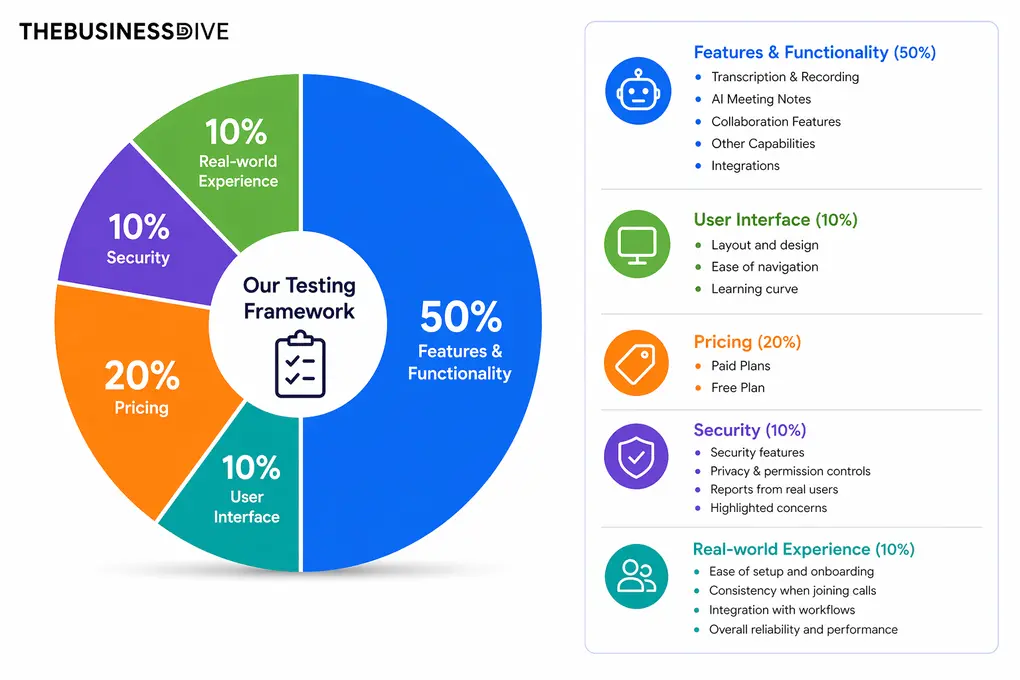
We evaluate every AI note-taking tool using this weighted framework, based on hands-on testing in real meetings and everyday workflows.
Our scoring breakdown after testing 20+ AI note-takers:
🤖 Features & functionality — 50%
🖥️ User interface — 10%
💰 Pricing — 20%
🔐 Security — 10%
👥 Real-world experience — 10%
Want a detailed breakdown of how we test each category?
Learn exactly how we test tools → Review methodology
Comparing my day-to-day experience with both tools
In the sections below, I’ll compare Fellow and Plaud based on my hands-on testing, covering their features, pricing, user interface, strengths, weaknesses, and the types of users each tool is best suited for.
My hands-on experience with Fellow
After relying on Fellow for more than a year and comparing it with over 20 AI note-taking tools, I still consider it the most well-rounded solution I’ve tested. It wasn’t just the quality of the transcription that impressed me, but how the platform supported the entire meeting workflow.
During my testing, Fellow consistently delivered transcription accuracy above 95% and produced structured AI summaries just a few minutes after each meeting. Instead of replaying recordings, I could quickly review the key decisions, discussion points, and follow-up tasks.
The platform also helped before the meeting even started. I could review AI-generated meeting briefs, revisit previous conversations, and organize agendas in advance, making it much easier to jump back into ongoing projects.
I also liked Fellow’s flexible recording options. Depending on the situation, I could choose between bot-based and bot-free recording, and both worked reliably across virtual and in-person meetings. Password-protected meeting recaps were another welcome addition, giving organizations more control over how shared meeting summaries are accessed.
Overall, Fellow stood out as the most complete AI meeting intelligence platform I tested, combining accurate meeting notes with collaboration, flexible recording, and enterprise-grade governance.
🔎 Read my full Fellow Review: My Thoughts After +12 Months (2026)
Short on time? Here’s a quick overview of Fellow
Who should use Fellow
Who should NOT use Fellow
My hands-on experience with Plaud
Plaud genuinely surprised me and exceeded my expectations. Before testing it, I relied on the mobile apps of AI note-takers to capture ideas and meetings, and I didn’t think I needed a dedicated recording device.
After using the NotePin for a few weeks, my perspective changed. The combination of its lightweight design, one-button recording, accurate transcription, and well-structured AI summaries made it much easier to capture conversations and ideas without interrupting the moment.
If your day involves in-person meetings, phone calls, commuting, or capturing ideas on the go, Plaud offers a noticeably smoother experience than reaching for your phone every time.
That said, I also realized Plaud feels much more like a personal productivity tool than an organization-wide meeting platform. It works exceptionally well for individuals, but it doesn’t offer the centralized administration or governance features larger organizations typically expect.
Short on time? Here’s a quick overview of Plaud
When to choose Plaud
When you should skip Plaud
Key features
Below, I’ll walk you through the features that stood out the most during my Fellow vs Plaud testing.
Fellow’s features
Bot-free or bot transcription
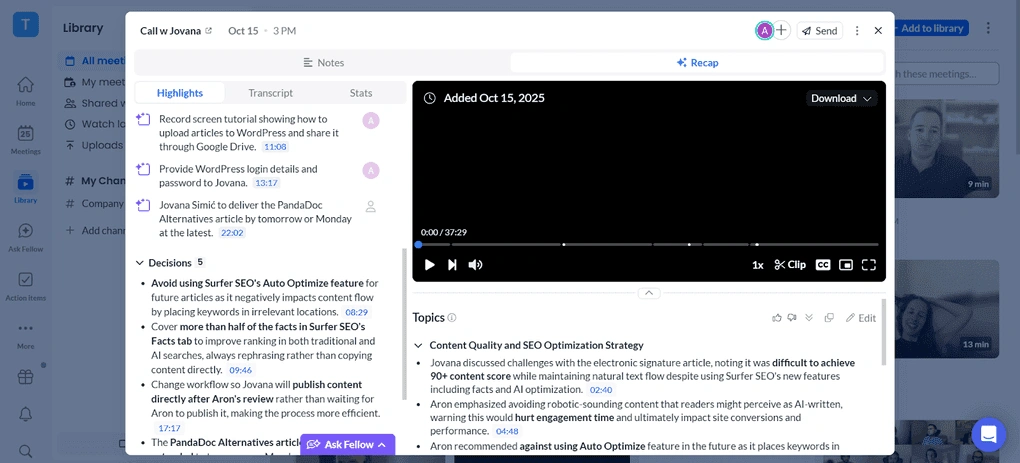
One of Fellow’s biggest advantages is that you can choose whether to record meetings with a bot or without one. It supports Zoom, Microsoft Teams, Google Meet, and Slack Huddles, automatically recording and transcribing meetings in more than 92 languages.
If you prefer bot-free recording, simply select Record without bot, and Fellow captures the meeting in the background while maintaining the same enterprise-grade privacy and security controls as bot-based recordings.
If you choose to use a bot instead, it always requests permission to join the meeting and appears as a participant, so everyone knows the meeting is being recorded.
Based on my testing, Fellow’s transcriptions were highly accurate, around 95% or higher. They were available within a few minutes and included timestamps and speaker identification.
Security and recording controls
Fellow prioritizes enterprise-grade security with SOC 2, HIPAA, and GDPR compliance built in.
What stood out most was the zero-day retention option: Fellow gives you the option for raw recordings and transcripts to be deleted immediately after AI processing, so sensitive content never persists in the system.
For teams that need to share summaries, password-protected recaps let you lock down meeting notes while keeping the productivity benefits of automated action items and summaries.
The compliance portal gives admins granular control over recording rules and restrictions, so you can enforce policies across your workspace, whether that’s preventing recordings on certain call types or restricting who can access public recaps.
I also appreciated that Fellow makes clear that customer meeting data isn’t used to train AI models and remains fully under your ownership.
For organizations handling MNPI, privileged conversations, or patient data, these features move Fellow from “interesting tool” to “actually compliant solution.”
Recordings library and channels
Fellow automatically records calls, which you can access through your transcription and meeting notes. I found the recordings library valuable, especially for teams or larger organizations. You can organize your previous meetings into custom channels and auto-publish your recordings to the right ones.
Furthermore, you can create new channels for yourself or even your whole company. This library helps you structure your meeting recaps and offers an excellent way to organize your meeting history, and a way to share recaps with people who did not attend those meetings but want access to that information.
For example, the CEO can be a part of the Sales calls channel or the Project Check-In channel even if they didn’t attend those meetings, and then use “Ask Fellow” to ask for insights and updates from those conversations.
AI meeting notes
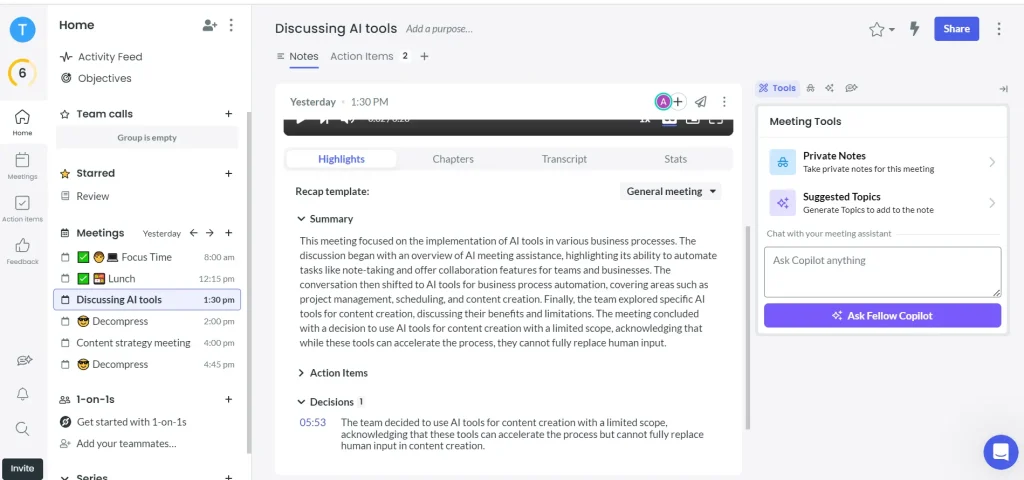
Fellow automatically generates AI meeting summaries that highlight key discussion points, decisions, and action items. Instead of reading an entire transcript, I could quickly review the summary and immediately understand what happened during the meeting.
I also liked that action items could be assigned directly to team members, making responsibilities clear before everyone left the meeting. Every summary remained connected to its transcript and recording, so finding additional context was always easy.
Meeting agendas
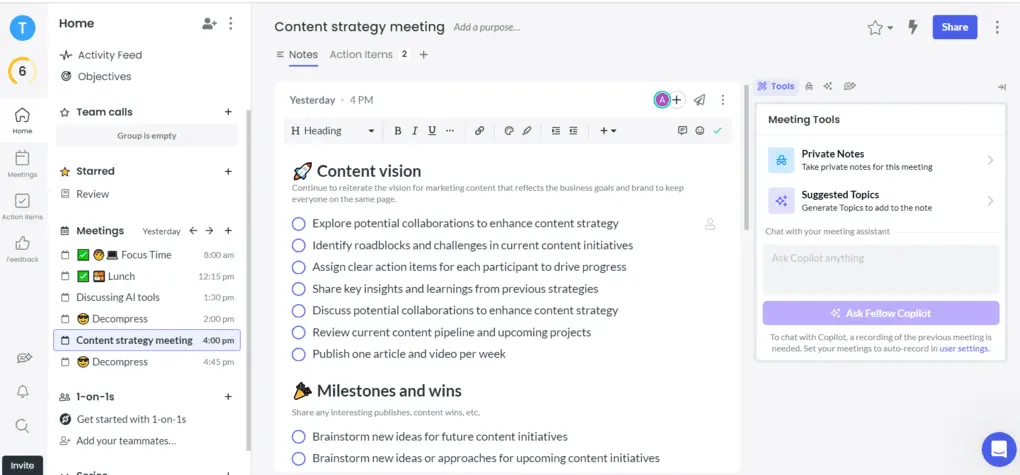
Meeting agendas are one of Fellow’s most distinctive features because they improve meetings before they even begin.
You can build collaborative agendas, ask AI to suggest discussion topics, and use AI-powered pre-meeting briefs that summarize previous meetings, outstanding action items, and participant information. I found these briefs especially valuable when I had back-to-back meetings and very little time to prepare.
Everyone attending the meeting can contribute agenda items, assign talking points or action items, and even create private notes that are only visible to them during the meeting. Fellow’s Agenda Builder can also generate an agenda automatically using the meeting title and calendar description.
Clips
Clips make it easy to capture and share the most important moments from a meeting without sending the entire recording.
After opening a recording, you can select the beginning and end of a clip, save it to your recordings library, or share it directly with teammates.
I also liked that Ask Fellow can generate clips for you. For example, you can ask it to create a clip of a specific customer comment, and it will find and generate that segment automatically.
Ask Fellow
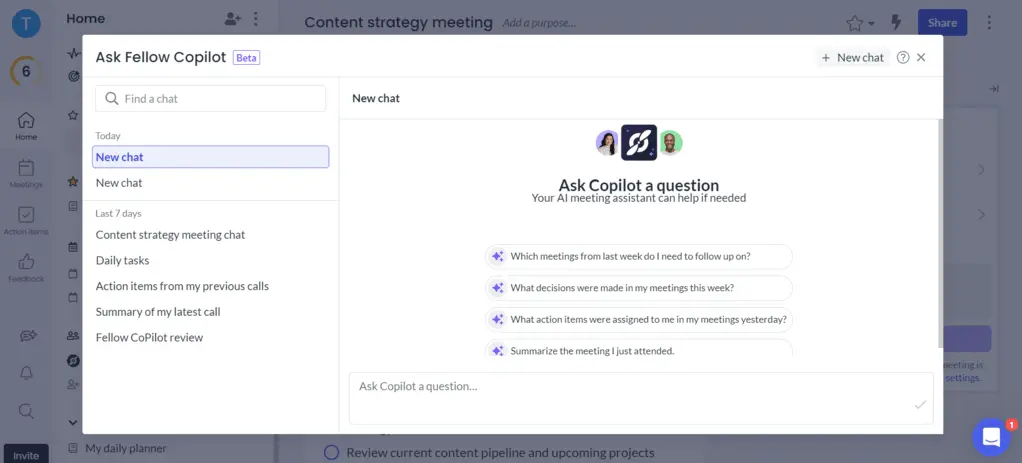
Ask Fellow is much more than a chatbot. It searches the meetings and channels you have access to, even if you didn’t attend them, to answer questions using your organization’s meeting history.
During testing, I used it to ask questions like “What did we decide about this project?” or “What should I follow up on from yesterday’s meeting?” and it quickly surfaced the relevant discussions, decisions, and action items.
Beyond answering questions, Ask Fellow can prepare you for upcoming meetings, summarize priorities, generate follow-up emails, create and edit documents, export content to Google Docs, Notion, or Confluence, generate meeting clips, manage your calendar, and remember your preferences over time.
Team collaboration
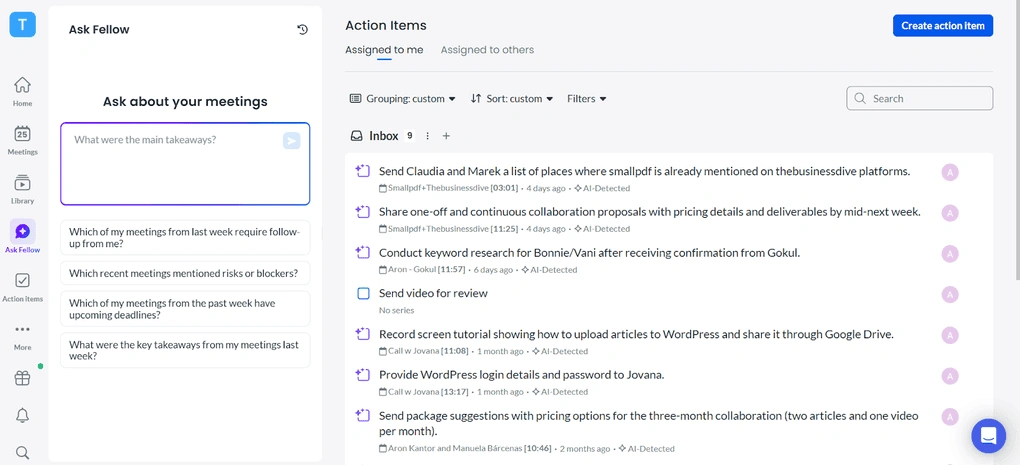
What makes Fellow special is that it was designed for the whole organization’s use cases. Whether it’s sales calls, interviews, or one-on-ones, you can implement Fellow in every team. It offers an excellent way to handle both external and internal calls and provides incredibly helpful collaboration features.
It supports collaborative agenda creation, you can assign action items, and easily share the meeting notes with others. Even when you’re using botless recording functionality, internal attendees in your organization will know that they are being recorded.
Similarly, Fellow will always prompt you to invite attendees to the meeting agenda and AI notes if you are recording an impromptu huddle or meeting, always keeping collaboration and alignment in mind.
Unlike Plaud, which is primarily designed around an individual’s device and account, Fellow gives organizations centralized ownership of meeting content. When employees leave the company, recordings, transcripts, and meeting notes remain within the organization’s workspace instead of staying tied to a personal account.
This organization-wide approach also simplifies offboarding because recordings, transcripts, and meeting notes remain within the organization’s workspace instead of staying tied to an individual’s account.
Integrations
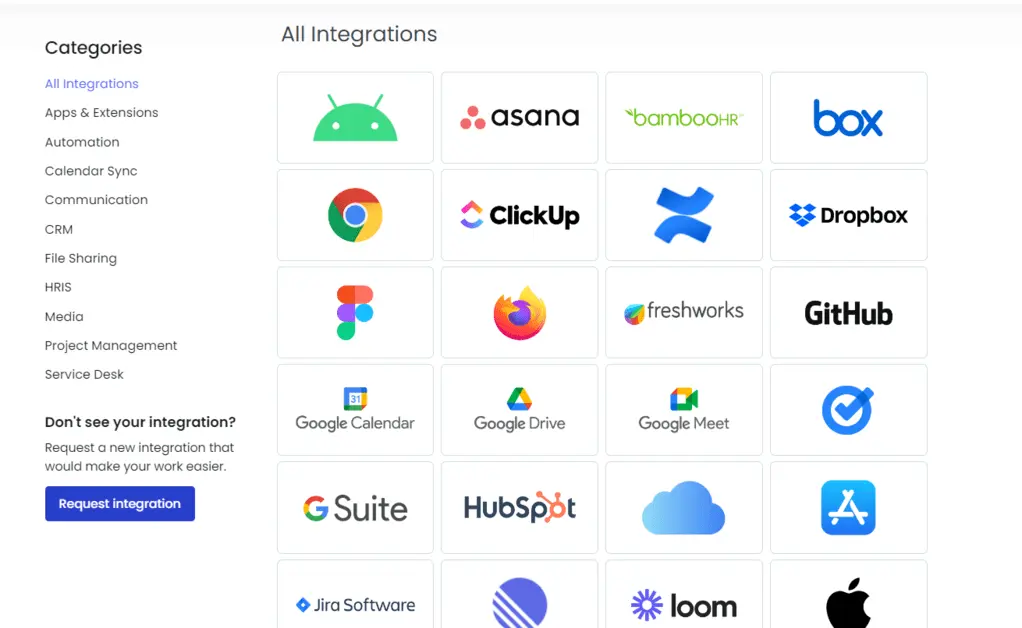
Fellow integrates with the tools most teams already use, including Zoom, Microsoft Teams, Google Meet, Slack, calendars, project management platforms, and enterprise CRM systems like Salesforce and HubSpot.
Rather than replacing your existing workflow, Fellow integrates into it by connecting meeting notes, recordings, and follow-up tasks to the rest of your productivity stack.
For organizations in highly regulated industries, it also integrates with compliance archiving solutions like Global Relay, making it easier to manage conversations within existing governance and compliance workflows.
Use this link to sign up and get 10% off the paid plans if you upgrade.
Plaud’s features
One-button recording
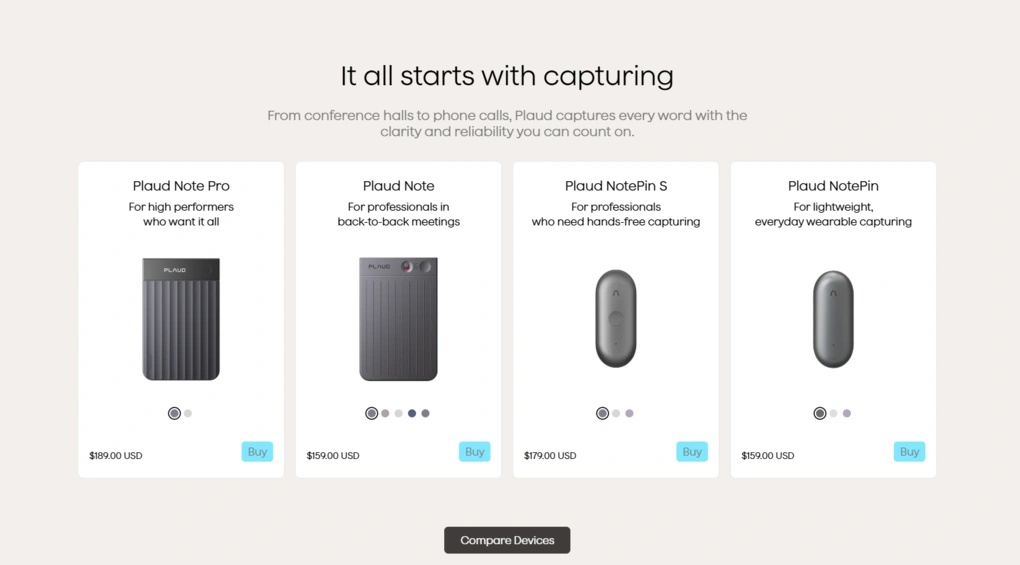
One thing I quickly appreciated about Plaud was how effortless it was to start recording. Instead of unlocking my phone, opening an app, and starting a recording, I simply pressed the button on the NotePin and started talking.
Compared to most AI note-takers, this was much faster and more convenient, especially while driving or commuting. After a few days, recording with Plaud became second nature, and I found myself capturing ideas far more often simply because the process required almost no effort.
While Fellow works best for scheduled meetings, Plaud excels when conversations happen away from your desk. I found it much easier to capture spontaneous ideas, phone calls, and in-person discussions without opening an app or joining a meeting.
This individual-first approach is one of Plaud’s biggest strengths, but it also defines who it’s best suited for. Since the device and recordings are typically tied to an individual user’s account rather than centrally managed by an organization’s IT team, Plaud is a much better fit for personal productivity than organization-wide deployments.
Accurate AI transcription and summaries
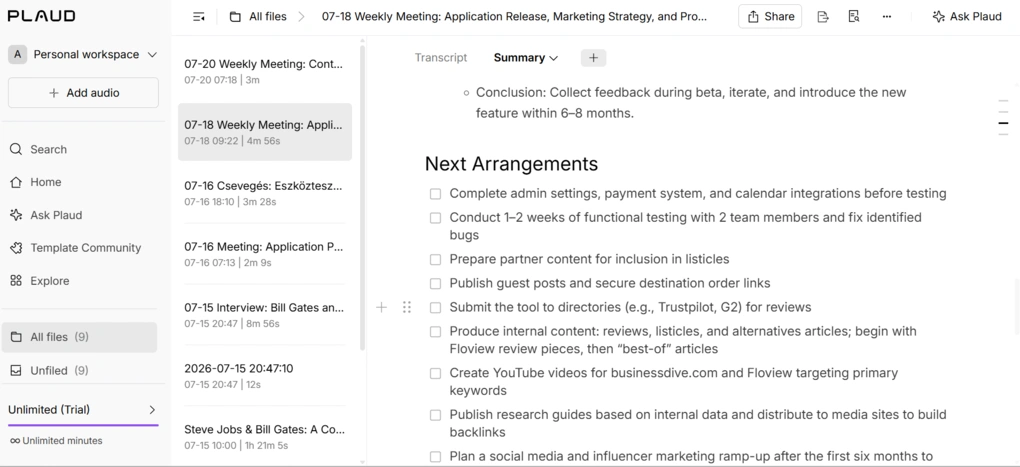
Plaud prepares AI meeting notes with key discussion points, decisions, and next arrangements. Depending on the recording length, it usually took around 5–10 minutes to upload the recording, generate the transcript, and create the AI summary.
The structured notes gave me a quick overview of every conversation without reading the full transcript. I could also edit the summary, rewrite sections, or generate different versions using templates like meeting minutes, highlights, intent analysis, and concept insights.
Since Plaud supports many languages, I also tested it in Hungarian. I was genuinely impressed by how accurately it transcribed conversations and generated summaries despite Hungarian being a challenging language for most AI note-takers.
That said, unlike Fellow, Plaud focuses on summarizing individual conversations rather than helping teams collaborate around them with agendas, shared notes, and follow-up workflows.
Ask Plaud
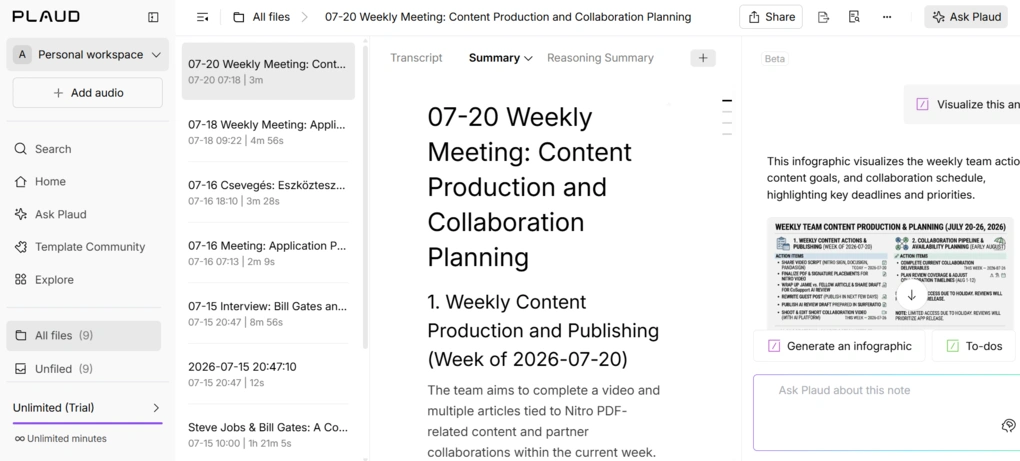
This is the feature I used the most.
Instead of searching through transcripts manually, I just asked questions like What 3deadlines were mentioned?, What tasks do I need to complete this week?, or What decisions were made during the meeting?
The responses were generated in just a few seconds. What impressed me most was that Plaud didn’t always return long paragraphs. Whenever possible, it organized the answers into tables with priorities, making them much faster to review and act on.
Built-in voice editor
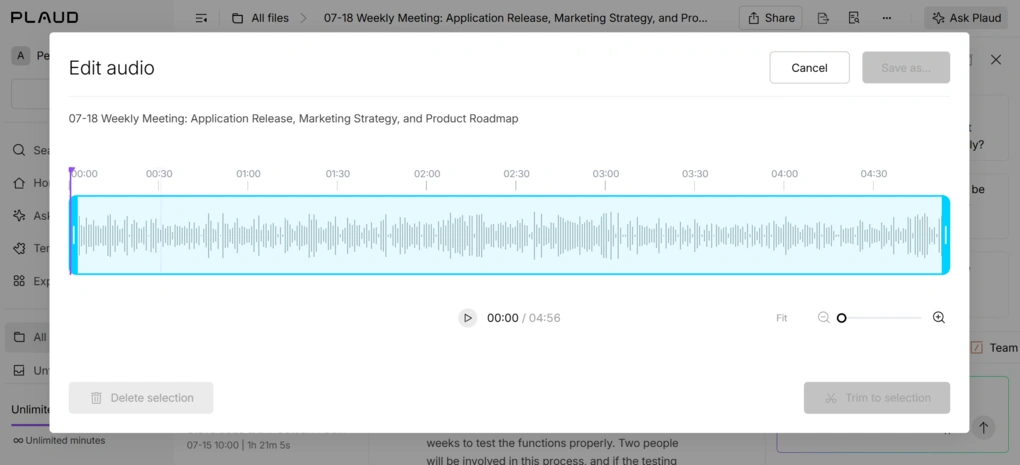
While testing Plaud, I also discovered its built-in voice editor. It lets you trim recordings, remove silence, and delete unnecessary sections before sharing them.
I mainly used it when I wanted to clean up a brainstorming session before sending it to my team. Although I didn’t rely on this feature every day, I still found it a valuable addition because I haven’t seen many AI note-takers include this type of editing directly inside the app.
Mind maps and AI templates
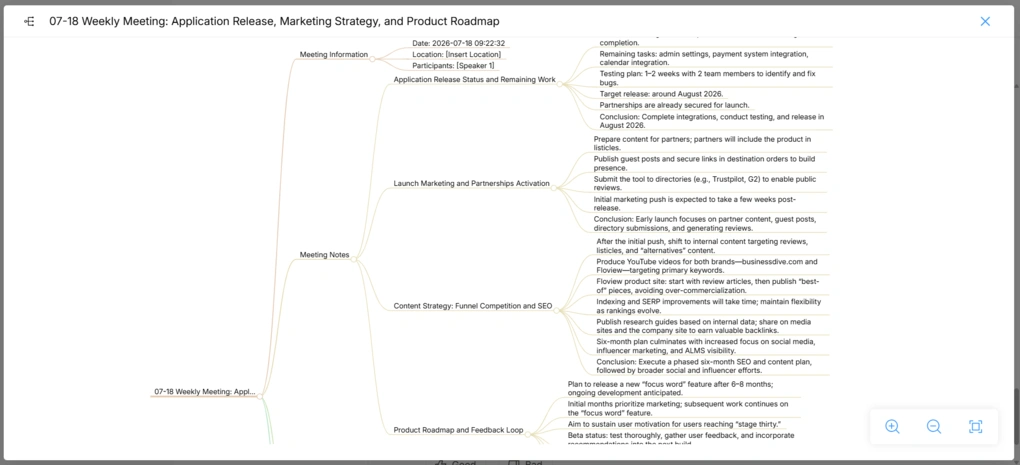
Plaud offers much more than a standard AI summary. Besides generating transcripts and meeting notes, it can also create mind maps from your conversations, which I found useful for visualizing ideas and brainstorming sessions.
I also liked that Plaud offers a wide range of AI templates. Depending on the conversation, I could generate meeting minutes, highlights, quantitative analysis, intent analysis, concept insights, and many other summary formats without rewriting anything manually.
Offline recording
Unlike most AI note-takers I’ve tested, Plaud can record even without an internet connection. I particularly liked this because I could capture ideas anywhere without worrying about connectivity.
Once I was back online, Plaud automatically synced the recording, generated the transcript, and created the AI summary. Combined with the dedicated hardware, this made it one of the easiest tools I’ve used for capturing ideas while traveling or commuting.
Plans & value
Fellow’s cost breakdown
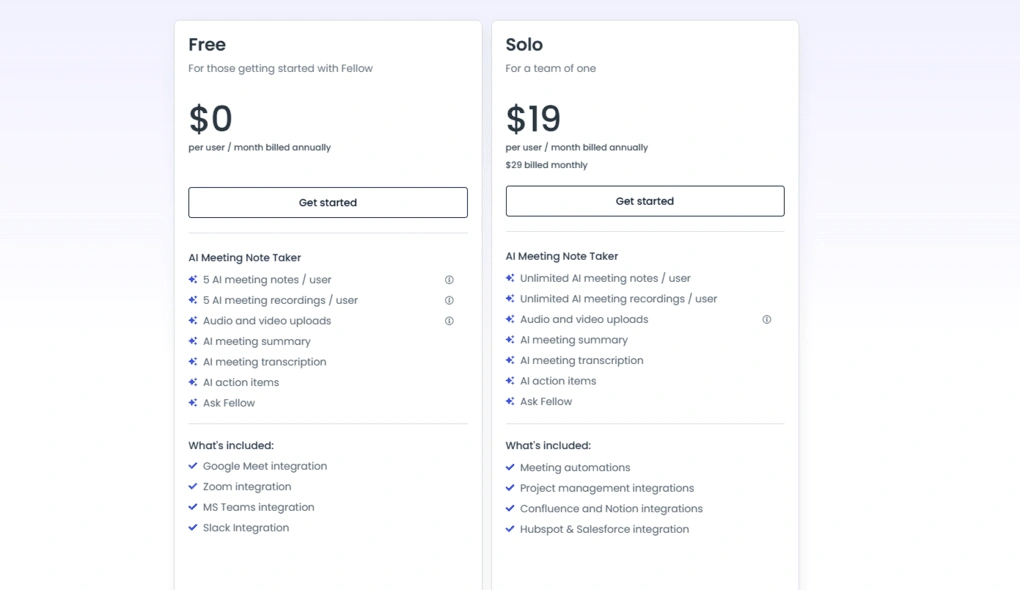
Fellow offers four plans. The Free plan includes access to AI recording, recaps, and transcriptions. Additionally, it provides access to features such as collaborative meeting notes, meeting agendas, meeting timers, and integrations with Zoom, Slack, Microsoft Teams, and Google Meet.
However, the free tier only includes five recordings per month, so heavy users will likely outgrow it quickly.
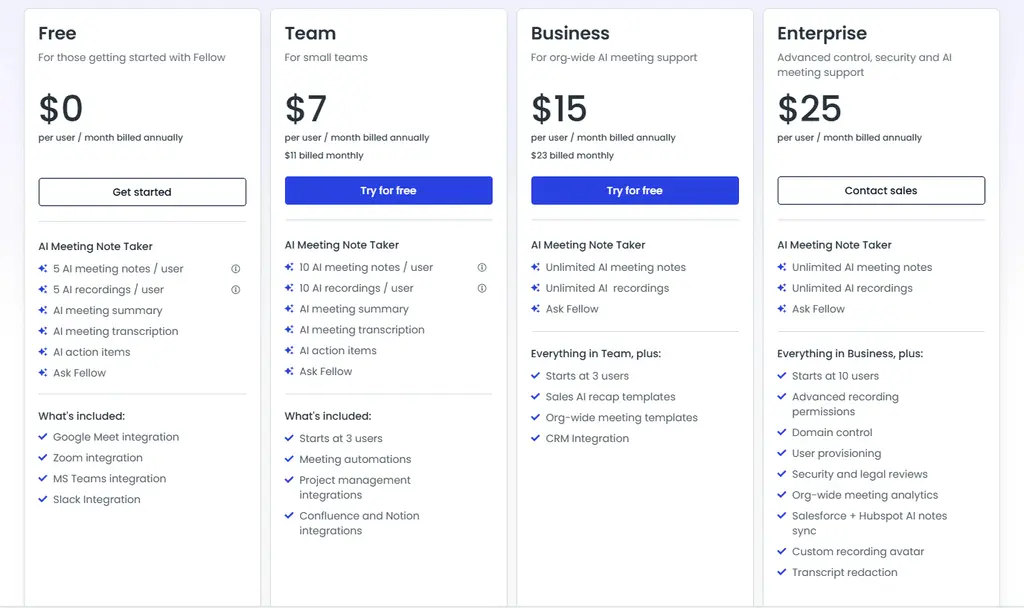
The Team plan was developed for small teams and starts with 3 users. It includes all the features in the Free plan with higher limits and offers meeting automation tools and additional integrations with Notion or project management tools.
The Business plan starts with 3 users and provides unlimited recordings, transcription minutes, organization-wide meeting templates, sales AI recap templates, and more integrations.
The Enterprise plan offers advanced control, security, and AI meeting support. With this plan, you can create customized rules for recording and have more recordings and transcription minutes.
Explore our Apps directory
A curated directory of software tools we’ve independently reviewed, with links to full reviews, comparisons, and category guides.
Plaud’s cost breakdown
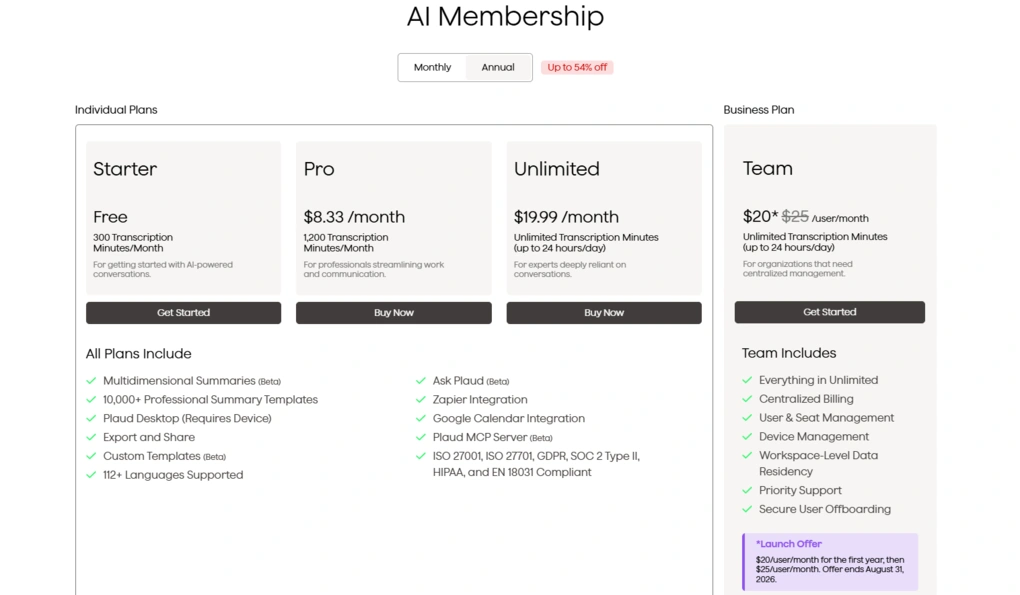
Before using Plaud, you’ll need to purchase a device, which starts at $159 and goes up to around $189, depending on the model.
The hardware is a one-time investment, while the subscription determines how many transcription minutes and AI features you’ll have access to.
The free plan includes 300 transcription minutes per month, making it a good option if you only record occasionally. Pro costs $8.33/month and increases the monthly limit to 1,200 transcription minutes, which should be enough for most users.
If you record throughout the day, the Unlimited plan removes transcription limits for $19.99/month. Businesses can also choose the Team plan for $20/month, which includes centralized billing, user management, and priority support.
Compared to other AI note-takers, I found Plaud’s subscription pricing competitive. The main consideration is the upfront hardware purchase, which makes it more expensive than software-only alternatives.
However, after carrying the NotePin for a few weeks, I found it more convenient than pulling out my phone every time I wanted to capture an idea or record a conversation. If you regularly have in-person meetings, phone calls, or brainstorm while commuting, the dedicated recorder can easily justify the extra cost.
That hardware-first approach makes a lot of sense for individual professionals, but it may be less practical for organizations looking to standardize AI meeting tools across teams. In those cases, software-based platforms that can be centrally deployed, managed, and governed are often a better fit.
User interface
Fellow’s user interface
Fellow has a simple and clean user interface. It’s particularly great that you can access many features from the homepage with just a few clicks.
I used this tool’s desktop version, which you can easily download from Fellow’s website. The desktop app helps you make the meeting experience smooth from beginning to end.
Use this link to sign up and get 10% off the paid plans if you upgrade.
Plaud’s user interface
The Plaud app itself is really straightforward and has no learning curve at all. Within a few minutes, I knew where everything was.
Nonetheless, the setup process of the Plaud device took more time than I expected. It took me around 10–15 minutes to figure out because the recording button required a firmer press than I anticipated. After my first day of use, it became second nature.
Wins & Trade-Offs of Fellow
Fellow wins
Fellow trade-offs
Pros and cons of Plaud
Plaud pros
Plaud cons
Alternatives to Fellow and Plaud
If you are not sure if Plaud and Fellow are the best choice for you, here are some:
|
App |
Best for |
Description |
|---|---|---|
|
Notta |
Best for multi-language transcription |
A unique AI note-taker that allows multi-language transcription, enabling people to speak two different languages during online meetings. |
|
Fathom |
Best free AI note-taker |
An accurate AI note-taker with an extensive free plan. |
|
MeetGeek |
Best for multi-language transcription |
A versatile AI note-taking app with the best AI meeting summaries. |
|
tl;dv |
Best simple AI note-taker |
A simple option for individuals with a feature-rich free plan. |
|
Radiant |
Best free AI note-taker for Mac |
It is a 100% free AI bot-less note-taker for Mac users for in-person and online meetings. |
|
Otter AI |
A popular AI note-taker |
One of the most popular AI note-takers for Google Meet, Zoom, and Microsoft Teams. |
|
Granola |
Best for users need a simple bot-less AI note-taker |
Granola is a lightweight AI note-taking app that transcribes and summarizes meetings without bots, with a generous free tier, but it’s basic and lacks advanced features. |
|
Krisp |
Best bot-less AI note-taker supporting high audio quality |
Krisp is a Voice AI platform for clearer communication and more productive meetings, combining real-time audio enhancements with AI note-taking. |
|
Bluedot |
An easy-to-use bot-less AI note-taker |
Bluedot is a straightforward and easy-to-use bot-free AI note-taker. |
|
Zoom AI Companion |
Best for Zoom users needing built-in AI note-taking |
A solid built-in AI assistant for Zoom that offers meeting summaries, basic transcription, and action items, but lacks advanced features. Full Zoom AI Companion review | Quick Zoom AI Companion overview |
My pick: Fellow vs Plaud
After testing both tools, my pick in this Fellow vs Plaud comparison is Fellow.
It goes beyond AI meeting notes by combining accurate transcription with collaboration, flexible recording options, and organization-wide governance.
That said, Plaud genuinely impressed me with its one-button recording, accurate transcription, and the convenience of carrying a dedicated recorder throughout the day. It’s one of the best solutions I’ve tested for capturing conversations, phone calls, and ideas away from a desk.
The biggest difference comes down to who each product is designed for.
Fellow is built for organizations that need secure AI meeting intelligence, centralized ownership of meeting data, and enterprise governance. Plaud, on the other hand, is built for individuals who want the fastest and most convenient way to capture conversations wherever they happen.
If your work revolves around team meetings and collaboration, choose Fellow. If you regularly record in-person conversations, phone calls, or ideas on the go, Plaud is the better fit.
Looking for similar tools?
Visit our AI note-takers library to explore other apps we’ve reviewed in this space and how they compare.
Why you can trust our reviews
At thebusinessdive.com, our team tests, reviews, and compares hundreds of productivity apps every year — from project management tools to note-taking apps. We dive deep into real-world use cases to help you find the right tools that actually improve your workflow, not just add noise.
Our mission? No fluff, no shortcuts—just honest, hands-on insights from productivity pros.
Discover how we stay transparent, read our review methodology, and let us know about any tools we missed.
Frequently Asked Questions
Is Plaud Note worth buying over a software-only AI note taker?
It depends on how you work. If you regularly record phone calls, in-person conversations, or capture ideas throughout the day, Plaud Note or Plaud NotePin can be worth the investment because the dedicated voice recorder makes recording much faster than reaching for your phone.
If you mainly attend online meetings and want advanced collaboration features, a software-based AI note taker like Fellow will likely provide better value.
Does Plaud support real-time transcription?
No. Unlike AI meeting assistants that generate real-time transcription during online meetings, Plaud processes the recording after it’s uploaded. During my testing, it usually took around 5–10 minutes to generate accurate transcripts, AI summaries, and meeting notes, depending on the recording length.
Can Fellow and Plaud record phone calls and virtual meetings?
Yes, but they do it differently. Fellow is designed for virtual meetings and integrates with platforms like Google Meet, Zoom, and Microsoft Teams, while also offering botless desktop capture.
Plaud, on the other hand, is built around dedicated hardware that lets you record phone calls, in-person conversations, and voice notes without relying on meeting bots.
What advanced AI features does Fellow offer that Plaud doesn’t?
Both tools generate meeting notes, transcripts, and AI summaries, but Fellow includes several advanced AI features designed for teams.
These include collaborative meeting agendas, AI meeting briefs, action item management, organization-wide search with Ask Fellow, CRM integrations, and the ability to create meeting clips.
Plaud focuses more on recording conversations and organizing them with summaries, mind maps, and Ask Plaud rather than Fellow’s organization-wide meeting intelligence.
Does Plaud offer a free plan?
Yes. Plaud offers free transcription through its Starter plan, which includes 300 transcription minutes per month.
If you need more recording time, you can upgrade to the Pro plan, which is billed annually, or choose the Unlimited subscription. Keep in mind that you’ll also need to purchase a Plaud device before using the service.
Disclosure: I only recommend products I would use myself, and all opinions expressed here are our own. This post may contain affiliate links that, at no additional cost to you, may earn a small commission. Read the full privacy policy here.

Hey there! I am Aron, the founder of Thebusinessdive. I have been testing productivity apps for almost three years now. I reach 25.000 -50.000 people monthly with the mission to help you find the perfect productivity apps. Subscribe to my YouTube channel, newsletter, and social media to hear more about the best productivity tools. Let’s dive in!
